The global supply chain is currently performing a desperate, expensive detour that most consumers only notice when their shipping costs tick upward. To avoid the threat of drone strikes and boarding parties in the Red Sea, the world’s largest shipping conglomerates have effectively abandoned the Suez Canal. They are opting instead for the long way around—a four-thousand-mile trek around the Cape of Good Hope. While analysts track the rising price of Brent Crude and the delay of European car parts, a far more permanent ecological debt is being accrued in the deep water.
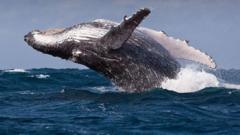
Giant container ships are being pushed into the migratory paths of endangered whale populations at speeds that make survival unlikely.
This isn't just a logistical hiccup. It is a mass-casualty event in the making. By shifting the arterial flow of global trade away from the Middle East, we have unintentionally weaponized the merchant fleet against marine life. The crisis is twofold: ships are entering waters where whales are not used to heavy traffic, and they are doing so at high speeds to make up for lost time.
The High Speed Tax on Marine Life
Shipping is a game of schedules. When a vessel is forced to add ten to fourteen days to its journey by bypassing the Suez, the pressure to maintain "Just-in-Time" delivery windows becomes immense. Captains are under orders to push their engines to the limit.
This creates a lethal environment. Most large whale species, particularly Blue whales and North Atlantic Right whales, occupy the upper layers of the water column. They are often unable to detect the acoustic signature of a ship approaching at 20 knots or more until it is too late. The physics of these encounters are brutal. When a vessel weighing 200,000 tons strikes a living creature, even at moderate speeds, the result is almost always internal hemorrhaging, blunt force trauma, or immediate death.
Research from the International Whaling Commission suggests that ship strikes are a leading cause of death for several endangered populations. By diverting hundreds of ships per week into the waters off the African coast—areas where monitoring is sparse and regulation is non-existent—we are flying blind into a biological meat grinder.
Mapping the Conflict Zones
The Cape of Good Hope is not just a geographical milestone; it is a biological crossroads. The waters off South Africa and the wider West African coast are critical feeding and breeding grounds for Humpback, Southern Right, and Bryde’s whales.
Under normal circumstances, these populations face a manageable level of local traffic. Today, they are facing a wall of steel. The sheer density of the diverted fleet means that the probability of an encounter has increased by orders of magnitude. Unlike the Mediterranean or the California coast, these African transit lanes do not have established "Slow Zones" or Mandatory Ship Reporting systems.
- The Southern Right Whale: Known for being slow-moving and buoyant, these whales are particularly vulnerable to hull strikes.
- Acoustic Pollution: It isn't just the physical impact. The roar of a diverted fleet creates a "fog" of underwater noise that masks the communication calls whales use to find mates and food.
- The Data Gap: Because these deaths happen far out at sea, most "strike" victims simply sink. We only see the tip of the iceberg when a carcass washes ashore with a propeller-mangled fluke.
The industry knows this is happening. They just consider it an "externality."
The Economic Pressure Cooker
The boardroom reality is that protecting whales doesn't pay the fuel bill. A ship rerouted around Africa consumes roughly $1 million extra in fuel per trip. To recoup those costs, shipping lines are passing the expense to retailers, who in turn pass it to you. In this environment, slowing down to 10 knots to protect a pod of whales is seen as an unacceptable commercial sacrifice.
We are seeing a total breakdown of the ESG (Environmental, Social, and Governance) promises made by major logistics firms. When push comes to shove, the "E" in ESG is the first thing thrown overboard. These companies publish glossy brochures about carbon neutrality while their diverted fleets are actively scouring the ocean floor with noise and striking down the very "charismatic megafauna" they use in their marketing.
The irony is thick. The Red Sea conflict is framed as a humanitarian and security crisis, which it certainly is. However, the solution—moving the traffic elsewhere—has created a secondary crisis that has no military solution and no diplomatic seat at the table.
Why Technology Isn't Saving Us Yet
There is a common misconception that "whale-safe" sonar or thermal imaging can solve this. It’s a myth.
Thermal cameras require a clear line of sight and struggle in high seas or heavy rain. Passive acoustic monitoring only works if the whale is vocalizing; if a whale is sleeping or simply swimming silently, it is invisible to the sensors. Even if a whale is detected, a container ship the size of an skyscraper cannot turn or stop on a dime. By the time the bridge crew sees a blowhole, the trajectory is already locked.
A Shadow Inventory of Death
The true number of whales killed by the Red Sea diversion will likely never be known. In the shipping industry, reporting a whale strike is largely voluntary. It involves paperwork, potential investigations, and bad PR. Consequently, most crews simply keep moving.
We are currently building a shadow inventory of ecological loss. Scientists who monitor these populations are already reporting "missing" individuals from known pods. These aren't just numbers on a spreadsheet; these are long-lived, sentient animals that play a vital role in carbon sequestration. A single Great Whale sequesters an average of 33 tons of carbon dioxide over its lifetime. By killing them, we aren't just losing a species; we are actively sabotaging the ocean's ability to regulate the climate.
The global community has a choice. We can continue to treat the ocean as a frictionless highway where the only cost of business is the price of low-sulfur fuel, or we can admit that our supply chain is currently a predatory force.
The Necessary Friction
To stop the slaughter, we need to introduce friction into the system. This means international mandates for speed reductions in known migratory corridors, regardless of the Suez situation. It means satellite-monitored "No-Go" zones that are enforced with the same vigor as territorial waters.
If a shipping line wants to avoid the Red Sea, they must accept the biological "tax" of a slower transit. If the world wants its cheap electronics and fast fashion, it has to accept that sometimes the ships arrive late because life in the water has a right to exist.
The current silence from international regulators is a choice. Every day that passes without a mandatory slow-down order is a day we choose to sacrifice the health of the ocean for the sake of the schedule. We are currently trading the future of the deep for the convenience of the now.
The whales aren't "collateral damage." They are the victims of a system that refuses to look below the surface. Stop looking at the map of the Red Sea and start looking at the wake behind the ships. That is where the real tragedy is being written, one hull-strike at a time.