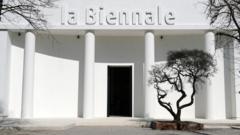
The resignation of a Venice Biennale jury mere days before the 2026 exhibition opening represents a catastrophic failure of institutional governance rather than a localized personnel dispute. When the mechanisms of selection and adjudication in a Tier-1 cultural event collapse, the resulting vacuum threatens the multi-billion dollar valuation of the global contemporary art market, which relies on the "Venice imprimatur" to validate blue-chip assets. This breakdown is the logical conclusion of a three-way friction between political appointment cycles, ideological gatekeeping, and the logistical necessity of operational continuity.
The Tripartite Stress Test of Artistic Institutions
The stability of a cultural institution is maintained by the equilibrium of three specific variables: political independence, curatorial autonomy, and administrative transparency. In the current context of the Venice Biennale, all three systems have experienced simultaneous breach.
- Political Interference vs. Appointment Cycles: The Biennale’s leadership is inherently linked to Italian state politics. When the national administration shifts, the pressure to align cultural output with state narratives increases. This creates a "Lag-Effect Conflict," where a jury appointed under one ideological framework must operate under a new, potentially hostile, administrative oversight.
- The Adjudication Bottleneck: A jury’s primary function is to provide a neutral "Quality Signal" to the market and the public. By resigning en masse, the jury does not merely stop working; they invalidate the "Golden Lion" award’s legitimacy for the cycle. This creates a "Zero-Value Year," where the absence of a consensus winner devalues the participation of every national pavilion involved.
- Governance Transparency Gaps: The resignation stems from a lack of defined protocols regarding the limits of administrative veto power over jury decisions. Without a codified "Curatorial Firewall," the board of directors can exert soft pressure on the selection process, leading to the eventual fracture of the working relationship.
The Cost Function of Institutional Vacuums
The financial and reputational impact of a pre-opening resignation can be quantified through the lens of stakeholder loss. The Biennale serves as a massive economic engine for the Veneto region and a critical inflection point for the global art trade.
The Immediate Economic Impact
The cost of a disrupted opening is not limited to ticket sales. It includes:
- Insurer Risk Re-assessment: Major exhibitions carry high-premium insurance for art transport and indemnity. A governance collapse is often flagged as an "Internal Risk Event," potentially raising future premiums for the institution.
- Sponsorship Withdrawal Clauses: Corporate sponsors frequently include "Brand Alignment" and "Governance Continuity" clauses in their contracts. Mass resignations provide legal grounds for the clawback of funding, creating an immediate liquidity crisis for the organizers.
- Patron Devaluation: High-net-worth individuals who fund national pavilions do so for the prestige associated with a stable, world-class competition. If the competition is deemed illegitimate due to jury absence, the "Prestige Return on Investment" (PROI) drops to zero.
The Secondary Market Signal
Art as an asset class behaves similarly to venture capital; value is driven by scarcity and expert endorsement. The Venice Biennale jury provides the ultimate endorsement. In the absence of a jury:
- Asset Liquidity Decreases: Works featured in a "failed" Biennale may take longer to sell or face lower hammer prices at auction houses like Christie’s or Sotheby’s.
- Career Velocity Stalls: For emerging artists, the Biennale is a "Scaling Event." The lack of a formal award or a vetted selection process prevents the typical 2x to 5x price appreciation seen following a successful Venice showing.
The Logic of Professional Protest
The mass resignation of a jury is rarely a spontaneous emotional reaction; it is a calculated strategic withdrawal designed to preserve professional capital. From a game theory perspective, the jury faces two choices when confronted with administrative overreach:
- Compliance: Stay and deliver a compromised verdict. This results in "Reputational Contamination," where the jurors' long-term credibility in the global art circuit is permanently damaged for the sake of a short-term project.
- Exit: Resign and signal the breach of protocol. While this causes short-term chaos, it protects the jurors' "Expert Status" by distancing them from a tainted process.
The timing—days before the exhibition—is the most potent leverage point available. It maximizes the pressure on the board of directors by ensuring the controversy cannot be buried before the global press arrives. This is the "Nuclear Option" of institutional politics.
Structural Failures in the Selection Protocol
The collapse of the 2026 jury reveals specific, remediable flaws in how international exhibitions are governed. To prevent a recurrence, institutions must move toward a "Decoupled Governance Model."
Variable 1: Appointment Duration and Overlap
Currently, Biennale appointments often coincide with political terms. A superior model involves "Staggered Terms," where jury members are appointed for cycles that do not align with national elections. This ensures that a jury seated during one administration carries its mandate into the next, providing a buffer against immediate political whims.
Variable 2: Veto Transparency
The primary friction point in this resignation appears to be the "Hidden Veto"—where administrators suggest changes to the jury’s shortlist without a formal, public record of why. A data-driven governance structure would require all administrative interventions to be logged in a "Transparency Registry," accessible to all stakeholders after the award ceremony. This makes the cost of interference—public scrutiny—too high for the board to pay.
Variable 3: Independent Funding of the Secretariat
When the administrative body that manages the jury is financially dependent on the same board that seeks to influence the outcome, a conflict of interest is inevitable. Professionalizing the "Jury Secretariat" as a third-party entity would insulate the adjudicators from direct pressure.
The Geopolitical Dimension of Cultural Signaling
The Venice Biennale is not just an art show; it is a theater of "Soft Power." National pavilions are tools of diplomacy. When the central governing body of the Biennale falters, it weakens the diplomatic efficacy of every participating nation.
The resignation signals to the international community that the host nation is currently unable to provide a neutral platform for cultural exchange. In the "Soft Power Index," this is recorded as a decline in "Institutional Reliability." For nations like the United States, China, or Germany, which invest millions into their Venice presence, a dysfunctional Biennale is a failed diplomatic mission.
Re-establishing the Institutional Floor
The path forward for the Venice Biennale requires a radical shift from "Personality-Driven Governance" to "System-Driven Governance." The current crisis is a symptom of an outdated model that assumes goodwill and tradition are sufficient to hold a complex, high-stakes organization together.
To stabilize the 61st Biennale and protect the 62nd, the following operational adjustments are mandatory:
- Immediate Appointment of an Interim Adjudication Panel: To preserve the "Award Signal," an emergency panel of former Golden Lion winners or retired curators must be empaneled under a strict "Non-Interference Charter."
- Codification of the "Curatorial Autonomy Act": The Biennale must adopt a formal constitution that defines the precise boundaries between the Board of Directors and the Jury. This document should include an "Arbitration Clause" for disputes, moving them from the realm of public resignation to private, professional resolution.
- Audit of the Selection Timeline: The proximity of the resignation to the opening suggests the selection timeline is too compressed. Moving the jury’s final deliberation further ahead of the public opening would allow for a "Cooling-Off Period" during which administrative friction can be resolved before the media cycle begins.
The Venice Biennale remains the "Linchpin Asset" of the global art world. However, as this resignation proves, even the most established institutions are subject to the laws of governance. Without structural reform, the "Venice Brand" risks a permanent transition from a source of market certainty to a source of systemic risk. The solution is not more art, but more rigorous institutional architecture. Professionalizing the oversight of the selection process is the only way to ensure the Golden Lion remains a benchmark of value rather than a trophy of political alignment.