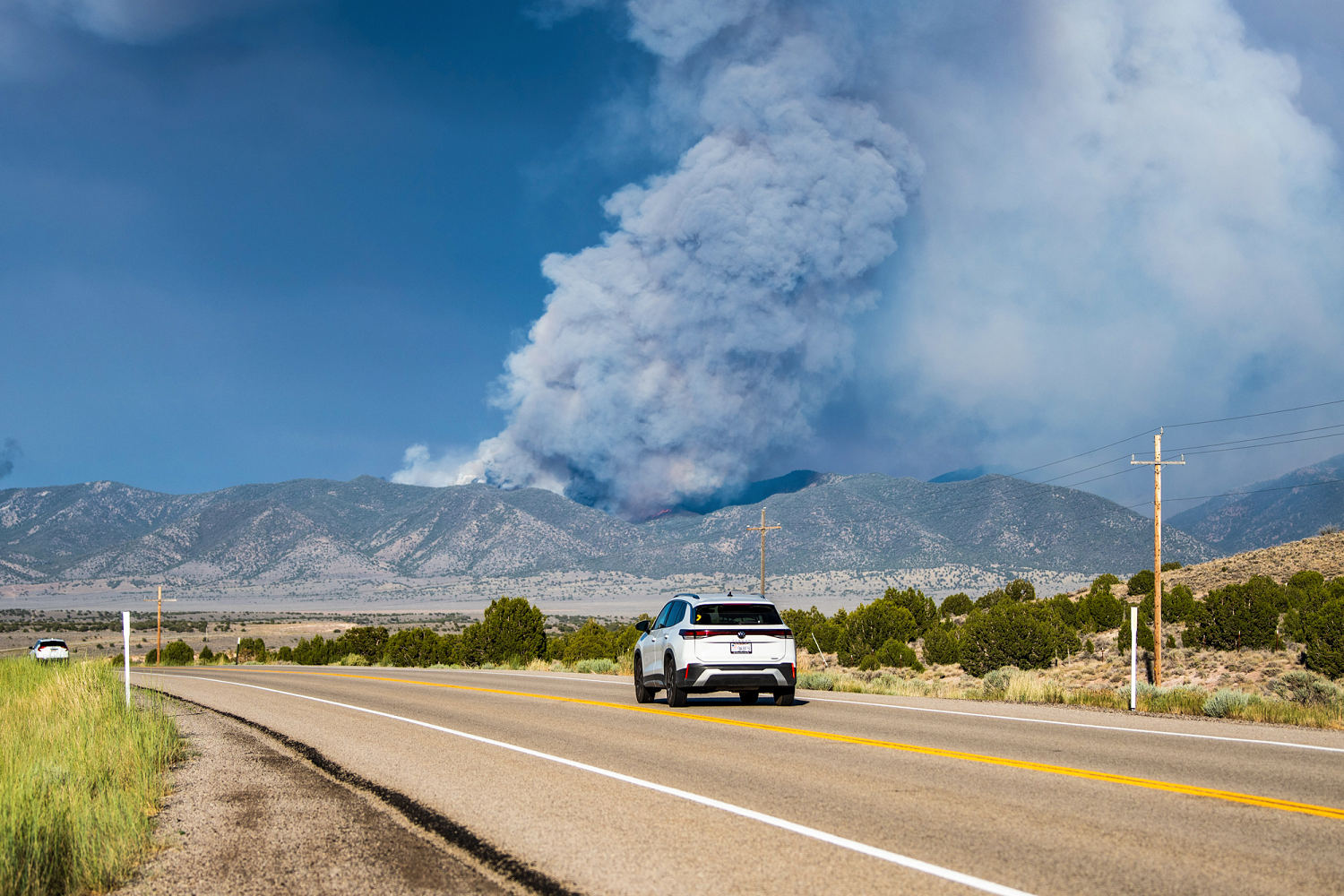
The American West is bracing for a volatile convergence of dry lightning and high winds, a meteorological cocktail that threatens to ignite explosive wildfires across vulnerable ecosystems. While traditional weather reports focus heavily on surface temperatures, the real danger stems from a severe moisture deficit in the lower atmosphere. When thunderstorms develop in these conditions, precipitation evaporates before reaching the ground, leaving only cloud-to-ground electrical discharges to strike parched vegetation. Combined with erratic wind gusts driven by the storms themselves, the region faces an immediate infrastructure and containment crisis.
This is not a simple story of hot summer days. It is a structural failure of geography and atmospheric physics.
The Anatomy of a Dry Thunderstorm
To understand why a storm without rain is so dangerous, you have to look at the vertical profile of the atmosphere. In a standard thunderstorm, moisture extends from the cloud base all the way to the soil. In the West, particularly across the Great Basin and the volatile timberlands of the Pacific Northwest, a layer of intensely dry air often sits directly beneath high-based clouds.
When a storm cell moves over this dry layer, the falling rain hits a wall of low humidity. The water evaporates mid-air, a phenomenon known as virga. This evaporation cools the air rapidly, making it denser than the surrounding atmosphere. This cold, heavy air plummets toward the earth, smashing into the ground and fan-spreading out in all directions as violent wind gusts.
Meanwhile, the electrical mapping of the cloud remains entirely intact. Lightning bolts strike the ground at speeds exceeding 200,000 miles per hour, hitting timber, brush, and grasslands that have been baking in the sun for months.
Consider a hypothetical scenario where a single dry thunderstorm moves across a mountain range. The storm might produce five hundred lightning strikes in an hour, but zero measurable rainfall. Every single strike acts as a match thrown into a tinderbox, while the downburst winds provide an immediate supply of oxygen to whip those newborn embers into a frenzy.
The Fuel Problem We Ignored
Forest management policies over the last century have fundamentally altered the western landscape. By aggressively suppressing every minor fire for decades, agencies inadvertently allowed an unprecedented buildup of underbrush and dead wood.
- Fine fuels: Annual grasses sprout in the spring, dry out by June, and become highly combustible kindling.
- Ladder fuels: Low-hanging branches and thick shrubs allow a ground fire to climb up into the forest canopy.
- Coarse woody debris: Dead logs and stumps burn slowly, creating intense heat camps that are incredibly difficult for fire crews to extinguish.
When dry lightning hits this altered ecosystem, it does not just start a fire. It starts a fire that burns with extreme intensity. The sheer volume of available fuel means that a blaze can rapidly outpace traditional ground suppression tactics.
Grid Vulnerability and the Wind Factor
The danger multiplies when you factor in the high winds that accompany these dry weather fronts. Strong winds do more than just push flames across a ridge. They create a phenomena known as spotting, where embers are lofted miles ahead of the main fire front, jumping rivers, highways, and containment lines to spark entirely new blazes.
This puts regional power grids under immense strain. High winds can knock dry branches into high-voltage transmission lines, generating additional ignitions completely independent of the lightning strikes. Utility companies are increasingly forced to resort to Public Safety Power Shutoffs, cutting electricity to tens of thousands of homes to prevent their equipment from causing a catastrophe.
It is a agonizing trade-off. Turning off the power keeps the lines from sparking, but it also disables water pumps, cuts off air conditioning for vulnerable residents, and disrupts local communication networks precisely when real-time information is most critical.
The Limits of Fire Suppression Technology
We like to think that modern technology can solve any natural disaster. We point to massive air tankers dropping red fire retardant and satellite arrays tracking hot spots from orbit.
The reality on the ground is much more sobering.
Air tankers cannot drop retardant effectively in the violent, unpredictable winds generated by dry thunderstorms. The turbulence is too dangerous for pilots, and the wind shears disperse the retardant before it can hit the targeted ridge lines. Furthermore, retardant does not actually extinguish a fire; it merely slows its advance so that ground crews can dig containment lines with bulldozers and hand tools.
If a dry lightning storm ignites fifty distinct fires simultaneously across a single county, local resources are instantly overwhelmed. Incident commanders are forced to play a brutal game of triage, deciding which communities to defend and which forests to let burn.
The Predictable Predictability of the Crisis
Meteorologists can see these setups coming days in advance. They issue Red Flag Warnings and Fire Weather Watches with high geographic accuracy. Yet, year after year, the response remains largely reactive.
True resilience requires a fundamental shift in how we build and live in western communities. Homeowners must create defensible space by clearing vegetation within one hundred feet of their structures, replacing wood-shake roofs with fire-resistant materials, and installing mesh screens over attic vents to keep flying embers out.
Local governments must reform zoning laws to limit expansion into the wildland-urban interface, the high-risk zone where homes meet wild vegetation. Building deep in the woods might offer privacy, but it creates an unsustainable burden for emergency services when dry fronts move through.
The immediate threat of wind and lightning will pass as seasons change, but the underlying vulnerability remains. Communities that fail to adapt to this atmospheric reality will find themselves continuously rebuilding from the ashes of a cycle that is entirely preventable.