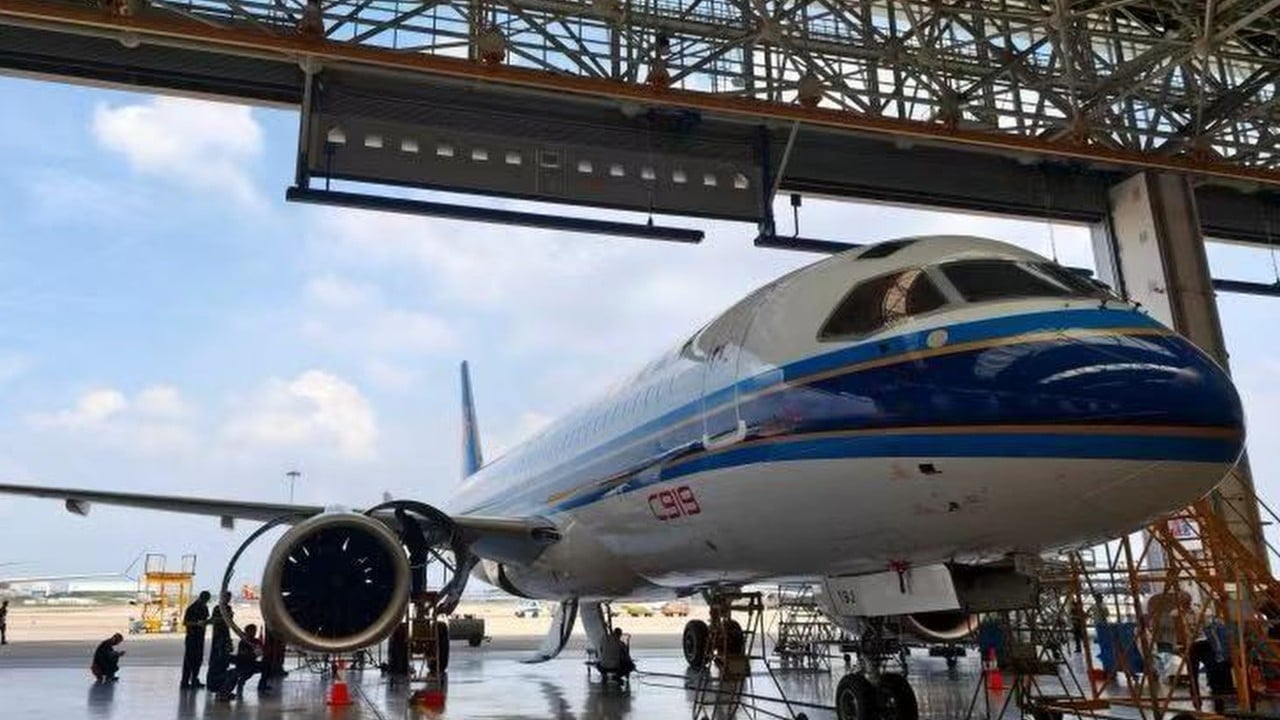
A quiet milestone recently occurred at Guangzhou Baiyun International Airport. A Comac C919 narrowbody jet, operated by China Southern Airlines, rolled out of a hangar and returned to commercial service. It had just completed its first "C-check"—the highly detailed, multi-week heavy maintenance teardown required after an airliner accumulates thousands of hours in the sky.
On paper, the message from Beijing was clear: China’s domestic jetliner is no longer a prototype novelty. It is a mature, hardworking commercial asset capable of undergoing deep industrial servicing completely within the Chinese domestic ecosystem. For an alternative perspective, consider: this related article.
But behind the celebratory headlines lies a high-stakes standoff. As Chinese airlines master the physical maintenance of the C919, European regulators are watching with deliberate, agonizing slowness. Western aviation authorities are not just evaluating the metal and software of China's narrowbody; they are holding the keys to its geopolitical survival. Beijing, increasingly frustrated by the glacial pace of Western safety approvals, has begun using aggressive trade leverage to force Europe’s hand.
The technical battle inside the maintenance hangars has officially transformed into an international chess match over global airworthiness. Similar coverage on this trend has been shared by Business Insider.
The Reality Behind the First Deep Teardown
To understand why this routine maintenance check has put Western aerospace executives on edge, one has to understand what a C-check actually reveals. It is an engineering trial by fire. Technicians spent nearly 6,000 working hours over 20 consecutive days meticulously dismantling parts of the fuselage structure, flight control systems, and avionics to hunt for microscopic structural fatigue, corrosion, or design vulnerabilities.
For an unproven aircraft, the first wave of C-checks is historically where the skeleton falls out of the closet.
When Western manufacturers debut a new airframe, early heavy maintenance often exposes unexpected wear patterns, problematic wiring routes, or fast-fatiguing alloys. The fact that China Southern’s aircraft cleared nearly 700 standard work orders and 28 engineering modifications to return to the skies indicates that Comac’s baseline structural engineering is holding up under real-world domestic stress.
The aircraft is proving it can fly, yield revenue, and survive the physical rigors of high-frequency domestic routes.
But proving airworthiness to domestic technicians inside a Guangzhou hangar is entirely different from proving it to the European Union Aviation Safety Agency (EASA). The C-check shows that the aircraft can be maintained according to its current manual. What it cannot do is solve the fundamental geopolitical flaw built directly into the C919's supply chain.
The Illusion of a Domestic Airliner
Beijing proudly markets the C919 as an achievement of self-reliance, a symbol of China breaking the absolute global duopoly held by Airbus and Boeing.
The industrial reality is far less independent. The C919 is a Western aircraft wrapped in a Chinese fuselage.
+-------------------------------------------------------------+
|                 THE C919 SUPPLY CHAIN MATRIX                |
+-------------------------------------------------------------+
| Aerostructures (Wings, Fuselage, Tail)   --> COMAC (China)  |
| Propulsion (LEAP-1C Engines)             --> CFM (US/France)|
| Avionics & Flight Controls               --> Honeywell (US) |
| Power Systems                            --> Collins (US)   |
| Landing Gear                             --> Liebherr (Ger) |
+-------------------------------------------------------------+
While the structural assembly takes place in Shanghai, every critical system that keeps the plane in the air comes from Western suppliers. The engines are CFM International LEAP-1C models, built by a joint venture between American-owned GE Aerospace and French-owned Safran. The flight control components, auxiliary power units, and wheels are packed with components from Honeywell, Collins Aerospace, and Parker Aerospace.
This dependence means the C919 does not exist in a vacuum. It lives at the mercy of Western export licenses.
The extreme fragility of this arrangement was laid bare when the United States Department of Commerce abruptly suspended export licenses for the LEAP-1C engines destined for Comac. While the restriction was quietly resolved and lifted after roughly five weeks, the shockwave through Beijing's aviation leadership was permanent.
Washington effectively proved that with a single administrative stroke, it could freeze China's flagship commercial aviation program in its tracks.
This supply-chain vulnerability directly explains why international airworthiness certification from EASA is a life-or-death priority for Comac. Without validation from a top-tier global regulator like EASA or the US Federal Aviation Administration (FAA), the C919 is legally barred from operating or being sold in Western markets. It cannot win orders from legacy international carriers, and it cannot easily secure aircraft leasing financing outside of Chinese state banks.
Worse, non-Western airlines in Southeast Asia, Africa, and Latin America—the primary target markets for Comac’s initial export push—frequently refuse to buy commercial aircraft that lack an EASA or FAA stamp of approval. They simply lack the independent regulatory infrastructure to certify an airliner on their own, relying on Western regulators to do the heavy lifting.
Europe's Strategy of Agonizing Caution
Recognizing this, European regulators are executing a strategy of deliberate, rigorous foot-dragging.
EASA test pilots traveled to Shanghai to conduct initial verification flights on the C919. While Comac executives publicly voiced hopes of securing European certification, EASA's leadership quickly poured cold water on those expectations. European officials have explicitly warned that validating the C919 could take years.
This is not standard administrative bureaucratic delay. It is a calculated assessment of risk.
Under normal circumstances, when Airbus or Boeing introduces a new derivative, bilateral aviation safety agreements allow regulators to fast-track approvals because they are intimately familiar with the legacy design philosophy and manufacturing quality control systems. Comac enjoys no such historical trust.
European inspectors are treating the C919 as a completely blank slate, demanding granular data on everything from the software integration of the flight management computers to the structural tolerances of the composite materials used in the wings.
There is also a deeper, unstated technical concern animating European safety specialists. Because the C919 integrates complex Western systems into an entirely new, state-directed Chinese airframe architecture, EASA must ensure that the digital handshakes between American avionics, French engine computers, and Chinese hardware operate flawlessly under extreme failure conditions.
A failure to detect a hidden software bug or an unforeseen system conflict could result in a catastrophic hull loss. For EASA, rushing an approval for a geopolitical challenger while lowering its gold standard of safety is an institutional non-starter.
Beijing Twists the Airbus Arm
China's Civil Aviation Administration (CAAC) has realized that technical appeals alone will not speed up the regulators in Cologne. Consequently, Beijing has shifted the battle ground from technical compliance to economic pressure.
China has begun weaponizing its vast domestic aviation market, intentionally withholding the final administrative delivery approvals for roughly 20 completed Airbus narrowbody jets bound for Chinese airlines. The impact on Airbus was immediate and painful, causing the European aerospace giant to log its lowest first-quarter delivery performance in nearly two decades.
More than five billion euros in completed, paid-for aircraft inventory is currently sitting stranded on European tarmac because Chinese regulators refuse to sign the paperwork.
The message to Toulouse and Brussels is unvarnished: If you want your planes to enter our market, you must let our planes enter yours.
"We are witnessing the outright politicization of aircraft certification," says an industry insider who requested anonymity due to active business ties in Shanghai. "Historically, airworthiness was treated as a sanctified island of pure engineering, isolated from trade wars. That era is dead. Beijing is openly holding Airbus deliveries hostage to force EASA into moving faster on the C919."
This leaves Airbus trapped in a commercial nightmare. The company has invested heavily in its final assembly line in Tianjin, betting its single-aisle market dominance on continuous, frictionless access to Chinese airlines. Now, it is being used as an industrial shield by Beijing to batter the very European regulatory body designed to protect aviation safety.
The Flawed Economics of the Challenger
Even if Beijing's pressure tactics succeed in squeezing a safety certificate out of Europe, Comac faces a brutal economic bottleneck that no amount of political leverage can solve: scale.
To truly challenge the Airbus-Boeing duopoly, a manufacturer must be able to build planes by the hundreds. Comac's internal goal was to deliver dozens of C919s annually. The actual production numbers tell a far more sobering story.
By the end of last year, Comac had managed to deliver only about 16 aircraft for the entire calendar year—missing its own heavily revised production targets by nearly 50 percent.
+-------------------------------------------------------------+
|               COMAC C919 ANNUAL DELIVERY TRACK              |
+-------------------------------------------------------------+
| 2022: | 1                                                   |
| 2023: | 2                                                   |
| 2024: | 13                                                  |
| 2025: | 16  (Revised Target: 25 | Original Target: 75)       |
+-------------------------------------------------------------+
With an official order book that allegedly claims more than 1,000 commitments, mostly from domestic state-aligned carriers and leasing entities, a production rate of just over one plane a month is deeply problematic. At this current pace, a customer placing an order today would have to wait decades to receive their aircraft.
The primary cause of this industrial slowdown is not a lack of factory space or state funding. It is the supply chain itself.
Every time Washington tweaks export controls, or a Western sub-tier supplier encounters a component shortage, the assembly line in Shanghai grinds to a halt. Comac cannot simply manufacture an alternative flight control computer or a composite landing gear strut overnight.
Furthermore, Western suppliers are prioritizing their primary, high-volume customers—Airbus and Boeing—who buy components by the thousands, leaving Comac at the back of the queue for critical aerospace parts.
An Unforgiving Horizon
The successful execution of domestic C-checks proves that China can operate its narrowbody experiment within its own borders. It validates the ground crews, the local maintenance tracking, and the day-to-day durability of the airframe under high-cycle domestic utilization.
But an airliner confined to its home country is not an international commercial threat; it is an expensive import-substitution program.
The true test of the C919 will not be decided by technicians turning wrenches in Guangzhou. It will be decided by whether EASA blinks in the face of multi-billion-euro delivery blockades, or whether European regulators choose to hold their safety line, forcing China to accept that global aerospace credibility cannot be coerced.
Until Comac can scale its production and free itself from the geopolitical volatility of Western component supplies, the C919 remains a highly sophisticated hostage to the very global order it seeks to disrupt.