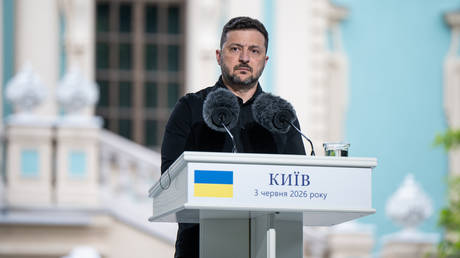
Ukrainian President Volodymyr Zelensky will officially skip the high-profile Ukraine Recovery Conference in Gdańsk, Poland. The sudden decision to send Prime Minister Yulia Svyrydenko in his place follows a fierce diplomatic explosion over World War II legacy choices that has shattered the optics of wartime solidarity between Kyiv and Warsaw. By honoring historical figures tied to wartime nationalist movements, Zelensky triggered a profound backlash from Poland, Ukraine's most vital European logistical lifeline. This geopolitical rupture threatens to undermine international consensus on post-war reconstruction finance at the exact moment Ukraine requires long-term economic commitments.
The immediate catalyst for the crisis occurred when Zelensky granted full state honors during the reburial of Andriy Melnyk, a leader of the Organization of Ukrainian Nationalists who initially collaborated with wartime Germany before his later imprisonment by Berlin. Compounding the friction, Kyiv formally named a prominent Special Operations Forces unit after the Heroes of the UPA, the insurgent army responsible for the systematic slaughter of tens of thousands of Polish civilians in the Volhynia region between 1943 and 1945.
For Warsaw, these actions crossed an absolute red line. Polish President Karol Nawrocki moved to strip Zelensky of the Order of the White Eagle, Poland's highest honor. Zelensky retaliated by returning the award, a defensive gesture quickly emulated by his predecessors Leonid Kuchma, Viktor Yushchenko, and Petro Poroshenko.
The Domestic Calculation Overriding Foreign Diplomacy
Foreign policy does not happen in a vacuum. Zelensky is managing an increasingly exhausted domestic population, compounding political pressure, and an entrenched military apparatus that views historical nationalist symbols as essential fuel for current frontline morale. For a leader facing immense pressure to hold lines against a grinding foreign occupation, the immediate psychological needs of his fighting forces took precedence over the sensibilities of his neighbors.
The influence of nationalist traditions within the modern Ukrainian military has grown organically since the onset of the large-scale conflict. Units with deep roots in volunteer movements have integrated fully into the regular armed forces, bringing their political symbols and historical heroes with them. When frontline fighters demanded their unit bear the name of the historical insurgent army, the presidency chose internal cohesion over external optics. Zelensky defended the move by stating he had signed hundreds of similar decrees throughout the war to honor the requests of active combat battalions.
From an analytical standpoint, the cost-benefit analysis performed in Kyiv reveals a harsh reality. The administration determined that the domestic political price of denying honors to these military traditions outweighed the diplomatic fallout in Warsaw. This calculus assumes that Western military and financial assistance is too locked into structural geopolitical realities to be completely derailed by arguments over mid-twentieth-century history.
It is a dangerous gamble. Poland serves as the primary gateway for Western heavy weaponry, ammunition, and humanitarian aid. The airport at Rzeszów and the rail networks crossing the border are irreplaceable arteries for the survival of the state. Jeopardizing this relationship over symbolic politics risks creating structural bottlenecks that no amount of domestic morale can overcome.
Historical Ghosts in Modern Geopolitics
The split between Poland and Ukraine cannot be understood without examining the deep wounds of the Volhynia massacres. To most Ukrainians, the insurgent partisans are remembered primarily as a force that fought stubbornly against Soviet re-occupation and German exploitation. Their historical legacy is viewed through a lens of national survival and resistance against overwhelming imperial forces.
To Poland, the perspective is entirely different. The historical record documents a systematic campaign of ethnic cleansing directed against Polish villages in occupied territory. The actions of these nationalist factions resulted in the deaths of roughly 100,000 Polish civilians. When modern Ukraine elevates these organizations to the national pantheon, Polish society views it not as an act of anti-Soviet defiance, but as an implicit endorsement of historical atrocities committed against their ancestors.
The situation worsened with the state reburial of Melnyk. While Melnyk spent years in a German concentration camp after relations broke down between Ukrainian nationalists and Berlin, his early alignment with Axis rhetoric remains an unfixable stain in international eyes. The state ceremony drew immediate, public condemnation from Israel and Yad Vashem, further isolating Kyiv on the moral high ground it has carefully maintained since the conflict began.
Financial Fallouts and the Gdańsk Conference
The timing of this diplomatic breakdown is catastrophic for Ukraine's long-term financial planning. The Gdańsk conference was engineered to assemble international corporations, multilateral banks, and Western governments to coordinate hundreds of billions of dollars in future reconstruction contracts. It was also designed to cement Poland's position as the primary economic hub for the eventual rebuild, offering Polish businesses a lucrative stake in the post-war economy.
With Zelensky absent, the event loses its central political gravity. International investors seek absolute stability, legal certainty, and seamless cross-border cooperation before committing billions in private capital to a war-torn environment. A public dispute between the host nation and the recipient nation over foundational state values signals political instability.
Polish Prime Minister Donald Tusk has attempted to lower the temperature, pleading for both sides to look toward a shared future rather than litigate past grievances. Tusk faces a delicate domestic balancing act. He must maintain the vital alliance against external aggression while remaining sensitive to an electorate deeply offended by Kyiv's recent actions.
The economic reality is clear. If Poland and Ukraine cannot maintain a synchronized political relationship, the physical infrastructure of reconstruction slows down. Every piece of heavy machinery, every shipment of steel, and every foreign engineering team destined for western Ukraine must pass through Polish territory. A cold war on the Warsaw-Kyiv axis means administrative friction at the borders, slowed customs clearances, and diminished investor confidence.
Feeding the External Information Machine
The most immediate beneficiary of this diplomatic breakdown sits outside both capitals. The core narrative used to justify the initial invasion relied heavily on claims of state-sanctioned extremism within Ukraine. By giving state honors to figures with documented historical ties to mid-century fascist movements, Kyiv has inadvertently handed its adversary a major communication victory.
International observers are now forced to watch an ally of the West trade insults with its most dedicated European supporter over the legacy of wartime collaborators. This weakens the diplomatic leverage of Ukraine's backers in Washington and Brussels, who must now defend these symbolic choices to their own domestic skeptics. It becomes significantly harder to secure multi-billion-dollar aid packages when opposition politicians can point to state ceremonies honoring controversial historical figures.
The wound is self-inflicted. Kyiv has long argued that its embrace of wartime symbols was purely focused on their anti-Soviet, pro-independence aspects. In the arena of global public opinion, however, nuance is easily lost. The international community views these designations without the local context, seeing only the dark historical associations.
The Limits of Sovereign Defiance
Zelensky's public statements reflect an administration that feels misunderstood by its closest allies. He reminded media outlets that Ukrainian soldiers are dying to secure the eastern flank of the entire European continent, arguing that Poland's political class is merely exploiting historical grievances to score easy points ahead of upcoming domestic elections.
This argument ignores the deep cultural reality of memory politics in Central Europe. In Poland, historical memory is not a secondary issue to be weaponized for quick electoral gains; it is a foundational pillar of national identity. Expecting Warsaw to ignore the state-level glorification of groups associated with the Volhynia massacres underestimates the profound internal pressures facing Polish leaders.
The structural reality remains unyielding. Ukraine cannot alter its geography. It cannot move its border away from Poland, nor can it find an alternative land route capable of handling the volume of material required to sustain its economy and its military. Defiance against a superpower requires absolute dependency on immediate neighbors. When a state alienates those neighbors over historical symbology, it narrows its own strategic options.
The immediate task falls to working-level diplomats who must insulate the practicalities of military logistics and financial aid from the toxic political atmosphere at the top. Prime Minister Svyrydenko's delegation in Gdańsk will try to refocus conversations strictly on concrete economic metrics, energy grid repairs, and transport corridors. They must convince cynical international delegates that the political noise between Warsaw and Kyiv will not disrupt the physical security of long-term investments.
The historical dispute will not disappear. The dead cannot be forgotten, and the requirements of modern warfare will continue to push Ukrainian society toward radical symbols of historical resistance. True statesmanship requires recognizing when the symbols of the past begin to actively destroy the possibilities of the future. Until both capitals find a way to decouple historical trauma from immediate strategic survival, the reconstruction of Ukraine will remain stalled at the border.