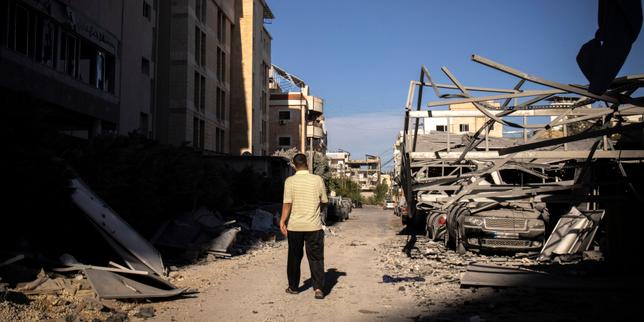
The destruction of the healthcare infrastructure in southern Lebanon is not an accidental byproduct of urban warfare. It is the result of a calculated military strategy designed to render entire regions unlivable. Over the course of recent campaigns, dozens of medical centers, clinics, and emergency transport units have been forced offline by targeted or adjacent bombardments. While international observers frequently dismiss these incidents as unfortunate collateral damage, an examination of the operational patterns, shifting military doctrines, and the sheer volume of strikes reveals a systematic dismantling of civilian survival systems.
By taking out the safety net of public health, the conflict achieves a secondary purpose. It forces the permanent displacement of populations without the need for a total ground occupation.
The Doctrine of Proximity Bombardment
To understand why hospitals in Tyre, Nabatiyeh, and Tebnine are crumbling, one must look at how modern air campaigns are planned. Military spokespeople routinely maintain that medical facilities are not the intended targets. They claim that the destruction is an incidental side-effect of hitting nearby weapon caches or insurgent command posts. This defense functions as a legal shield, but it falls apart under engineering and tactical scrutiny.
When high-yield ordnance is dropped within dozens of meters of a hospital, the facility is effectively destroyed even if the walls remain standing. Heavy airstrikes generate massive pressure waves. These shockwaves blow out reinforced windows, shatter delicate diagnostic machinery, and sever main electrical lines.
At the Jabal Amel hospital in Tyre, a strike on an adjacent building completely knocked out the facility's power grid, forced the emergency evacuation of patients connected to life-support systems in the intensive care unit, and heavily damaged the structural integrity of the first floor. The physical building was bypassed by the bomb, but its capacity to save lives was terminated.
The strategy relies on a loophole in the laws of armed conflict. By targeting the immediate perimeter of a protected structure, a military force can achieve the functional liquidation of a hospital while maintaining a baseline of deniability in international courts.
The Deliberate Deprivation of Medical Neutrality
A parallel component of this crisis is the direct targeting of the frontline medical personnel themselves. Since the escalation of hostilities, well over 100 healthcare workers and paramedics have been killed in the line of duty. Ambulances are routinely hit while in transit or while responding to initial strike locations.
The defense infrastructure of southern Lebanon relies heavily on localized emergency response networks. These include the state civil defense, the Lebanese Red Cross, and various community-backed health associations. By classifying entire organizations as hostile entities based on administrative or political ties, the distinction between active combatants and medical workers is intentionally erased.
International humanitarian law is explicit. Medical personnel and transport vehicles lose their protected status only if they are used to commit acts harmful to the enemy, and only after a clear warning with a reasonable time limit has been ignored. Presenting blanket public allegations without providing verifiable evidence does not meet this legal standard. Instead, it serves as a pre-emptive justification for strikes on first responders.
When a paramedic crew is eliminated during a secondary strike while trying to pull survivors from the rubble of an initial blast, it sends a chilling message to the remaining workforce. The psychological toll has induced a quiet exodus of specialized physicians and nurses, leaving the remaining public hospitals staffed by exhausted generalists who lack the tools for complex trauma care.
The True Cost of Forced Isolation
The impact of these strikes extends far beyond the immediate casualty lists. When a regional hospital closes, the entire surrounding ecosystem of care collapses. Primary health centers, which manage chronic illnesses like diabetes, kidney failure, and cardiovascular disease, depend on larger referral hospitals for supplies and emergency transfers.
- Logistical Strangulation: The destruction of transit corridors means ambulances must navigate cratered roads, turning a standard fifteen-minute transport into a multi-hour gamble.
- Equipment Failure: Power instability and shattered supply chains mean that vital equipment, such as dialysis machines and neonatal incubators, sit idle due to a lack of spare parts or steady electricity.
- Secondary Mortality: Far more civilians are dying from unmanaged, treatable conditions than from direct blast injuries. A preventable cardiac event becomes fatal when the nearest functional emergency room is two hours away across an active combat zone.
Those who choose to remain in the battered towns of the south do so with the full knowledge that any sudden medical emergency is a potential death sentence.
The Geopolitical Calculus of Desertion
A city without water can survive for days. A city without food can hold out for weeks. A city without a functional hospital empties within forty-eight hours of an escalation. The systematic degradation of healthcare infrastructure is the most efficient mechanism for demographic engineering available to a modern military.
When the Nabatiyeh Governmental Hospital or the Najdeh Al-Shaabiyeh facility are compromised, the civilian population recognizes that the basic conditions for human survival have been removed. This is not the incidental friction of a complex war. It is a highly effective method of territorial clearing that operates just beneath the threshold of overt population expulsion.
The international community's reliance on hollow statements of concern ensures that the baseline for what is permissible in modern warfare continues to drop. Until international legal bodies enforce consequences for proximity strikes and the killing of accredited first responders, the hospital will remain a prime tactical objective for forces seeking to clear a landscape without holding the ground.