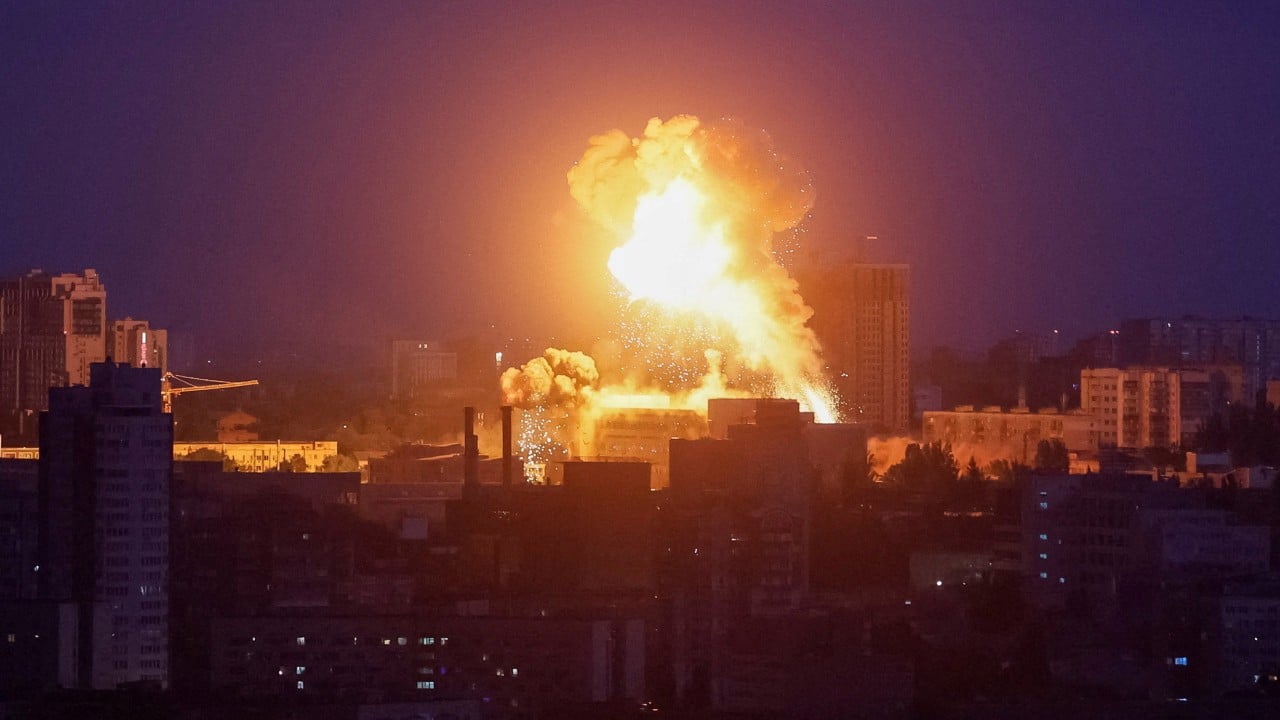
Moscow has explicitly threatened to launch systematic and consistent strikes against Ukrainian military sites and decision-making centers in Kyiv, warning U.S. Secretary of State Marco Rubio to immediately evacuate American diplomats and citizens from the capital.
The ultimatum, delivered directly by Russian Foreign Minister Sergei Lavrov during a high-stakes telephone call with Rubio, marks a dangerous escalation in the Kremlin’s strategy. Moscow is attempting to establish a de facto no-go zone over the Ukrainian capital by using the threat of its new, nuclear-capable Oreshnik intermediate-range ballistic missile to terrorize foreign governments into isolation. For another view, read: this related article.
While the immediate pretext for the warning is a Ukrainian strike in occupied Luhansk, the broader geopolitical calculation is far more calculating. By signaling an imminent, catastrophic bombardment of Kyiv's administrative heart, Russia is actively testing the threshold of Western resolve under a shifting Washington infrastructure, attempting to force a unilateral diplomatic retreat that would leave Ukraine isolated.
The Geography of Escalation
The warning from Lavrov was not an isolated diplomatic cable. It arrived on the heels of a massive aerial assault that saw over 90 missiles and 600 drones rain down across Ukraine. Among those munitions was an Oreshnik ballistic missile, targeted just south of Kyiv. This marks only the third time Russia has deployed the experimental weapon, and the first time it has been detonated so close to the capital. Similar coverage on the subject has been shared by The Washington Post.
By following a kinetic strike with a direct phone call to Washington, the Kremlin is executing a classic coercive diplomacy playbook. They are using the Oreshnik as a political instrument rather than a purely military one. The message to the State Department is clear: clear out, or risk your personnel becoming collateral damage in a devastating new phase of the air campaign.
The Russian Ministry of Foreign Affairs public statement underscored this intent, explicitly advising all foreign states with missions in Kyiv to ensure the withdrawal of their personnel.
The Response from the Ground
The Western response to the ultimatum has exposed a critical fault line between Washington and its European allies. While the State Department confirmed the call occurred and noted that Rubio exchanged views on the war, European officials have responded with defiance.
Katarina Mathernova, the head of the European Union mission in Kyiv, rejected the implicit threat. She stated bluntly that the 27-nation bloc is not going anywhere.
"Russia wants fear, panic, isolation of Ukraine," Mathernova said. "It will not work. The EU is not going anywhere. We are staying in Kyiv."
This split highlights the exact psychological fracture the Kremlin hopes to exploit. If the United States heeds the warning and draws down its embassy presence, it signals to the world that Moscow's nuclear-capable blackmail works. It would set a precedent that any city can be diplomatically quarantined simply by threatening it with advanced rocketry. Conversely, staying risks a catastrophic incident that could draw the United States into direct kinetic conflict with Russia.
Inside Kyiv, the civilian population has reacted with the grim, desensitized resilience that has characterized the last four years of conflict. Hours after the weekend barrage damaged nearly 300 sites across the capital, local residents were back in the streets. Emergency workers cleared charred debris in the Lukyanivka neighborhood while nearby cafes continued serving patrons.
The Pretence of Luhansk and the Alaska Friction
Moscow has publicly framed this impending assault as a retaliatory measure for a Ukrainian strike on a facility in the Russian-occupied town of Starobilsk, located in the Luhansk region. Russian officials claim the strike hit a school dormitory and killed more than 20 people, labeling the act as terrorism. Ukrainian military officials countered that the target was the active headquarters of a Russian drone unit, rejecting accusations that civilian infrastructure was intentionally targeted.
Yet the true driver of this escalation lies not on the battlefields of the Donbas, but in the collapse of recent diplomatic backchannels. During the call, Lavrov reportedly accused European powers and Ukraine of actively undermining the fragile understandings reached between Vladimir Putin and U.S. President Donald Trump during their summit in Alaska.
Those talks had floated a potential framework to freeze the conflict along existing frontlines, with Washington potentially pushing Kyiv to relinquish the Donbas in exchange for a halt to Russian advances. However, the subsequent implementation of a €90 billion European Union loan package for Ukraine—cleared after Hungary dropped its veto—alongside a highly effective Ukrainian counter-air campaign that destroyed over 80 Russian air defense systems, convinced Moscow that Kyiv has no intention of capitulating to a forced freeze.
The Long-Range Attrition Game
The timing of Russia's ultimatum is also driven by a worsening domestic military reality. Ukraine has significantly intensified its strike campaign against Russian radar installations and surface-to-air missile systems. By suppressing Russian air defenses, Ukraine has begun to degrade Moscow's ability to protect its own logistical hubs behind the frontline.
President Volodymyr Zelensky noted that Ukraine’s technological innovations and long-range drone operations have successfully stabilized volatile sectors of the front. This has drawn uncharacteristic criticism from Russian military bloggers, who are openly questioning the military command's inability to protect its assets.
Faced with a stabilizing frontline and an adversary that refuses to compromise on its territorial integrity, Putin is reverting to the one arena where Russia holds a distinct advantage: absolute ruthlessness from the air. By targeting the "decision-making centers" in Kyiv, Russia is attempting to decapitate Ukraine's political leadership while using the threat of Western casualties to keep international observers away from the target zones.
The coming days will reveal whether Washington chooses to call Moscow’s bluff or protect its personnel at the cost of giving in to geopolitical blackmail. What remains certain is that the airspace over Kyiv is no longer just a military battleground. It has become the primary theater for a psychological war of nerves that will define the terms of any future peace.