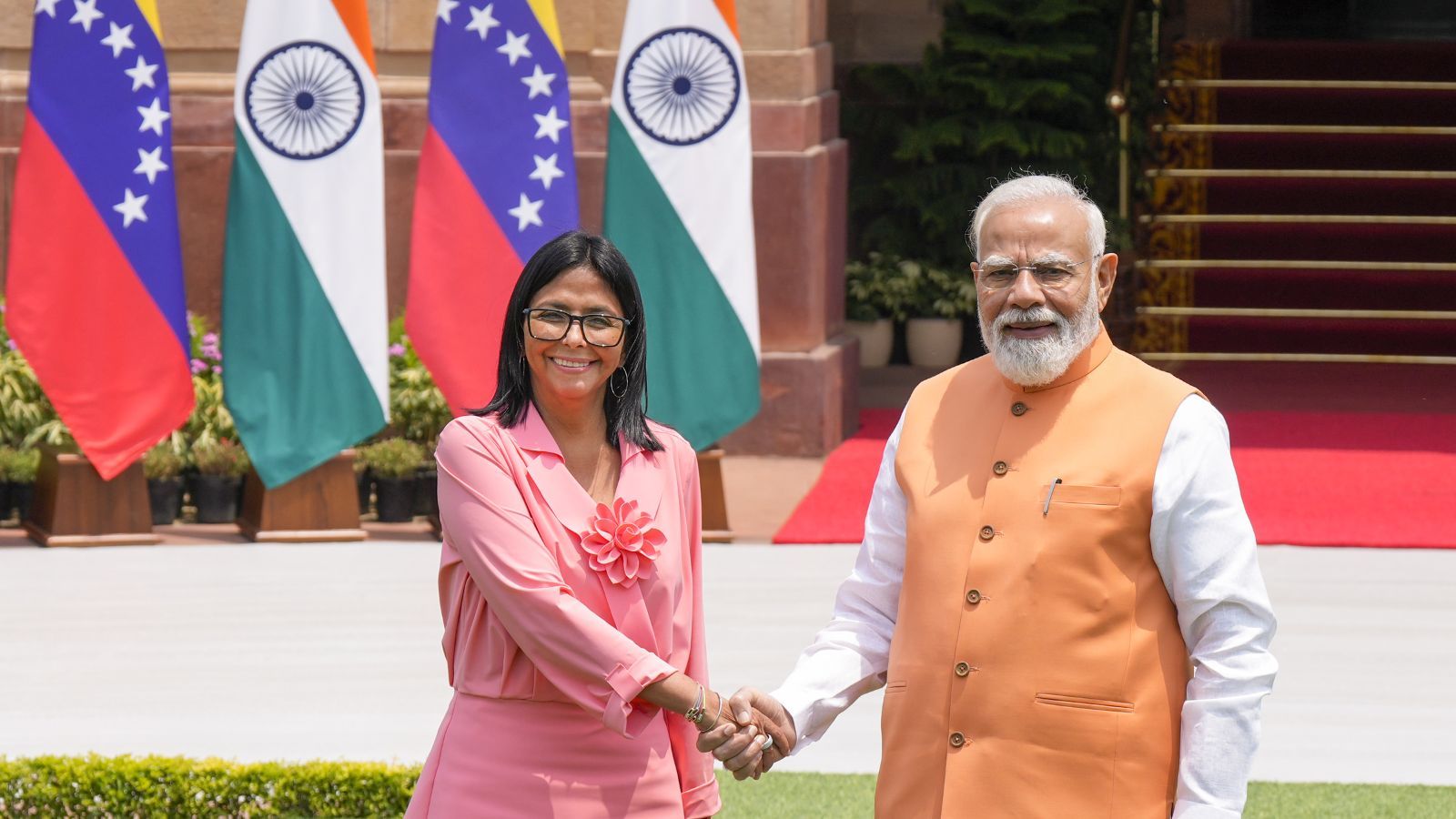
India has quietly turned to Venezuela to salvage its economy from a crippling energy shock, accelerating crude imports to historic levels as a catastrophic war in the Middle East chokes off traditional shipping lanes.
The emergency diplomatic mission in New Delhi between Prime Minister Narendra Modi and Venezuelan Acting President Delcy Rodriguez exposes a high-stakes rush for crude. With the conflict in Iran effectively sealing the Strait of Hormuz—a maritime chokepoint that previously carried nearly 40% of India's oil supplies—New Delhi faced an existential economic crisis. By rolling out the red carpet for Rodriguez, India is executing an aggressive pivot toward Latin American heavy crude, locking in long-term supply agreements to keep its domestic refineries running and prevent a catastrophic spike in domestic fuel prices.
The Hormuz Chokehold and the Dash for Caracas
For decades, Indian energy policy operated on a predictable, if precarious, reliance on the Middle East. That strategy collapsed when regional warfare abruptly halted traffic through the Strait of Hormuz. For a nation that imports roughly 90% of the crude it consumes, losing access to Persian Gulf suppliers was not a minor logistics hiccup. It was an immediate threat to national stability.
New Delhi had to replace hundreds of thousands of barrels of daily supply almost overnight. Turning back to Caracas was the only logical, albeit complicated, escape hatch.
The shift has been aggressive. Indian arrivals of Venezuelan crude have rocketed from zero during the height of past US sanctions to an estimated 380,000 barrels per day. This sudden surge has rapidly elevated Venezuela to India’s third-largest oil supplier.
Estimated Indian Imports of Venezuelan Crude (2026)
+----------------+-------------------------+
| Month          | Barrels Per Day (BPD)   |
+----------------+-------------------------+
| April          | 283,000                 |
| May            | 427,000                 |
| June (Est.)    | 380,000                 |
+----------------+-------------------------+
The data compiled by industry trackers underlines a raw reality. India is not engaging in casual diplomacy; it is buying every drop of heavy crude it can get its hands on.
Why Indian Refineries Need Venezuela’s Sludge
The corporate forces driving this sudden alignment are led by Reliance Industries. The company operates the massive refining complex in Jamnagar, Gujarat, which stands out as one of the few facilities globally engineered to handle Venezuela's incredibly heavy, sulfur-rich bitumen-like crude.
Most standard refineries view Venezuelan oil as low-quality sludge that is too costly and corrosive to process. For Jamnagar, it is high-yield profit. Reliance signed a foundational term agreement to source up to 400,000 barrels per day from Petroleos de Venezuela SA back in 2012, giving Indian engineers over a decade of experience refining this specific variety of oil.
During the current state visit, Rodriguez’s delegation is scheduled to tour these exact refining hubs. The diplomatic goal is to prove to Caracas that while the rest of the world struggles to adapt to unconventional crude, India possesses the exact industrial infrastructure required to monetize Venezuela’s vast underground reserves.
The $500 Million Debt Hanging Over the Table
Despite the public displays of solidarity and shared commitment to the Global South, the diplomatic discussions in New Delhi are far from simple. Beneath the official handshakes lies a persistent financial dispute that has strained bilateral relations for years.
India's state-owned energy arm, ONGC Videsh, has more than $500 million in frozen dividends trapped inside Venezuela. The cash represents returns on major upstream investments made by Indian public sector units before the political turmoil in Caracas and subsequent US financial restrictions froze the country out of the global banking system.
Indian diplomats addressed the issue directly during the talks. Foreign ministry officials confirmed that the multi-million-dollar debt was raised with Rodriguez, noting that the current Venezuelan leadership remains highly sensitive to the matter.
Paying back India in raw cash is virtually impossible for a cash-strapped Venezuelan treasury. Consequently, the two nations are quietly negotiating complex oil-for-debt swap mechanisms. Under these proposed frameworks, Venezuela would discharge its half-billion-dollar sovereign debt by granting Indian state companies direct equity in new upstream extraction projects or delivering heavily discounted crude parcels.
Critical Minerals and the Non-Oil Pivot
While oil remains the immediate priority, the long-term objective of the Modi-Rodriguez summit involves diversifying into mining and manufacturing. Venezuela holds massive untapped reserves of critical minerals, bauxite, gold, and diamonds.
India’s rapid industrial expansion requires an uninterrupted pipeline of lithium, cobalt, and rare earth elements to power its domestic semiconductor and electronics manufacturing initiatives. The joint communique indicated that Indian technical teams will soon deploy to South America to actively map out and assess Venezuela's mineral reserves.
Expanding Beyond Commodities
The economic strategy discussed by the two leaders extends well beyond raw resource extraction. The details of the wider economic package include:
- Pharmaceutical Supply Chains: India plans to export bulk generic medicines and set up local manufacturing plants in Caracas to address Venezuela's chronic medical shortages.
- Agricultural Equipment: New Delhi is offering credit lines to export Indian-made tractors and harvest machinery to stabilize Venezuelan food production.
- Automotive Subsidies: Initial talks focused on introducing Indian commercial transport vehicles and passenger cars into the Latin American market.
The Friction of Imperial Realities
The primary obstacle to this massive bilateral expansion is the inherent fragility of Venezuela's domestic production infrastructure. Decades of underinvestment, political purges within PDVSA, and decaying infrastructure mean that Venezuela cannot simply turn a valve to double its output.
Furthermore, the geopolitical landscape remains incredibly volatile. While the recent political transition in Caracas—which saw Delcy Rodriguez assume the role of acting president following the detention of Nicolas Maduro—allowed for a tactical easing of western sanctions, that window could slam shut at any moment.
Indian energy analysts remain pragmatic about the limitations of this sudden partnership. The South American nation can offer a vital buffer during an acute Middle Eastern supply shock, but it cannot completely replace the sheer volume of the Persian Gulf.
By treating Caracas as a strategic partner rather than a temporary transactional fix, New Delhi is attempting to build a permanent energy hedge. If successful, India will secure a reliable flow of raw materials insulated from Middle Eastern blockades. If the initiative fails due to domestic instability in Caracas or a return to aggressive sanctions, India's state-backed energy investments will once again be trapped on the wrong side of the Atlantic.


