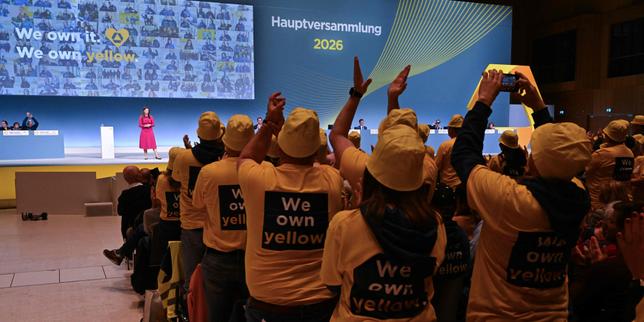
The corporate battle lines in European banking are rarely drawn with this much transparency. At Commerzbank’s annual general meeting in Wiesbaden, the rhetoric from the executive stage shifted from standard corporate defense to an outright fight for survival. Chief Executive Bettina Orlopp faced shareholders with a clear message: the hostile, all-share exchange offer from Italy’s UniCredit is an attempt to capture Germany’s second-largest listed bank on the cheap while exposing investors to severe, uncompensated structural risks.
At its core, this standoff is not just about asset valuations or premium percentages. It is a fundamental clash over the future of European banking integration, the independence of the German Mittelstand's primary financial engine, and the aggressive tactics of UniCredit CEO Andrea Orcel. For another perspective, see: this related article.
The Illusion of the Zero Premium Offer
The primary vulnerability in UniCredit’s current offensive is the financial math. Andrea Orcel has built a reputation as a master dealmaker, but his €39 billion non-cash proposal relies on an exchange ratio of 0.485 UniCredit shares for every Commerzbank share.
When the formal offer document was analyzed against market realities, the implied value sat at €34.56 per share. At that exact moment, Commerzbank shares were trading on the open market at €36.48. Related reporting on this matter has been provided by MarketWatch.
"The offer provides de facto no premium to Commerzbank's shareholders," Orlopp told the audience in Wiesbaden. "It is an attempt to take over control without offering adequate compensation."
In standard corporate finance, an acquiring institution must offer a control premium—historically between 20% and 40%—to convince equity holders to relinquish governance rights. By offering an implied value that tracks below the target’s actual market price, UniCredit is asking Commerzbank investors to fund their own acquisition. Independent equity research analysts place the median target price for Commerzbank on a standalone basis at approximately €41.50, meaning the current Italian bid asks shareholders to leave significant money on the table.
Why a Share Swap Shifts the Risk Downward
The structural design of the deal introduces an even deeper complication. Because this is an all-share exchange rather than a cash buyout, any investor who tenders their Commerzbank stock does not exit the position. They simply trade their German banking equity for paper in a combined entity dominated by Milan.
This structural quirk means Commerzbank shareholders are being asked to absorb UniCredit's specific balance sheet risks. Chief among these is UniCredit's lingering, highly profitable but volatile exposure to Russia. Commerzbank’s management explicitly weaponized this point in their 137-page formal rejection document, noting that the political and regulatory liabilities attached to Italian banking operations in Moscow represent a net negative for German investors.
Furthermore, the operational settlement of this deal is protracted. The regulatory approvals required for a cross-border merger of this scale mean that completion is unlikely before July 2027. For more than a year, shareholders would be locked into an arbitrage limbo, unable to capitalize on Commerzbank’s immediate operational momentum while holding assets tied to an uncertain regulatory verdict.
The Momentum 2030 Counter Strategy
To successfully reject an unwanted suitor, a target bank cannot simply say no. It must prove it is worth more alive than dead. Commerzbank is attempting to do this by turning its balance sheet into a capital-distribution machine.
The bank recently posted its strongest operating result in history for the 2025 financial year, with operating profit climbing 18% to €4.5 billion. Backed by these numbers, Orlopp and Supervisory Board Chairman Jens Weidmann used the shareholder meeting to ratify a massive capital return policy. The bank approved a dividend of €1.10 per share for 2025, up significantly from €0.65 the previous year. Combined with €1.5 billion in already executed share buybacks, Commerzbank is returning €2.7 billion to its investors—effectively 100% of its net result after accounting for mandatory capital cushions.
Under its newly upgraded Momentum 2030 framework, management has laid out specific, audited financial targets designed to make the independent path look vastly superior to Orcel's vague synergy promises.
| Financial Metric | 2025 Actual | 2030 Standalone Target |
|---|---|---|
| Annual Revenue | €10.5 billion | €16.8 billion |
| Net Profit | €2.4 billion | €5.9 billion |
| Cost-Income Ratio | 58% | 41% |
| Return on Tangible Equity (RoTE) | 8.7% | 21.0% |
Achieving a 21% Return on Tangible Equity would place Commerzbank among the most efficient, profitable banking operations in the Eurozone. To get there, management is planning an aggressive internal overhaul, including 3,000 headcount reductions and deep integration of automation technologies across back-office operations. The core argument to shareholders is simple: we can achieve elite profitability on our own, with low execution risk, without giving up control to Milan.
The Sovereign Veto and Labor Resistance
Beyond the financial spreadsheet lies the geopolitical reality of German economic policy. The German federal government remains a critical stakeholder, retaining a 12.7% equity position inherited from the 2008 bailout era.
Berlin’s political establishment is deeply uncomfortable with the prospect of losing domestic operational control over the primary lender to the German Mittelstand—the network of small-to-medium export enterprises that form the backbone of the nation's economy. Berlin is quietly exploring options to increase its stake back toward 25%, a threshold that would grant the federal government an absolute blocking minority veto under German corporate law. Chancellor Olaf Scholz's administration has publicly warned against "hostile, aggressive takeovers" that threaten systemic financial stability.
Simultaneously, the domestic labor force has mobilized. Outside the Wiesbaden congress center, hundreds of employees represented by the Verdi union protested with signs reading “UniCredit Go Away.”
Germany's system of corporate codetermination gives workers half the seats on the supervisory board. This is not merely symbolic resistance. Labor representatives have the institutional power to delay, disrupt, and legally challenge integration plans, IT migrations, and branch closures. Any cross-border synergy model that relies on rapid, ruthless cost-cutting will inevitably run aground on the realities of German labor law. Deka Investment representative Andreas Thomae summarized the institutional sentiment at the meeting, warning that a forced integration would bog both institutions down for years in cultural and structural warfare, destroying customer focus at a time when the German economy is already struggling for growth.
Orcel’s Next Move
Andrea Orcel does not back down easily. UniCredit has quietly accumulated an economic stake of roughly 39% through derivatives and direct holdings, positioning itself as Commerzbank’s largest single shareholder.
Orcel’s core thesis remains structurally valid: European banking is too fragmented to compete globally with American behemoths, and cross-border consolidation is the only path to building true scale. However, by launching an uninvited, underpriced exchange offer, he has unified Commerzbank’s management, its workforce, institutional investors, and the German government against him.
The standoff has reached a point where capital discipline must override corporate ego. If UniCredit wants to break the deadlock, it must return with a heavily revised, cash-sweetened offer that honors the traditional control premium. Until Milan puts real money on the table, Commerzbank's board has given shareholders every reason to sit tight and collect their dividends.


