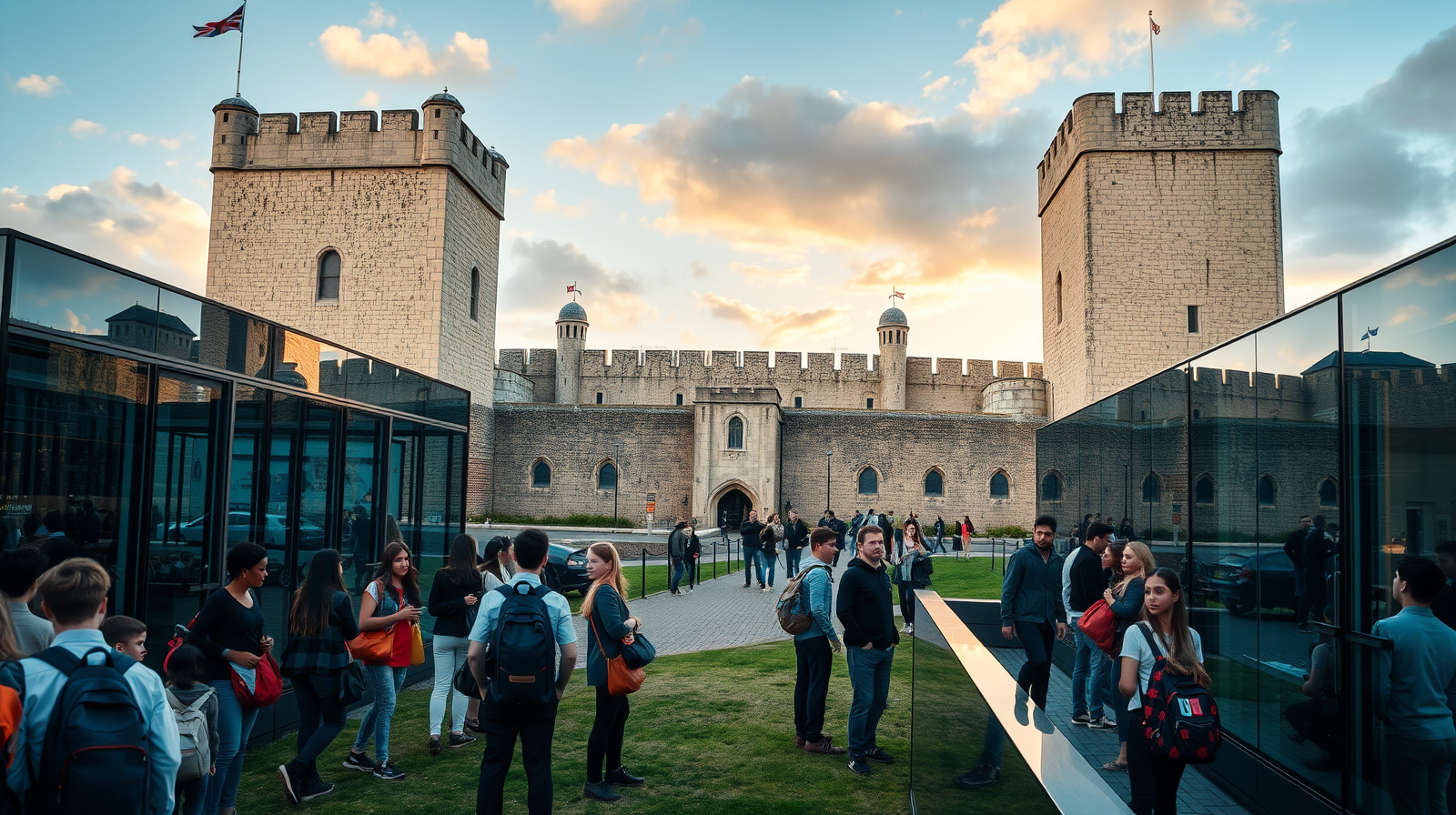
Paper, Dust, and Nine Hundred Years of Secrets
Put your fingers against the stone of the White Tower. Feel the chill. That block of Kentish ragstone was laid under the orders of William the Conqueror in the late 1070s. It feels permanent. It feels unyielding, as if it was born directly out of the earth and will outlast every human breath drawn within its shadow.
That feeling is an illusion.
Stone crumbles. Mortar turns to meal. Timber rots from moisture trapped in dark timber joists. For nearly a millennium, the Tower of London has not survived because it was indestructible. It survived because generations of forgotten clerks, draftsmen, masons, and surveyors obsessively documented every inch of its anatomy on paper.
They drew in cold rooms by candlelight. They dipped steel nibs into dark ink, mapping out secret passages, reinforcing ancient foundations, and designing prison cells that double as torture chambers. They drew up plans for grand armories, sewage channels, royal lodgings, and gun emplacements.
For centuries, those blueprints remained locked away in climate-controlled vaults, hidden from public eyes, treated as state secrets or obscure administrative clutter.
Now, Historic Royal Palaces has made an unprecedented move: opening an archive of 25,000 architectural drawings to the public for the very first time.
The Draughtsman in the Rain
To understand what 25,000 architectural blueprints actually mean, you have to look at one hypothetical figure based on the historical record: Arthur, a Victorian draftsman working for the Office of Works in November 1864.
Picture him standing on the damp cobbles of the Outer Ward. Rain drips off the brim of his felt hat, soaking into his wool coat. His boots are caked in London mud. In his hand, he holds a brass-bound ruler and a leather journal. His job is to measure the precise thickness of the Bloody Tower’s medieval walls before a restoration team cuts into the masonry.
His hands are blue with cold. Every time he breathes out, a cloud of vapor obscures his sight. Yet he places his rule against the stone, takes out a pencil, and marks a line on thick rag paper.
That drawing—one among thousands—is not an abstract piece of fine art. It is a working document. It shows where an 18th-century engineer plugged a leak, where a Tudor doorway was walled up to hold gunpowder, and where the floorboards need extra joists so a ten-ton cannon won't crash through into the cellar below.
For centuries, men like Arthur kept the fortress standing. They were not kings. They were not infamous prisoners like Anne Boleyn or Guy Fawkes. They were the invisible maintainers of power. When you hold their original drawings in your hands—or view them on a screen in high definition—you aren't just looking at structural lines. You are looking at the exact physical effort of human beings trying to keep history from falling down.
What Lies Within Twenty-Five Thousand Sheets
The sheer scale of this archive is staggering, but its true power lies in the small details.
Among the collection are plans dating back across centuries of British history, capturing moment-by-moment decisions made during times of existential crisis and quiet bureaucratic routine.
The Secrets of Defense and Subversion
- Gunpowder and Mortar: Detailed schematics mapping the transformation of a royal residence into a heavily fortified military depot capable of storing thousands of barrels of black powder.
- Prisoner Cells and Hidden Doors: Uncut cross-sections revealing double walls, hidden access hatches, and modified security gates designed to prevent escape from the realm's most dangerous captives.
- Restoration versus Invention: Victorian plans showing how 19th-century architects "gothicized" parts of the castle, adding battlements and decorative features that never existed in the Middle Ages to match popular romantic ideals.
Consider what happens when an architect looks at an ancient wall today. Without these plans, fixing a crack is a dangerous game of Russian roulette. Drill two inches too deep, and you might punch through into an ancient sewer or weaken a load-bearing arch that has held up a stone turret since the War of the Roses.
These 25,000 drawings are a cheat code for structural preservation. They reveal the mistakes, the hasty repairs, and the genius structural work of master builders who died five hundred years ago.
The Human Cost of Static Stone
We tend to treat monuments as static backdrops. We buy our tickets, walk through the archways, snap a photo of the Crown Jewels, and leave. We assume the fortress has always looked this way and always will.
It is a comfortable lie.
The reality of historic architecture is a constant, grinding war against entropy. Rain gets under the lead roofs. Thames fog eats away at the soft limestone. Vibrations from nearby underground trains shake centuries-old mortar loose from its joints.
Without continuous documentation, buildings die.
When fire swept through Notre-Dame Cathedral in Paris in 2019, architects relied heavily on precise 3D scans and historical drawings to understand how the timber roof had been constructed. Without those paper trails, full restoration would have been nearly impossible.
The release of the Tower of London’s architectural archive isn't just a gift to historians or castle enthusiasts. It is an act of democratic preservation. By placing these thousands of original documents online and into public access, the caretakers of the Tower are handing the keys of its structural memory to the entire world.
Anyone—a student in Mumbai, an architect in Chicago, or a curious reader at a kitchen table—can zoom in close enough to see the iron gall ink sinking into the fibers of two-hundred-year-old paper.
Reading the Ink Between the Lines
There is a quiet intimacy in these plans that short history textbooks can never replicate.
You can see where an architect spilled coffee on a floorplan of the Salt Tower in 1822. You can see pencil notes scribbled in the margin by an engineer who disagreed with his supervisor's decision to tear down a Tudor house inside the walls. You can trace the faint red chalk lines used to lay out coordinates before the black ink was applied.
These documents bridge the gap between the grand narrative of kings and the gritty reality of maintenance. They prove that history isn't made purely by proclamation. It is maintained by ink, chalk, sweat, and precision.
Standing in the shadow of the White Tower today, you look up at the soaring stone walls with a different perspective. You realize that behind every massive block of grey stone sits a sheet of paper. Behind every sheet of paper sits a pair of cold hands holding a pen. And behind those hands is the quiet, relentless human urge to build something that lasts forever.