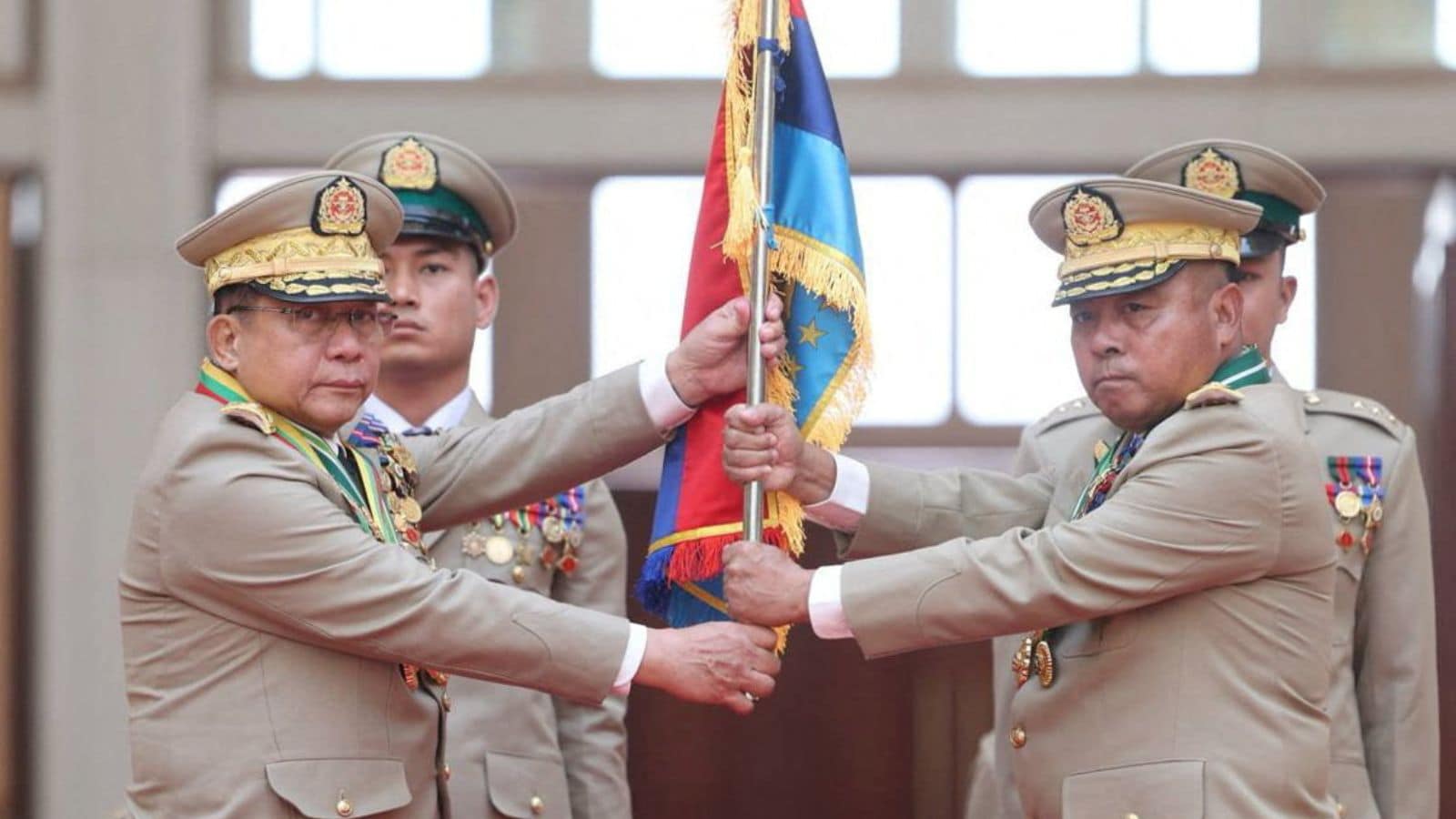
New Delhi is hosting Myanmar President U Min Aung Hlaing for a five-day official visit starting May 30, 2026. This trip marks his first foreign travel since transitioning from military junta chief to formal president following a tightly managed election cycle. The high-profile reception, which includes bilateral talks with Indian Prime Minister Narendra Modi, directly addresses India's urgent need to secure its volatile northeastern border, counter Chinese strategic dominance in the Bay of Bengal, and protect multi-million dollar infrastructure projects from collapsing amid Myanmar's ongoing civil war.
While Western capitals enforce strict diplomatic isolation and heavy sanctions against Naypyidaw, India is choosing calculated engagement over moral distancing. This strategy reveals the cold reality of shared geography, where idealistic foreign policy choices consistently clash with the immediate demands of national security.
The Calculus of Shared Borders
India and Myanmar share a highly porous 1,643-kilometer land border alongside a contested maritime boundary in the Bay of Bengal. For decades, ethnic insurgent groups operating in India’s northeastern states of Nagaland, Manipur, and Mizoram have used the dense jungles of western Myanmar as a safe haven. The collapse of central state authority across large swaths of Myanmar following the 2021 military coup has severely aggravated this security vulnerability.
The Indian security establishment views a total vacuum of governance along its periphery as an unacceptable threat. Anti-junta resistance forces, primarily composed of ethnic armed organizations and the People's Defense Forces, now control significant territory adjacent to the Indian border.
This territorial shift has direct consequences for India. The intense civil conflict has triggered an influx of tens of thousands of refugees into Mizoram and Manipur, straining local resources and altering fragile demographic balances. Local authorities have struggled to manage the social and economic friction caused by this displacement. By maintaining a formal diplomatic channel with Min Aung Hlaing’s administration, New Delhi intends to ensure that the primary institutional army in Myanmar remains cooperative in checking cross-border insurgent movements.
Countering the Chinese Footprint
Geopolitical competition with Beijing remains the unstated driver of India's policy toward Naypyidaw. China has aggressively advanced its China-Myanmar Economic Corridor, a strategic network of pipelines, deep-water ports, and railways designed to connect Yunnan province directly to the Indian Ocean. This infrastructure allows Beijing to bypass the vulnerable Malacca Strait, altering the maritime balance of power in South Asia.
India cannot afford to cede its eastern neighbor entirely to the Chinese sphere of influence. Had New Delhi chosen to completely isolate the junta, it would have left the isolated military regime with no alternative but to rely exclusively on Beijing for economic survival and diplomatic protection at the United Nations. By offering a diplomatic alternative, India retains a degree of leverage in Naypyidaw, attempting to prevent the total encirclement of its eastern frontier by pro-Beijing assets.
Sunk Costs and Strategic Corridors
The economic agenda of the visit, which includes high-level business forums in New Delhi and industrial site tours in Mumbai, centers on saving massive, delayed infrastructure initiatives. Foremost among these is the Kaladan Multi-Modal Transit Transport Project. This ambitious venture aims to connect the eastern Indian port of Kolkata with the Sittwe seaport in Myanmar's Rakhine State, continuing via riverine and highway routes to India's landlocked northeast.
| Project Name | Primary Route | Strategic Objective | Current Status |
|---|---|---|---|
| Kaladan Multi-Modal Project | Kolkata Port to Sittwe Port (Myanmar) then via Kaladan River to Mizoram | Bypass the narrow Siliguri Corridor; connect Northeast India to the sea | Seaport functional; inland highway sections stalled by active conflict |
| India-Myanmar-Thailand Highway | Moreh (India) through Myanmar to Mae Sot (Thailand) | Establish direct land-based trade connectivity with ASEAN markets | Large sections incomplete; construction severely disrupted by regional fighting |
Active fighting across Rakhine and Chin states has repeatedly halted construction on these corridors. Rebel advances have put several key transit nodes under the control of ethnic armed groups rather than the central government. New Delhi faces a complex dilemma. While it negotiates formal state-to-state agreements with Min Aung Hlaing in New Delhi, the actual physical security of India's investments on the ground increasingly depends on local ceasefires and informal understandings with the very rebel factions trying to overthrow the regime.
The High Cost of Pragmatism
This diplomatic path carries significant reputational risk. The National Unity Government, representing Myanmar's ousted democratic opposition, has condemned the visit, labeling the hosted leader a terrorist junta chief. Inside India, human rights organizations and diaspora groups are organizing protests across major cities to coincide with the official meetings.
The core vulnerability of India’s approach lies in its heavy reliance on a regime that faces unprecedented internal instability. Over the past year, coordinated rebel offensives have driven the military out of key trading posts along the Chinese and Thai borders. Betting entirely on an embattled central authority in Naypyidaw may yield diminishing returns if that authority continues to lose territory to the armed opposition.
New Delhi's strategy is a vivid case study in realpolitik. The administration is banking on the calculation that maintaining ties with the de facto rulers in Myanmar is a geopolitical necessity, regardless of their domestic legitimacy. In this high-stakes neighborhood, geography dictates policy, and stability on the border consistently overrides the export of democratic values.