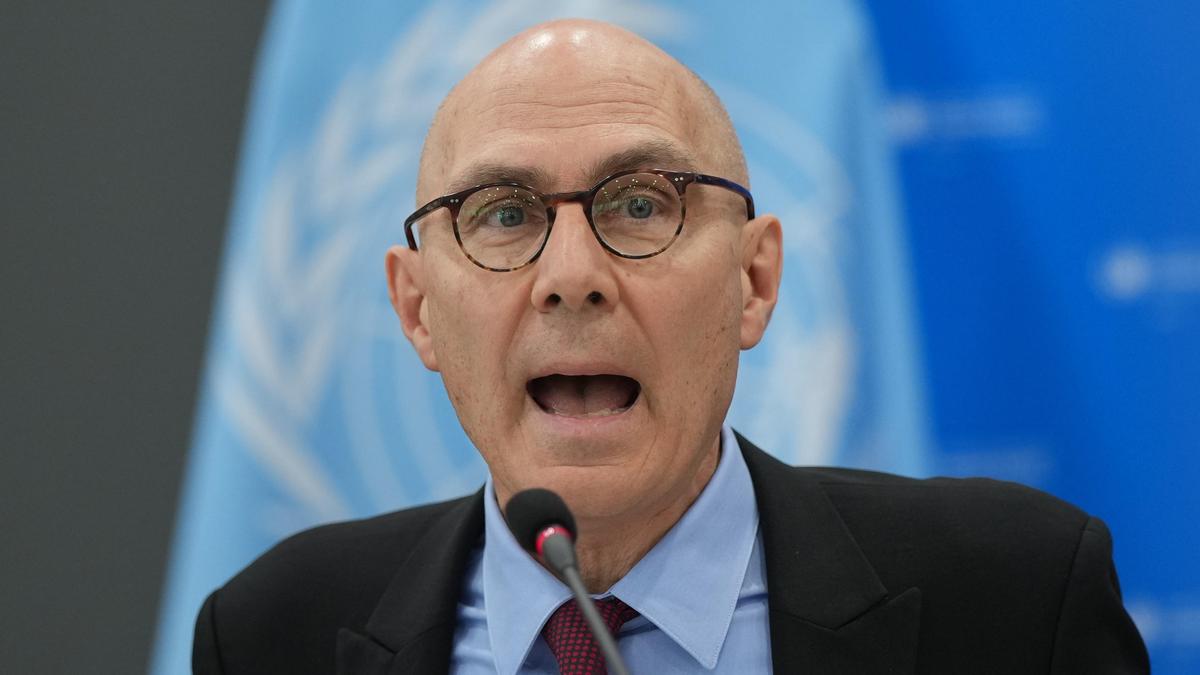
The United Nations Security Council is paralyzed. When the UN condemns a "dangerous escalation" in the Ukraine war, it operates on a faulty assumption. It assumes that public shaming and diplomatic censures still hold currency in Moscow or Washington. They do not. The reality of the current conflict has outpaced the institutional framework designed to contain it. What the international community calls an escalation is actually the predictable friction of a stalemated war where both sides believe time is on their side.
Behind the public hand-wringing at the UN General Assembly lies a harsher truth. The diplomatic tools used to pressure Russia have reached a point of diminishing returns. Western sanctions, once billed as an economic hammer, have instead forced a restructuring of global trade routes. Russia has not been isolated. It has simply pivoted, creating a parallel economic ecosystem that operates entirely outside the influence of Western financial networks.
To understand why the conflict continues to intensify despite global condemnation, we have to look past the rhetoric of diplomatic briefings. We must examine the shifting mechanics of energy markets, drone supply chains, and the fundamental breakdown of the post-Cold War security architecture.
The Fiction of Total Isolation
Sanctions do not stop armies. They reroute capital. When the European Union cut off Russian oil imports, the conventional wisdom suggested the Russian economy would collapse under the weight of its own unexportable surplus. That did not happen.
Instead, a vast, gray-market fleet of aging oil tankers emerged. These vessels, operating under flags of convenience and utilizing complex ship-to-ship transfers in the Mediterranean and the Indian Ocean, have kept Russian crude flowing to buyers in Asia. India and China did not join the Western sanctions regime. They capitalized on it. By purchasing discounted Russian Urals crude, these nations secured cheap energy for their own domestic growth while effectively laundering Russian oil back into the global market.
[Global Crude Oil Realignment]
Russia -> Gray Fleet Tankers -> Middlemen -> Refineries (India/China) -> Global Market
This economic bypass has created a buffer for the Kremlin. The Russian central bank, led by highly competent technocrats, managed the initial shock of asset freezes by enforcing strict capital controls and pivoting to the Chinese yuan as a primary reserve currency. By the time the UN issues a statement of concern regarding frontline advancements, the financial mechanisms funding those advancements have already been insulated from Western intervention.
The weaponization of the SWIFT banking network also produced an unintended consequence. It signaled to non-aligned nations across the Global South that reliance on the US dollar carries existential political risks. As a result, we are witnessing the early stages of a fragmented global financial system. When a state can bypass Western banks to trade in local currencies, the threat of Western financial exile loses its teeth.
The Drone Industrial Base and Fragmented Supply Chains
Wars are won by factories, not speeches. The current escalation on the battlefield is driven by a profound shift in military procurement. The battlefield in Ukraine has become a laboratory for automated attrition, where low-cost commercial components are turned into lethal precision weapons.
Consider the supply chain of a standard reconnaissance or kamikaze drone utilized on the Donbas front. The housing may be 3D-printed locally, but the electric motors, the speed controllers, and the optical sensors are almost entirely civilian-grade electronics manufactured in East Asia. These components are not classified as military hardware. They are found in agricultural drones, hobbyist RC planes, and consumer smartphones.
Preventing these parts from reaching the front lines is logistically impossible. A component manufactured in Shenzhen can be sold to a trading company in Dubai, shipped to a distributor in Kazakhstan, and trucked across the border into Russia without ever triggering an export control alarm. This is the reality of modern defense procurement. It is decentralized, privatized, and deeply embedded in the global consumer electronics supply chain.
Component Sourcing -> Middlemen Hubs -> Final Assembly -> Frontline Deployment
(Shenzhen/Taiwan)     (Dubai/Astana)     (Local Workshops)  (Donbas Front)
Ukraine faces a parallel logistical hurdle. While Western nations supply advanced air defense systems and long-range missiles, the delivery schedules are frequently delayed by political debate and industrial bottlenecks. Western defense contractors are built for low-volume, high-margin production. They are not configured for the relentless, high-volume consumption of an industrial artillery war. The gap between what Ukraine needs to maintain its positions and what Western factories can actualize remains a critical vulnerability.
The Collapse of Strategic Stability Treaties
The escalation of the war is not happening in a vacuum. It is the direct result of a twenty-year decay in the arms control agreements that previously maintained European stability. The guardrails are gone.
The dissolution of the Intermediate-Range Nuclear Forces (INF) Treaty and the suspension of the New START treaty have eliminated the verification mechanisms that once prevented miscalculation. Without inspectors on the ground and mandatory data exchanges, both sides are flying blind. They are forced to assume the worst about their opponent's capabilities and intentions.
The Problem with Asymmetric Escalation
When conventional forces are locked in a grinding war of position, the temptation to escalate via asymmetric means becomes overwhelming. This manifests in several ways:
- Sabotage of critical undersea infrastructure, such as pipelines and fiber-optic data cables.
- High-intensity cyber operations targeting civilian power grids and transport networks.
- GPS jamming and spoofing that disrupts commercial aviation across the Baltic region.
- The deployment of tactical nuclear rhetoric to deter deeper Western integration into the conflict.
These methods are attractive because they offer plausible deniability or stop just short of triggering a direct, conventional military response from NATO. However, this creates a highly volatile environment where a single misinterpretation of a cyberattack or a stray missile could trigger a wider, uncontrollable confrontation.
The Global South Rejects the Eurocentric Narrative
To view the war purely through the lens of a confrontation between Washington and Moscow is to miss the broader geopolitical shift. For much of the Global South, the conflict in Ukraine is seen as a European regional dispute that has been artificially inflated into a global crisis.
When Western diplomats travel to Latin America, Africa, or Southeast Asia to demand compliance with anti-Russian sanctions, they are frequently met with polite indifference or outright resistance. These nations are dealing with their own crises: food insecurity, debt distress, and the economic aftershocks of global inflation. From their perspective, the insistence that they sacrifice their economic self-interest for a war in Europe looks like a double standard.
They point to conflicts in the Middle East, the Horn of Africa, and Central Africa that have raged for years without drawing the same level of financial commitment, media attention, or institutional outrage from the West. This perceived hypocrisy has weakened the moral authority of the Western-led international order. The UN votes condemning the invasion may look decisive on paper, but the abstentions represent a massive chunk of the world's population and economic growth.
The Material Reality of Attrition
Wars of attrition are decided by three things: ammunition production, manpower, and political willpower. Diplomatic resolutions cannot be engineered until the material capacity of one or both combatants is exhausted, or the political cost of continuing becomes unbearable for the leadership.
Right now, neither condition is met. Russia has transitioned its economy to a war footing, dedicating a massive percentage of its GDP to defense spending. This has stimulated domestic manufacturing and insulated the regime from immediate internal unrest, even as it creates long-term structural inflation.
Ukraine, meanwhile, is fighting an existential battle for survival. For Kyiv, any ceasefire that leaves occupied territory in Russian hands is seen as a pause that will allow Moscow to regroup and strike again later. Consequently, the minimum conditions for negotiation held by both sides are completely irreconcilable.
The UN can pass resolutions and issue warnings about dangerous escalations until the archive rooms are full. It changes nothing on the ground. The trajectory of the war will be determined by the raw math of artillery shells produced per month, the recruitment numbers of reinforced brigades, and the resilience of the energy grids under winter bombardment. International law is a luxury of peacetime; in a war of survival, the only law that commands respect is the capacity to endure.