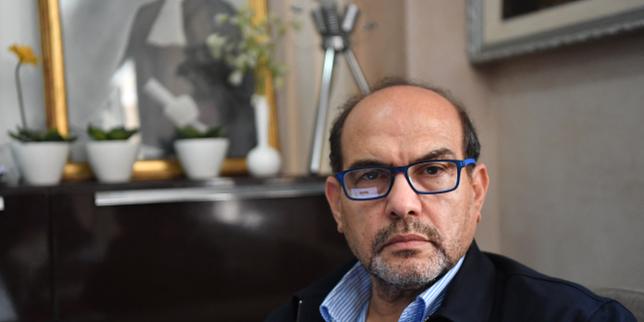
The specialized financial corruption chamber of the Tunis Court of First Instance handed down a crushing ten-year prison sentence to Chawki Tabib, the former head of the country’s independent anti-corruption authority.
Tabib, a prominent lawyer and the former head of the Tunisian Bar Association, was convicted of forging documents and destroying evidence. The judicial system claims it is simply executing the law. To independent observers, civil society leaders, and human rights organizations, however, the verdict represents a calculated political assassination of the country's most vocal institutional watchdogs.
By turning the tools of anti-corruption against the very officials who built them, President Kais Saied has neutralized the independent checks and balances that once made Tunisia the sole democratic success story of the Arab Spring.
The Fakhfakh Affair and the Irony of the Charges
To understand how Tabib ended up facing a decade behind bars, one must trace the timeline back to 2020. At the time, Tabib chaired the National Anti-Corruption Authority (INLUCC). Under his leadership, the body published a report exposing a massive conflict of interest involving the sitting Prime Minister, Elyes Fakhfakh. The report proved that Fakhfakh held shares in companies that had won lucrative government contracts.
Fakhfakh was forced to resign, but not before he used his final days in office to retaliate by sacking Tabib. Tabib denounced the move as an unconstitutional abuse of power.
The irony of the current conviction is staggering. The court has sentenced Tabib to ten years in prison based on allegations that he falsified the very documents used to expose Fakhfakh’s corruption. Rather than protecting whistleblowers or upholding the integrity of the state’s investigative archives, the Tunisian judiciary has ruled that the exposure of high-level government malfeasance was itself a fraudulent act.
The Systemic Dismantling of Checks and Balances
This verdict does not occur in a vacuum. It is the latest phase in an institutional purge that began on July 25, 2021. On that day, President Kais Saied suspended parliament, dismissed the government, and granted himself near-total executive authority.
Shortly after his power grab, Saied sent security forces to shut down the INLUCC offices. The building was sealed, its files confiscated, and its personnel locked out. The closure sent a chilling message to civil society: the state would no longer tolerate independent oversight.
[The Institutional Collapse of Tunisian Democracy]
2011: Jasmine Revolution ──> Creation of Independent Watchdogs (INLUCC, IVD)
2020: INLUCC Exposes Prime Minister Fakhfakh ──> Executive Retaliation
2021: Saied Presidential Power Grab ──> INLUCC Shut Down by Force
2024–2026: Systematic Prosecution of Watchdog Leaders (Tabib & Bensedrine)
The targeting of civil society leaders goes far beyond Tabib. Just weeks prior to his sentencing, authorities escalated legal proceedings against Sihem Bensedrine, the former head of the Truth and Dignity Commission (IVD), an body tasked with investigating human rights abuses committed under the pre-2011 dictatorship.
By prosecuting both Tabib and Bensedrine, the current administration is systematically rewriting the history of the democratic transition. The message is clear. Those who spent the last decade documenting state corruption and historical abuses are now being recast as criminals.
The Weaponization of the Judiciary
The primary vehicle for this crackdown is a heavily modified judicial system. Following his 2021 intervention, Saied dissolved the Supreme Judicial Council, an independent body meant to guarantee the separation of powers. He replaced it with a provisional council appointed directly by the presidency, granting himself the authority to dismiss judges summarily.
Under these conditions, judicial independence has evaporated. Judges who do not comply with the executive's unwritten directives face immediate dismissal, reassignment, or investigation.
Tabib's legal defense team, led by prominent attorney Samir Dilou, has repeatedly signaled that a fair trial is impossible under the current regime. Tabib spent the period leading up to the trial held in Mornaguia prison under a separate warrant issued by the economic and financial judicial pole. That separate case stems from an audit by the Court of Auditors, ensuring that even if Tabib appeals and overturns the forgery conviction, the state retains multiple legal mechanisms to keep him behind bars.
In a letter smuggled from his cell prior to the verdict, Tabib wrote that the proceedings "go beyond my personal case and strike at the very foundations of the legal profession." He warned that when the state turns on the lawyers and the investigators, no citizen can expect protection under the law.
A Bleak Outlook for International Transparency
The domestic implications of Tabib's sentencing are immediate, but the international consequences will take longer to materialize. For years, international donors—including the International Monetary Fund and European partners—conditioned financial assistance packages on Tunisia's ability to demonstrate progress in governance and anti-corruption.
With the INLUCC dissolved and its former leader sentenced to a decade in prison, Tunisia no longer possesses an independent mechanism to track the misuse of public funds. Western diplomats face a difficult paradox. They must decide whether to continue funding a state that has systematically jailed its own watchdogs, or cut off aid and risk pushing an economically fragile Tunisia into total financial collapse.
The international community's response has so far been limited to statements of concern. Organizations like the International Observatory for Lawyers in Danger (OIAD) have signed motions of support, calling the trial politically motivated. Yet, these statements carry little weight in Tunis, where the executive branch increasingly views international human rights standards as foreign interference.
The decade-long experiment that began with the self-immolation of Mohamed Bouazizi in 2010 has reached a dark conclusion. The jailing of Chawki Tabib signals that the transition period is officially over. Tunisia has not merely paused its democratic trajectory; it has constructed a judicial apparatus designed to ensure that the transparency of the post-revolutionary era can never happen again.