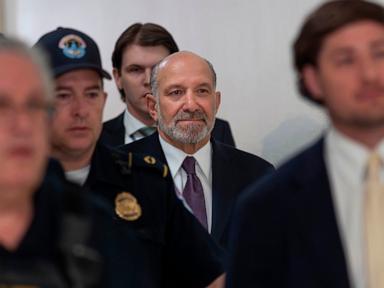
Howard Lutnick, the billionaire chairman of Cantor Fitzgerald and a central figure in the incoming political administration, is currently attempting to perform a delicate act of social and professional surgery. He wants to excise his historical connection to Jeffrey Epstein by labeling their interactions as "meaningless and inconsequential." It is a classic move from the high-finance playbook: minimize, dismiss, and hope the public lacks the stamina to check the receipts. But in the world of ultra-high-net-worth networking, nothing is truly meaningless.
The reality is that Lutnick, like many of his peers in the late 1990s and early 2000s, operated in a circles-within-circles environment where Epstein was a recurring node. By dismissing the relationship as a byproduct of a crowded social calendar, Lutnick isn't just defending his reputation; he’s highlighting the systemic insulation that allows power brokers to rub shoulders with predators while claiming total ignorance of the person standing three feet away.
The Infrastructure of Plausible Deniability
Wall Street thrives on information, yet its leaders often claim a sudden, total lack of it when a social connection turns radioactive. Lutnick’s defense rests on the idea that appearing in Epstein’s black book or attending the same functions was merely a matter of proximity, not partnership. This argument relies on the public’s misunderstanding of how the elite 1% actually functions.
At that level, your network is your net worth. People like Lutnick don't just "bump into" individuals repeatedly by accident. Every seat at a dinner table is curated. Every name in a flight manifest is vetted. The suggestion that these interactions carried no weight ignores the very currency of the industry Lutnick helped build. In the brokerage world, access is the ultimate product. To suggest Epstein was a "nothing" while he was simultaneously being courted by the largest banks in the world requires a suspension of disbelief that most investigators find hard to swallow.
The Flight Logs and the Social Web
The paper trail is often where the "inconsequential" narrative begins to fray. While Lutnick maintains that he was never part of the inner circle, the presence of names in Epstein’s orbit creates a gravity well that is difficult to escape. We have seen this play out with Leslie Wexner, Leon Black, and Bill Gates. In each instance, the initial defense was a variation of Lutnick’s: We met, it was brief, it meant nothing.
However, Epstein’s entire operation was built on the appearance of consequence. He traded in the social capital of men like Lutnick to lure others into his web. When a titan of industry stands in a room with a man like Epstein, they are lending him a portion of their credibility, whether they intend to or not. This is the "halo effect" of Wall Street. By treating these interactions as neutral, Lutnick ignores the utility he provided to Epstein’s social standing.
The Political Stakes of a Clean Slate
Lutnick isn't just a CEO anymore; he is a gatekeeper for a nascent government. This transition from private equity to public policy changes the math on his past associations. In the private sector, a few awkward questions at a board meeting can be managed with a stern memo. In Washington, those same questions become the basis for confirmation hearings and international scrutiny.
The push to categorize Epstein as a distant acquaintance is a preemptive strike against political opponents. If Lutnick can cement the idea that he was a victim of circumstance—just another face in a crowd of Manhattan elites—he can neutralize the "Epstein card" before it is played. But this assumes the public will accept the "it was a different time" defense.
The Problem with the Different Time Defense
The late 90s weren't the Wild West; they were the era of extreme due diligence. If Cantor Fitzgerald was looking to acquire a firm or hire a top-tier trader, they would have known their blood type and their third-grade teacher. The idea that the same level of scrutiny wasn't applied to the people attending private dinners or being invited into personal circles is a convenient fiction.
The financial industry prides itself on being the most informed group of people on the planet. To then claim to be the least informed about the character of their social peers is a glaring contradiction. It suggests that either the due diligence is a myth, or the proximity was more comfortable than is currently being admitted.
Beyond the Transcript
When we look at the transcripts of Lutnick’s recent explanations, we see a masterclass in verbal containment. He uses specific, distancing language. He focuses on the lack of "business dealings," a clever narrowcast that ignores the fact that Epstein’s power wasn't always about direct transactions. It was about the environment of influence.
Investigative history shows us that Epstein functioned as a "super-connector." He didn't need to sign a contract with you to benefit from you. He just needed to be seen with you. Lutnick’s insistence that there were no "dealings" may be factually true in a legal sense, but it is socially irrelevant. The damage in these relationships isn't found in a ledger; it’s found in the normalization of a monster.
The Resilience of the Cantor Brand
It is impossible to discuss Howard Lutnick without acknowledging the tragedy of 9/11 and his role in rebuilding Cantor Fitzgerald. He used that trauma to forge an identity as a survivor and a protector of his employees' families. This earned him a massive amount of moral capital—capital he is now spending to deflect the Epstein association.
There is a palpable tension between the Lutnick who wept on national television while promising to take care of the families of the fallen and the Lutnick who now dismisses his association with a sex trafficker as a minor footnote. For many, the former makes the latter harder to believe. How can a man so attuned to the nuances of human loyalty and corporate responsibility be so oblivious to the nature of the man in his social periphery?
The Selective Memory of the C-Suite
This isn't just a Howard Lutnick problem; it is a corporate governance crisis. We are seeing a pattern where high-level executives are granted a "pass" for their historical associations as long as they remain profitable or politically useful. This selective memory creates a moral hazard. If there are no consequences for rubbing shoulders with the Epstein's of the world, there is no incentive for the next generation of leaders to vet their circles more effectively.
The following factors contribute to this persistent amnesia:
- The Bubble Effect: High-level executives often live in a curated reality where uncomfortable truths are filtered out by assistants and handlers.
- Mutual Protection: If Lutnick is "guilty" by association, then so are dozens of other CEOs, creating a collective incentive to keep the bar for "consequence" as high as possible.
- The Speed of the News Cycle: Leaders know that if they can hold a "no comment" or a "it was meaningless" stance long enough, the public will move on to the next scandal.
Managing the Narrative
Lutnick’s current strategy is a form of brand management. By taking a proactive stance and calling the interactions "meaningless" in a transcript, he is attempting to index that specific phrase in the public consciousness. He wants the search results for "Lutnick Epstein" to be dominated by his dismissal rather than by investigative deep dives.
But the documents—the logs, the calendars, the witness accounts—have a way of resurfacing. In the age of digital archiving, a "meaningless" interaction can be re-contextualized in a heartbeat by a single photograph or a newly discovered memo. The risk for Lutnick is that by being so dismissive, he leaves no room for error. If a single interaction is proven to have been "meaningful," his entire defense collapses.
The Role of the Media
Journalism often fails in these moments by simply reporting the denial without questioning the underlying logic. Reporting that "Lutnick said it was meaningless" is a stenography service, not an investigation. The real work lies in asking why a man of his intellect and resources would find himself in such a position repeatedly, and what that says about the culture of the firms he leads.
The culture of Wall Street has always been one of "see no evil" when the "evil" is wealthy enough. Epstein was a billionaire—or at least played one convincingly. In the eyes of the C-suite, that was often the only vetting required.
The Next Phase of Scrutiny
As Lutnick moves closer to formal political power, the "meaningless" defense will be tested by people who aren't impressed by his net worth. The vetting process for high-level government roles is designed to find the meaning in the inconsequential. Every dinner, every handshake, and every shared flight is a data point in a larger map of character.
If Lutnick wants to lead, he must move beyond dismissal. A truly "hard-hitting" defense wouldn't involve calling the interactions meaningless; it would involve explaining exactly how a system of such immense wealth and power could be so easily infiltrated by a predator, and what he is doing to ensure his current circles are different.
The silence on the "how" is more telling than the denial of the "what."
Wall Street leaders often forget that while they can delete emails and burn ledgers, the social memory of a city is long and unforgiving. Howard Lutnick is betting that his legacy of rebuilding after 9/11 is stronger than the stain of the Epstein era. He might be right. But he should be aware that "meaningless" is a word that rarely applies to the company a man keeps when he thinks no one is watching.
Demand a higher standard of transparency from those stepping into public service. Ensure the vetting process values character as much as it values a balance sheet. Stop accepting "I didn't know" from the people whose entire careers are built on knowing everything.