The morning air in Beijing has a way of tasting like cold metal and ancient dust. It is a city of layers, where the gleaming glass of the Central Business District stares down the gray, low-slung roofs of the old hutongs. But the most impenetrable layer of all isn't made of brick or silicone. It is made of silence.
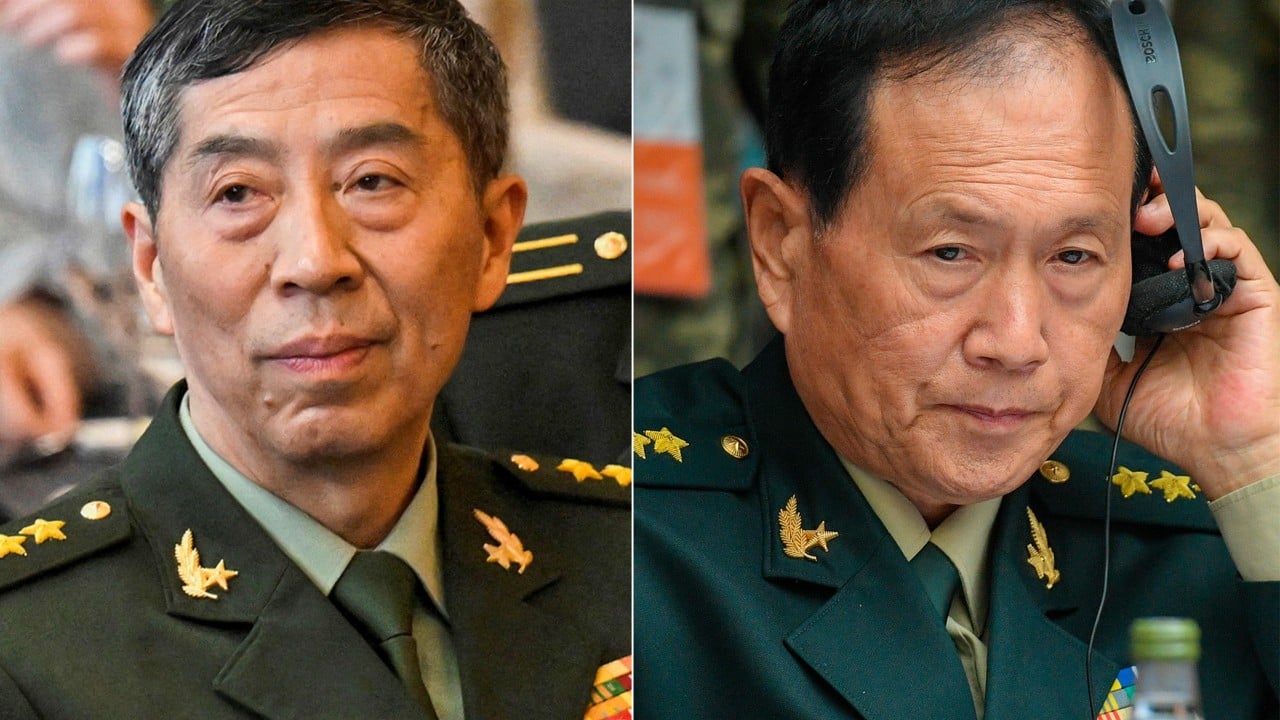
When the state media reports drop, they don't arrive with a bang. They arrive with the clinical precision of a surgeon removing a tumor. Two names, Li Shangfu and Wei Fenghe, were recently excised from the body politic. To the outside world, they were titles: former Ministers of National Defense, generals of the People’s Liberation Army, men of the "Rocket Force." To the inner circles of the Forbidden City, they are something else entirely. They are a message written in the ink of absolute consequence.
The message is simple: The Party does not just demand your service. It demands your soul.
The Weight of the Golden Chair
Imagine a room where the air is so thick with history you can barely breathe. A man sits at a heavy mahogany desk, the weight of the world’s largest military resting on his shoulders. He has spent forty years climbing the ladder, surviving purges, navigating the treacherous waters of provincial politics, and proving his "redness" at every turn. He has seen the rise of skyscrapers where there used to be cabbage patches. He has seen China go from a bicycle economy to a global hegemon.
But as he looks at the gold-embossed folders on his desk, there is a shadow. In a system where loyalty is the only true currency, the temptation of actual currency is a siren song. The defense sector, particularly the high-tech "Rocket Force" responsible for the nation’s nuclear and conventional missiles, is a world of astronomical budgets. When billions of yuan flow into the development of hypersonic gliders and silent submarines, the friction of those transactions leaves a residue.
Corruption is not just a financial crime in this context. It is a structural failure. If a bolt on a missile is made of inferior alloy because a contractor kicked back a percentage to a general, the missile doesn't just miss its target. The entire apparatus of the state begins to rust.
The Vanishing
The disappearance of a high-ranking official in China follows a predictable, haunting choreography. First, there is the missed meeting. A scheduled visit to a foreign capital is "postponed for health reasons." Then, the name is scrubbed from the official websites. The photos where they stood three paces behind the President are cropped or removed.
For Li Shangfu and Wei Fenghe, the end came not in a courtroom with a jury of their peers, but in the sterile language of a Politburo meeting. They were accused of "losing their ideals and beliefs" and "betraying their original aspirations." In the West, we talk about corruption in terms of dollars and cents. In the halls of Beijing, they talk about it in terms of spiritual decay.
The Party views itself as a living organism. When a cell goes rogue, it must be destroyed to save the whole. This isn't just about money; it’s about the terrifying realization that if the men holding the keys to the nuclear arsenal can be bought, the Party’s grip on the future is a fantasy.
The Invisible Stakes of the Rocket Force
Why the Rocket Force? Why now?
The Rocket Force is the crown jewel of China’s military modernization. It is the tip of the spear in any potential conflict over the Taiwan Strait or the South China Sea. To understand the gravity of these purges, one must look at the technical reality of modern warfare. We are no longer in the era of massed infantry charges. We are in the era of the "system of systems."
When a general accepts a bribe, he isn't just buying a villa in the hills. He is compromising the integrity of the kill chain. A compromised procurement officer might approve a satellite sensor that fails in the humidity of the Pacific. A corrupt commander might inflate the readiness numbers of his brigade to please his superiors.
Consider this hypothetical: A carrier strike group moves into position. The order is given to launch a deterrent strike. But the software, developed by a firm that won the contract through "gifts" rather than merit, glitches. The missile stays in the silo. The deterrent is gone. The state is humiliated.
The current leadership knows that the only thing more dangerous than a weak military is a military that thinks it is strong but is actually hollowed out by graft. The purges are a desperate, violent attempt to ensure that the hardware matches the propaganda.
The Culture of the Red Line
There is a psychological toll to living within this system. It creates a culture of "performative loyalty." If you are a rising officer, you don't just do your job; you ensure that your every word reflects the current ideological wind. You study the "Small Red App" on your phone. You attend sessions where you must "self-criticize" and point out the flaws in your own character.
It is a high-stakes game of poker where the pot is your life and the house always wins. The recent downfall of these defense heads suggests that even the most "loyal" servants are being watched through a microscope. It signals that the era of "relaxed" corruption—the 1990s and early 2000s when a little graft was seen as the grease for the wheels of progress—is dead.
The new era is one of austerity and ideological purity. But purity is a difficult thing to maintain in a globalized world. These officials have children who study in London or New York. They see the wealth of the private sector billionaires. They are human, and humans are susceptible to the gravity of greed.
The Mirror of History
History in China is a circle, not a line. The leadership is haunted by the ghost of the Soviet Union. They have analyzed the collapse of the USSR with the intensity of a forensic investigator at a crime scene. Their conclusion? The Soviet Communist Party failed because it lost its discipline. The soldiers stopped believing. The generals started looking for a way out.
By striking down Li and Wei, the Party is attempting to stop the clock. It is telling every mid-level officer and every aspiring bureaucrat: "Your rank will not save you. Your past service will not save you. Only your absolute, unwavering subordination to the center will suffice."
It is a brutal way to run a country, but from the perspective of the Great Hall of the People, it is the only way. To them, the alternative is chaos. The alternative is the "Century of Humiliation" returning.
The Silent Office
In the wake of the purge, there is a vacuum. New names will fill the chairs. They will sit at the same mahogany desks and look at the same gold-embossed folders. They will speak the same slogans with even greater fervor.
But as they look at the empty space where their predecessors once stood, they will feel a chill that no heater in Beijing can touch. They know that the Party’s favor is a flickering candle. One day you are the architect of the nation’s defense, and the next, you are a ghost in the archives.
The silence in the halls of the Rocket Force headquarters is not the silence of peace. It is the silence of a breath being held. Everyone is waiting to see who is next. Everyone is wondering if the alloy in their own life is strong enough to withstand the heat of the next investigation.
The suit is hollow, the chair is cold, and the Party is always watching. It is the ultimate price of power in a system that fears its own shadow more than any foreign enemy.
The most dangerous thing in China isn't the missiles. It's the moment someone decides that their own survival is more important than the Party's. And that is why the purges will never truly end.