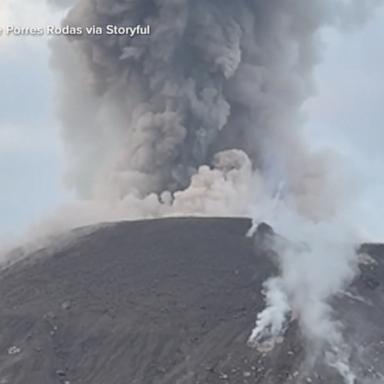
You’ve seen the footage. A group of hikers stands on a ridge, phones out, filming a plume of ash that looks like a slow-motion explosion. Then the wind shifts. The "scenic" smoke turns into a wall of searing gas and rock racing down the slope at 100 miles per hour. Suddenly, the camera shakes, people scream, and the screen goes dark. It’s terrifying. It’s also entirely avoidable if you know how to read the mountain.
When a volcano erupts, you don't have time to think. Most people assume they’ll see the lava coming and just walk the other way. That’s a lethal mistake. Lava is rarely the thing that kills you. It’s the invisible gases, the pyroclastic flows, and the sudden displacement of air that ends lives. If you’re hiking near an active peak, you aren't just on a trail; you’re on a ticking geological clock.
Why Pyroclastic Flows Are Your Biggest Threat
If you’re watching a volcano erupt from the rim, you’re already in the kill zone. The most dangerous phenomenon in these videos isn't the glowing red stuff. It’s the pyroclastic flow. This is a high-density mix of hot lava blocks, pumice, ash, and volcanic gas.
These clouds can reach temperatures of over 1,000°C. They move fast. Fast enough to overtake a car, let alone a hiker in boots. When you see hikers fleeing in those viral clips, they’re often trying to outrun a force of nature that defies logic. These flows follow gravity, hugging valleys and depressions, but they can also surge over ridges if they have enough momentum. If you see a gray cloud hugging the ground and moving toward you, running "away" from the mountain usually isn't enough. You have to move perpendicular to the flow's path.
The Myth of the Safe Distance
Distance is relative on a volcano. Many hikers feel secure because they're two or three miles away from the main vent. On a mountain like Mount Ontake in Japan—which erupted in 2014 without warning—hikers were caught right at the summit. The tragedy killed 63 people. They weren't "reckless" tourists; they were experienced trekkers who happened to be in the wrong place when a phreatic eruption occurred.
A phreatic eruption happens when magma heats groundwater, creating an instant steam explosion. There is no "lava" warning. The mountain just blows its top. This is why checking the local volcanic alert levels is non-negotiable. Organizations like the USGS (United States Geological Survey) or Italy’s INGV provide real-time data. If the alert level is anything above "normal," you stay off the upper slopes. Period.
Volcanic Gases The Silent Killers
Even if the mountain doesn't explode, it can still kill you. Volcanoes "breathe" out carbon dioxide, sulfur dioxide, and hydrogen sulfide. Some of these gases are heavier than air. They collect in low-lying areas, hollows, or caves.
You could be walking through a beautiful valley on the side of a volcano like Mauna Loa and suddenly feel lightheaded. You might not smell anything. Carbon dioxide is odorless and colorless. In high concentrations, it displaces oxygen and knocks you out before you realize there's a problem. I’ve talked to geologists who won't even step into a depression on a volcanic field without a handheld gas monitor. If they won't do it, you shouldn't either.
What to Actually Do When the Ground Shakes
If you’re on the trail and an eruption starts, your brain will scream at you to look at it. Don’t. Every second spent filming is a second you lose for survival.
- Protect your lungs. Ash isn't like campfire ash. It’s pulverized rock and glass. It’s abrasive. Breathing it in will shred your lung tissue and form a literal "cement" when it mixes with the moisture in your throat. Wrap a damp cloth or a buff around your face immediately.
- Seek high ground, but avoid the peak. While you want to avoid valleys where pyroclastic flows and mudslides (lahars) travel, you also need to get off the summit. Lightning is incredibly common in ash plumes due to static electricity.
- Watch for ballistics. Large rocks, called volcanic bombs, can be ejected miles from the vent. If you see rocks falling, don't just run blindly. Look up. It sounds counterintuitive, but you need to see where the "bombs" are landing so you can sidestep them.
The Gear That Actually Matters
Forget the fancy trekking poles for a second. If you’re hiking an active or dormant volcano, your kit needs specific additions.
- N95 Mask: A standard bandana won't filter out the finest volcanic ash. An N95 is the bare minimum for respiratory protection.
- Goggles: Ash will scratch your corneas and make it impossible to see. Sealed goggles (like ski goggles) are life-savers.
- Long Sleeves and Pants: You want to minimize skin exposure to acidic ash and heat.
- Satellite Communicator: Cell towers are often the first things to go down during an eruption or the subsequent earthquakes. A Garmin InReach or similar device can be the only way to signal for a rescue.
Understanding the Lahar Risk
Even after the eruption stops, the danger persists. Lahars are volcanic mudflows that have the consistency of wet concrete. They happen when heat melts snow and ice, or when heavy rain hits fresh ash. These flows can travel dozens of miles down river valleys, picking up boulders and trees along the way. If you’re hiking in a valley downstream from a volcano, and you hear a roar that sounds like a freight train, get to high ground instantly. You won't outrun it in the channel.
Stop Chasing the Shot
Social media has created a "death by selfie" culture near volcanoes. People see a slow-moving lava flow on Kilauea and think they can poke it with a stick for a TikTok. What they don't see are the "laze" (lava haze) clouds formed when lava hits the ocean, sending hydrochloric acid and glass particles into the air. Or the fact that the "solid" ground they’re standing on is actually a thin crust over a molten tube that could collapse at any moment.
Respect the mountain. A volcano isn't a backdrop; it's a living, changing geological system. Before you head out, check the Smithsonian Institution’s Global Volcanism Program website. They track every active volcano on Earth. If the mountain is showing signs of restlessness, pick a different trail. No view is worth a pyroclastic surge.
Check the wind direction. If the wind is blowing the plume toward your trail, cancel the trip. Acid rain and ash fall can turn a moderate hike into a survival situation in minutes. Pack a radio. Listen to local authorities. Most importantly, keep your eyes on the terrain, not your phone screen. Your survival depends on your ability to react to the environment, not your ability to capture it.


