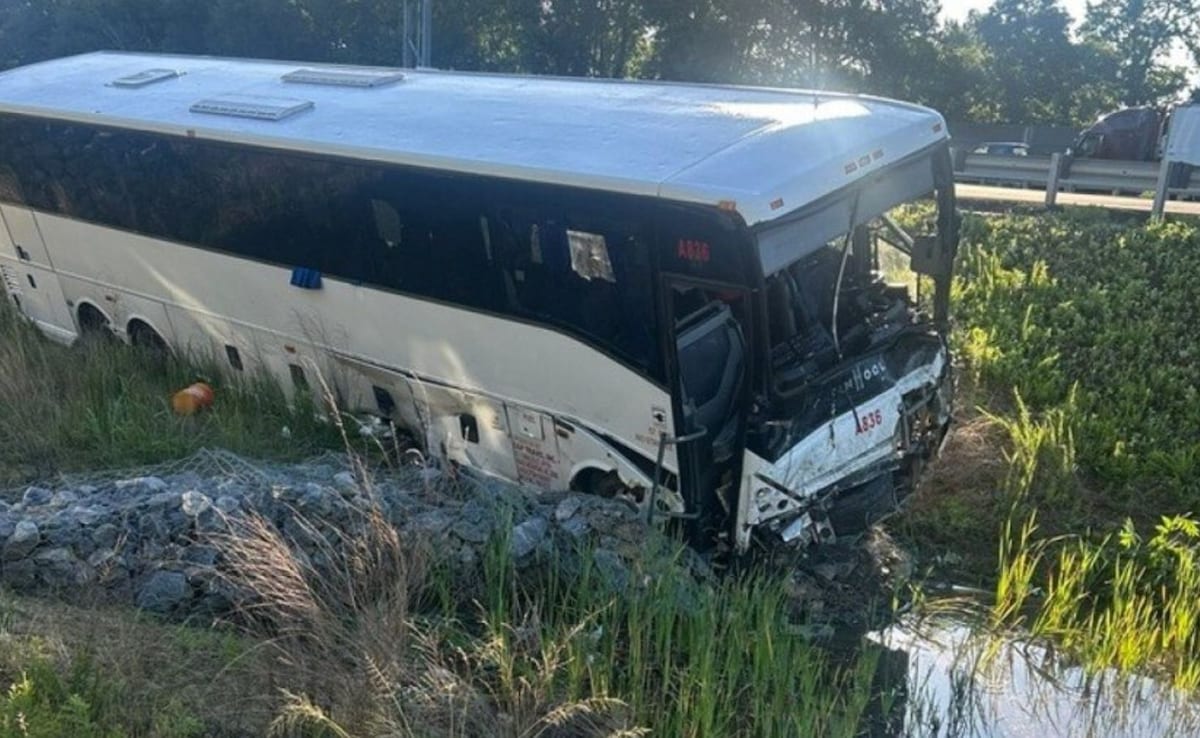
A devastating collision on Interstate 95 in Stafford County, Virginia, highlights a terrifying reality on American highways. Early Friday morning, a passenger bus failed to slow down for an active construction zone, plowing into six vehicles. The impact was catastrophic. Five people lost their lives, and 34 others were rushed to local hospitals, with three fighting for survival in critical condition.
The initial details provided by the Virginia State Police paint a chilling picture. Around 2:35 a.m., southbound traffic near Quantico began slowing to a crawl as vehicles approached an upcoming work zone. The bus, operated by E&P Travel Inc., slammed into the line of cars at highway speed. Four of the fatalities occurred inside a single vehicle that exploded into flames upon impact. The victims from that vehicle were later identified as a family from Greenfield, Massachusetts: Dmitri Doncev, his wife Ecaterina, their 13-year-old daughter Emily, and their 7-year-old son Mark. The fifth victim was a 25-year-old woman from Worcester, Massachusetts, who was traveling in a separate SUV struck during the chain reaction.
State police identified the bus driver as 48-year-old Jing S. Dong of Staten Island, New York. Federal officials noted that Dong obtained his commercial driver's license just two years prior. While criminal charges are currently pending, the National Transportation Safety Board (NTSB) has deployed a specialized "go-team" to launch an exhaustive safety investigation.
This disaster isn't an isolated incident. It’s part of a dangerous, systemic pattern. Highway construction zones are increasingly hazardous, and large commercial passenger buses present unique risks when drivers fail to adapt to changing road conditions.
The Lethal Physics of Commercial Vehicle Crashes
When a multi-ton passenger coach hits a standard passenger car, the basic laws of physics guarantee devastation. A fully loaded motorcoach can weigh up to 50,000 pounds. Compare that to a standard sedan, which averages around 3,500 pounds, or a compact SUV weighing roughly 4,000 pounds.
The stopping distance required for a commercial bus is significantly greater than that of a standard vehicle. At 65 mph, under ideal conditions, a commercial passenger bus requires the length of a football field—roughly 300 feet—to come to a complete stop after the driver steps on the brakes. If a driver is fatigued, distracted, or traveling too fast for overnight construction conditions, that distance multiplies rapidly.
Overnight highway construction presents a specific set of challenges. Between midnight and 4:00 a.m., long-haul drivers face a natural drop in alertness due to circadian rhythms. When you combine reduced visibility, sudden lane shifts, and unexpected bottlenecks with a massive vehicle that cannot stop on a dime, work zones turn into absolute minefields.
A Broken Safety Record in the Motorcoach Industry
Public records show that E&P Travel Inc., the carrier involved in the Virginia crash, maintained a "satisfactory" safety rating from the Federal Motor Carrier Safety Administration (FMCSA). The company, based in Kings Mountain, North Carolina, operated just four vehicles and employed 11 drivers. On paper, they looked compliant.
Yet, this tragedy forces us to look at the historical data regarding interstate passenger bus safety. Federal regulators have wrestled with these exact scenarios for decades. Following a string of horrific motorcoach accidents in 2008 that claimed 41 lives, the U.S. Department of Transportation launched an aggressive Motorcoach Safety Action Plan.
The NTSB previously analyzed data across dozens of fatal motorcoach crashes, looking for root causes. The findings were stark. Driver-related issues—specifically chronic fatigue, undiagnosed medical conditions, and sudden inattention—accounted for 56% of all investigated commercial bus accidents. Worse, those same driver errors were responsible for a staggering 60% of total fatalities.
Despite mandatory electronic logging devices designed to track service hours, driver fatigue remains an open secret in the commercial transport industry. Overnight routes are highly profitable for budget travel companies, but they place immense physical strain on the human beings behind the wheel.
Surviving the Danger Zone
You can't control how a 25-ton bus behaves behind you, but you can alter your driving habits to protect yourself when approaching highway construction. Traffic patterns in work zones change instantly, requiring total focus.
- Ditch the distractions instantly: The second you see orange barrels, signs, or flashing lights, put your phone away. Even hands-free calls drain the mental bandwidth needed to react to sudden braking.
- Create a survival buffer: Don't tail the car ahead of you. If someone rams you from behind, you need space in front of your bumper to absorb the impact instead of getting crushed between two vehicles.
- Monitor your rearview mirror: When traffic slows down abruptly on an interstate, look backward. Watch the headlights behind you. If you see a large commercial truck or bus approaching at a speed that seems too fast, use the shoulder as an emergency escape route.
- Turn on your hazard lights: If you are the last vehicle in a sudden highway backup, activate your hazards immediately. Give the drivers behind you an explicit, flashing warning that the flow of traffic has stopped.
The tragedy on I-95 is a grim reminder that our highway infrastructure requires absolute vigilance. As federal investigators piece together the mechanical and human failures that caused this specific crash, drivers must take defensive action every time they enter a construction zone. Your life depends on it.