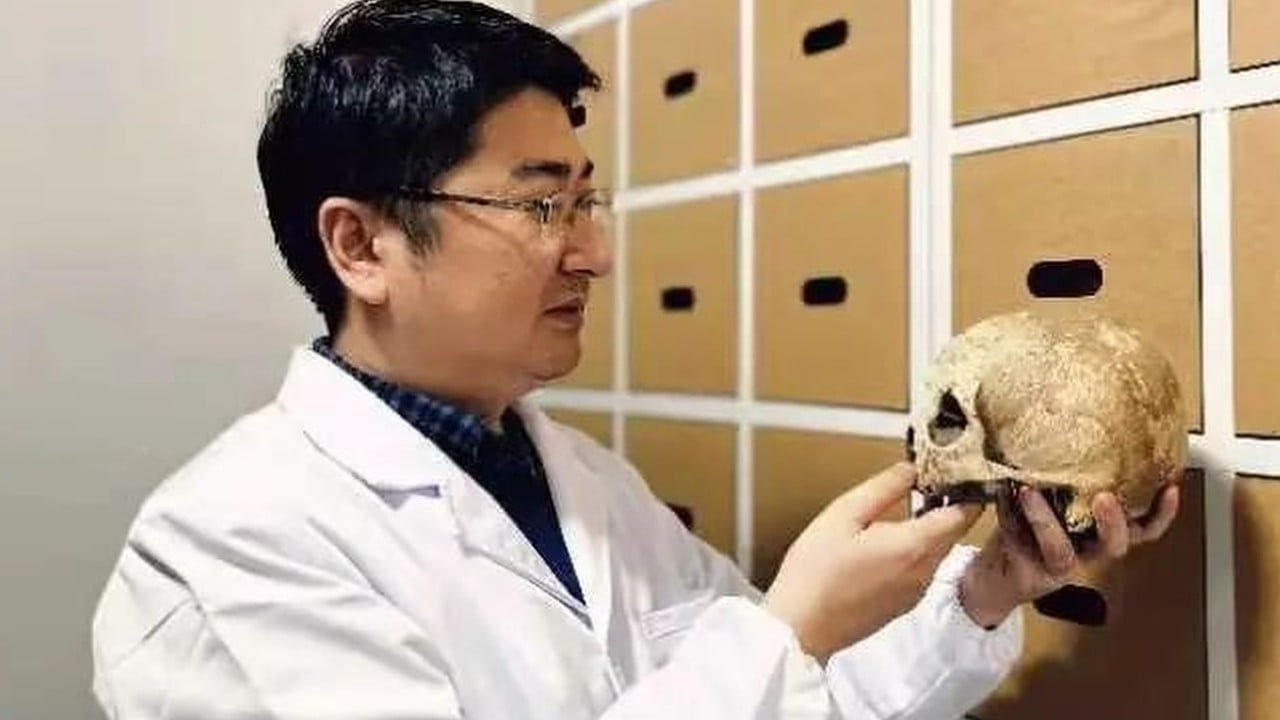
For decades, a rigid textbook narrative dominated the history of human migration. It claimed that vast geographic barriers kept Eastern and Western populations entirely segregated until the formal opening of the Silk Road. New archaeogenomic data from China's heartland completely dismantles this assumption. By sequencing ancient DNA from human remains spanning four millennia along the Hexi Corridor, researchers have uncovered a continuous, violent, and cooperative genetic tug-of-war. The data reveals that Western steppe herders and Eastern millet farmers were mixing in the heart of Asia thousands of years earlier than previously assumed.
This was not a single, peaceful migration event. It was a prolonged 4,000-year battle of genes, technologies, and survival strategies that shaped the modern Eurasian genetic profile. Discover more on a related subject: this related article.
The Crossroads of the Ancient World
The Hexi Corridor is a narrow, 600-mile bottleneck squeezed between the Tibetan Plateau and the Gobi Desert. It serves as the ultimate funnel for human movement. Anyone traveling overland between the Eurasian Steppe and the fertile plains of central China had to pass through this strip of land.
Archaeologists previously relied on pottery styles and bronze artifacts to trace ancient cultural exchanges. These metrics were often deceptive. A community could adopt a Western bronze knife without actually inheriting Western DNA. Archaeogenomics eliminates this guesswork by extracting DNA directly from petrous bones and teeth found in ancient burial sites across Gansu and Qinghai provinces. Additional reporting by The Washington Post delves into related views on the subject.
The genetic timeline reveals a highly dynamic shifting frontier. During the Early Neolithic period, the region was overwhelmingly dominated by individuals carrying genetic signatures closely related to Upper Paleolithic East Asians. These populations relied heavily on hunting and foraging before establishing early agricultural settlements based on millet cultivation.
Around 4,000 years ago, a massive genetic shift occurred. The DNA sequence of burials from this era shows a sudden, heavy influx of Western Eurasian ancestry. This genetic profile matches the Yamnaya and Afanasievo cultures, nomadic pastoralists from the Pontic-Caspian steppe. They brought more than just their genes. They brought a entirely different lifestyle.
Wheat Versus Millet
The clash between these two populations was fundamentally an ecological competition. The Western migrants brought pastoralism, cattle, sheep, and metallurgy. More importantly, they brought wheat and barley.
Millet is a summer crop. It thrives in the monsoonal climate of central China but struggles in colder, arid highland conditions. Wheat and barley are winter crops, originating in the Fertile Crescent. They possess a far greater tolerance for frost and drought.
When the global climate cooled significantly around 4,000 years ago, the agricultural systems of the Hexi Corridor collapsed. The incoming Western pastoralists capitalized on this environmental vulnerability. The genetic data shows that during this period of climatic stress, Western Eurasian ancestry in the region surged to nearly 50 percent in certain communities.
This was a genetic occupation driven by superior climate adaptation. The newcomers did not just trade with the locals; they replaced them or integrated with them on a massive scale. For centuries, the Hexi Corridor existed as a highly diverse genetic melting pot where the ratios of Eastern and Western ancestry fluctuated wildly from one valley to the next.
The Agricultural Counter-Offensive
The Western genetic expansion eventually hit a wall. As the climate stabilized, the massive population density of the agricultural societies in central China began to push back.
During the Shang and Zhou dynasties, organized agricultural states expanded their borders outward. They possessed a weapon that the nomadic pastoralists could not match: sheer numbers. Rice and millet farming supported immense population densities compared to the vast acreage required for livestock herding.
The genetic record tracks this counter-offensive with stark clarity. Over a period of several centuries, the distinct Western genetic signatures in the Hexi Corridor began to dilute. Eastern Eurasian lineages surged back into the data pool, slowly absorbing the steppe-derived populations. By the time the Han Dynasty established its formal military commanderies along the corridor in the second century BCE, the genetic profile of the region had shifted decisively back toward an Eastern majority.
This was a victory of demographic weight over technological mobility. The Western genes did not vanish entirely; instead, they were subsumed into the expanding genetic ocean of the agricultural heartland. Modern populations in northwest China still carry small but measurable percentages of this ancient steppe ancestry, a permanent biological footprint of a forgotten migration.
Sifting Through the Contamination
Extracting reliable data from samples thousands of years old is an immense technical challenge. DNA degrades rapidly when exposed to fluctuating temperatures, moisture, and soil acidity. The hot summers and wet periods of the Hexi Corridor are far from ideal for preservation.
Scientists use next-generation sequencing platforms to map these ancient genomes. The primary obstacle is distinguishing authentic ancient DNA from modern human contamination. Microbes in the soil and the archaeologists who handle the bones leave behind their own genetic traces.
To solve this, researchers look for specific patterns of chemical damage. Over millennia, the cytosine bases at the ends of ancient DNA strands naturally degrade into uracil through a process called deamination. Modern DNA contamination does not show this specific pattern of decay. By programming algorithms to isolate only the fragments showing these characteristic end-site mutations, geneticists can separate ancient data from modern noise with absolute precision.
The Limits of Biological Data
While archaeogenomics provides irrefutable evidence of population movement, it cannot explain human intent or social structures. A sudden shift in genetic ancestry can indicate a violent invasion and replacement. Alternatively, it can represent a gradual, peaceful integration driven by intermarriage and trade.
To understand the social dynamics of this 4,000-year battle, researchers must pair genetic data with isotopic analysis of bones. By analyzing strontium and oxygen isotopes fixed in the enamel of ancient teeth, scientists can determine where an individual spent their childhood. Strontium profiles reflect the local geology of the food and water consumed during bone development.
If a burial site contains individuals with 50 percent Western ancestry, isotope analysis can reveal if those individuals were first-generation immigrants who walked across the steppe, or if they were the descendants of families who had lived in the corridor for generations. Current isotopic data suggests a mix of both scenarios. The Hexi Corridor was not a constant war zone, but rather a porous borderland where communities adapted to survival by blending both cultural practices and lineages.
The 4,000-year genetic struggle in China's heartland proves that globalization is not a modern phenomenon. Long before traders carried silk and spices across Eurasia, human populations were already clashing, interbreeding, and altering the genetic landscape of the continent in response to a changing climate. The bloodlines of modern Eurasia were forged in the environmental crises of the ancient world.

/https://tf-cmsv2-smithsonianmag-media.s3.amazonaws.com/filer/c6/97/c697b065-e0bd-4970-81ea-819779296b91/u765404inp.jpg)
