The air in Miami does not circulate in July. It clings. Inside the stadium, seventy thousand people are breathing the same heavy, humid oxygen, their shirts stuck to their backs, their voices reduced to a collective, anxious hum.
On the pitch, twenty-two men are running on fumes.
To the casual observer, a football match is ninety minutes of tactical positioning, athletic endurance, and occasional bursts of brilliance. But to anyone who has ever stood on those terraces—or watched from a cracked plastic chair in a Buenos Aires cafe with a cold sweat pooling on their collarbone—it is a study in psychological decay. Under intense pressure, human beings break. Their hamstrings tighten. Their decision-making slows by fractions of a second. They begin to look at the clock, begging for the whistle.
Except for one man.
While everyone else decays, Lionel Messi seems to exist in a different relationship with time. He does not run to the whistle; he waits for the moment the rest of the world tires of running.
The Illusion of the Finished Story
Everyone loves a script. We want our heroes to dominate from the opening whistle, to paint their masterpieces with bold, sweeping strokes from minute one to ninety. When Argentina fell behind early, a palpable, familiar dread settled over the crowd. The opposing defense had spent seventy-eight minutes executing a flawless blueprint: low block, physical disruption, double-coverage on the wings. It was a suffocating display of modern athletic geometry.
For most of the match, Messi was a ghost.
He walked. He adjusted his captain's armband. He stared at the grass. To the uninitiated, this walk is a sign of defeat, a concession to age and the relentless humidity. The commentators began to whisper about the end of an era, casting glances at the young substitutes warming up on the touchline. They wrote the obituary in real-time.
But the walk is not laziness. It is mapping.
Imagine a chess player who spends the first thirty moves simply watching how his opponent breathes when they move their knight. Messi is measuring the distance between the center-back and the fullback. He is calculating how many steps it takes for the defensive midfielder to recover when the ball transitions. He is waiting for the precise moment when physical exhaustion forces a five-inch gap in a defensive line that has spent the night looking like a brick wall.
The shift is invisible until it is catastrophic.
With twelve minutes left on the stadium clock, the air changed. The opposition’s right-back, outstanding all evening, took a fraction of a second too long to recover his position after an overlapping run. It was a mistake born of sheer, lung-burning fatigue.
One step. That was the crack in the dam.
The Anatomy of the Turn
What followed was not a display of raw power. It was a masterclass in kinetic economy.
When the ball found Messi’s feet thirty yards out, the stadium held its breath. The double-team arrived, but it was late—exhausted legs trying to cover ground that their minds knew they couldn't reach in time.
Consider the mechanics of the equalizer. He did not attempt a theatrical dribble. Instead, he used a body feint so subtle it barely registered on the television broadcast—a slight drop of the left shoulder that convinced the defender he was cutting inside. The defender committed his weight to his heels.
In the laws of physics on a slick pitch, once your weight is on your heels, you are dead.
Messi slipped the ball through the opening, a pass weighted with such ridiculous precision that the oncoming striker did not even have to break his stride to smash it into the far corner. The stadium exploded. The noise was not just celebration; it was relief. The release of a collective breath held for nearly eighty minutes.
But the equalizer was only the prelude.
The Heavy Weight of Expectation
There is a unique cruelty to being the greatest of all time. When you win, it is treated as the default setting of the universe. When you are held to a draw, it is viewed as a systemic failure.
As the match bled into stoppage time, the pressure did not dissipate; it concentrated. Argentina’s younger players, desperate to secure the three points, began rushing their passes, forcing the play through congested lanes. The rhythm was frantic, ugly, and desperate.
In these moments, the temptation is to do too much. To try the impossible shot. To force the hero narrative.
Instead, Messi slowed the game down.
In the ninety-second minute, with the ball bouncing chaotically near the edge of the eighteen-yard box, he did not snatch at it. He touched it once to settle it, twice to invite the pressure, and then, with three defenders closing in like a collapsing vice, he chipped a delicate, impossibly soft ball over the backline.
It was a pass that defied the urgency of the moment. It belonged in a training session, or a backyard game, not in the dying seconds of an international match with millions watching.
It fell perfectly into the path of the late-running midfielder. A touch, a strike, the back of the net.
Two-one.
The comeback was complete, not through a burst of youthful adrenaline, but through the deliberate, cold-blooded application of football intelligence.
What We See When We Watch Greatness
We live in an era obsessed with metrics. We track expected goals, distance covered, sprint speeds, and heat maps. We try to reduce the beautiful, chaotic reality of sport into spreadsheet data that can be digested by algorithms.
But you cannot measure gravity.
You cannot quantify the sheer panic that ripples through a defensive line the moment a specific number ten shirt turns toward goal. You cannot put a statistic on the way an entire stadium stops breathing because they know they might be about to see something they will tell their grandchildren about.
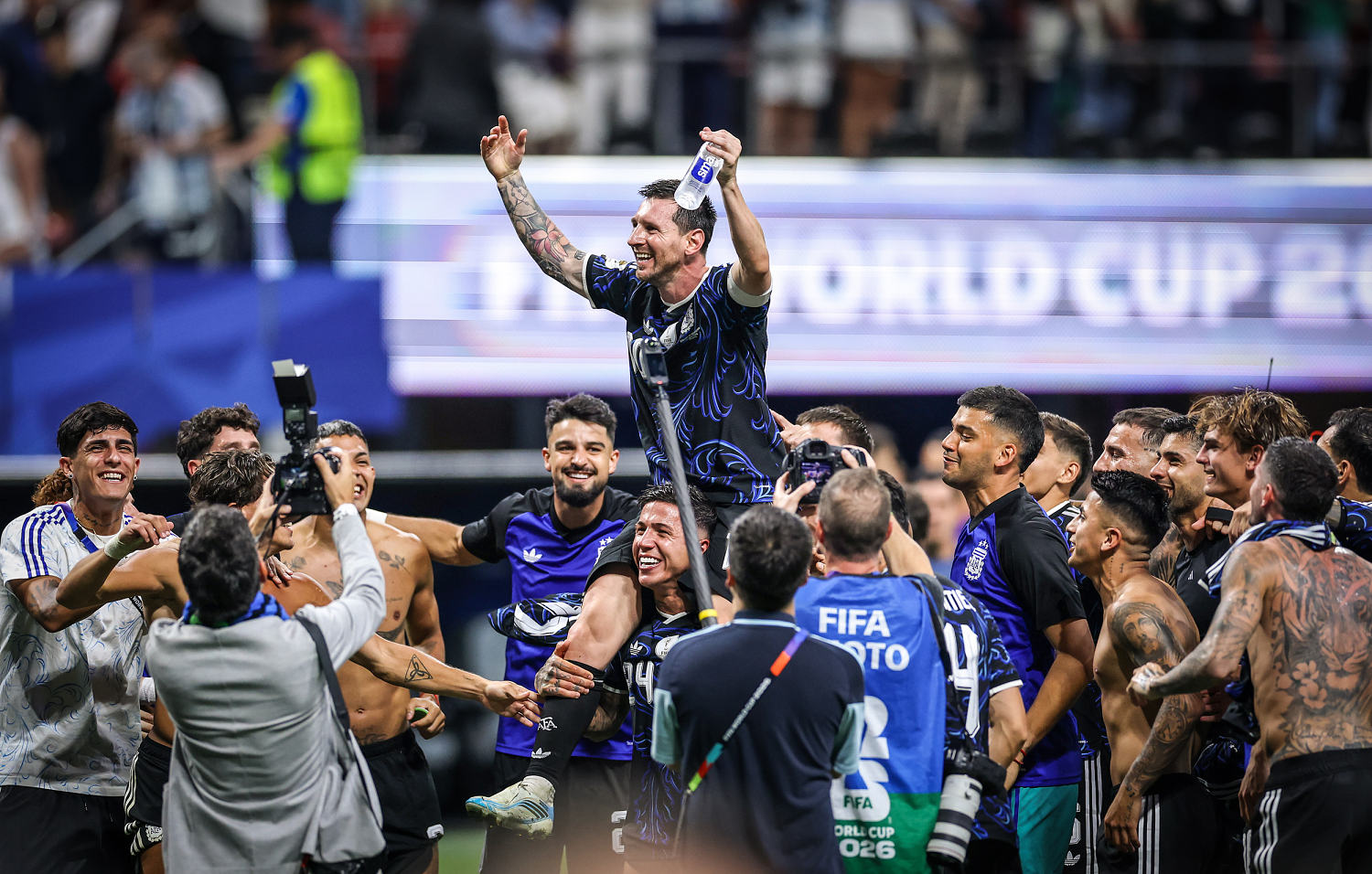
When the final whistle blew, Messi did not celebrate wildly. He did not run to the cameras or rip off his shirt. He simply stood near the center circle, hands on his hips, breathing heavily, looking like a man who had just finished a difficult day at the office.
The young players around him fell to the grass, spent, emptied of everything they had to give. He walked over, offered a hand to lift them up, and smiled.
It was just another Wednesday night in the office. But for everyone else in the stadium, it was a reminder that while youth is fleeting and tactics are temporary, genius simply waits for its cue.