From a hundred yards away, the sound is exactly what you expect from a pitch in Santa Cruz, Bolivia, during July. It is the rhythmic, reassuring thud of a leather ball striking a synthetic boot. It is the sharp, sudden burst of a coach's whistle slicing through the humid lowland air. If you close your eyes, you can almost track the flight of the ball by the rising pitch of the voices calling for a cross.
Then you open them. Read more on a connected issue: this related article.
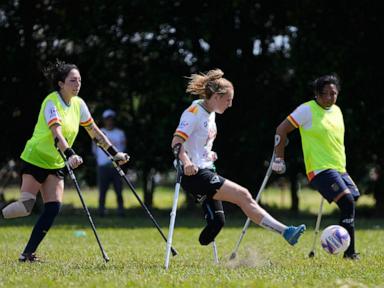
The mechanics of the motion are entirely wrong, yet entirely breathtaking. A winger breaks down the left flank. She does not run; she propels. Her arms grip two metal aluminum crutches, planting them into the grass with a fierce, violent cadence that drives her torso forward. Her right leg is missing above the knee. Her left leg sweeps forward in a blur, catching the ball on the half-volley and sending it screaming toward the upper corner of the net.
In the goal, a woman dives. She reaches out with her only arm, her left sleeve pinned neatly to her jersey. The ball glances off her fingertips and ricochets off the post. She hits the turf hard, rolls, and is back up on her feet before the defender can even turn around. Further journalism by CBS Sports highlights similar views on the subject.
This is the first South American training camp for female amputees, a five-day gauntlet that recently concluded at the Ramón Aguilera Academy. Nearly three dozen women from ten countries—including Argentina, Brazil, Ecuador, Colombia, and Bolivia—converged here under a sun that felt heavy enough to bruise. They are building something that did not exist in any meaningful way a few years ago. They are training for the 2027 Women’s Amputee Football World Cup in Poland.
But to talk only about the tournament is to miss the point entirely. The real gravity of what is happening on this eastern Bolivian pitch has very little to do with trophies and everything to do with the heavy, silent weight of what these women leave behind at the touchline.
Consider the rules of seven-a-side amputee soccer. They are deceptively simple, designed to isolate the raw athleticism of the players. Outfielders must have a lower-limb amputation, and goalkeepers must have an upper-limb difference. No prosthetics are allowed on the field. None. Every high-tech, carbon-fiber limb that helps these women navigate the uneven sidewalks of their hometowns must be unstrapped and laid on the bench.
The crutches they use to run cannot touch the ball. If a piece of metal accidentally deflects a pass, it is penalized as a handball.
To watch an athlete play under these constraints is to watch a masterclass in physics and human stubbornness. Imagine hopping on one leg for fifty minutes. Now imagine doing it while sprinting, turning on a dime, tracking an aerial ball, and absorbing a shoulder-to-shoulder challenge from a defender who weighs 140 pounds. The physical toll is immense. The triceps burn. The palms blister and tear against the rubber grips of the crutches. The single quad muscle hypertrophies until it looks like twisted steel.
But the mental shift is even more radical. For most of these women, a crutch has always been a symbol of what was lost. It was the device that marked them as different in the markets of Bogotá or the streets of São Paulo.
On this pitch, however, the crutch ceases to be a medical necessity. It becomes an extension of the skeleton. It becomes a weapon.
To understand the stakes, you have to look at a face like Filomena Luna’s. She is 50 years old, a mother of six from Bolivia. Her skin is lined by the high-altitude sun, her eyes quiet and watchful. When she was 11, she scratched her leg. It was a minor thing, the kind of injury a child forgets by dinner. But the scratch turned into an infection. Her parents, terrified of the cost and the bureaucracy of the city hospitals, took her to a traditional healer. By the time she finally saw a medical doctor, the bone was ruined. The leg had to come off.
For nearly forty years, Luna lived in the margins of a society that rarely knows what to do with a disabled woman. In much of South America, a physical disability can feel like a life sentence of quiet isolation. You are looked at with pity, or worse, you are simply not looked at at all.
"Soccer is an escape for me," Luna says, her voice dropping into a register that forces you to lean closer to hear. "This practicing and training has helped me improve tremendously. I never imagined I could play."
The word escape gets thrown around a lot in sports writing. It is usually used as a metaphor for wealthy men running away from the pressures of a contract negotiation. For Luna, the escape is literal. It is an escape from the domestic routine, from the glances of strangers, from the internal voice that spent four decades telling her what she could not do.
The timing of this camp is not accidental. The world has spent the last month completely captivated by the final matches of the 2026 FIFA World Cup, with millions of eyes glued to the screens in bars from Buenos Aires to New York. The money, the glare, the immaculate grass of those mega-stadiums feel like they belong to a different planet.
Men’s amputee soccer has been around since the 1980s, often finding its roots in nations torn apart by conflict, like Angola or El Salvador. But the women’s game is a newborn. The very first Women's Amputee Football World Cup was held just two years ago, in 2024, in Barranquilla, Colombia. The hosts won that inaugural title in a dramatic penalty shootout against the United States, playing in front of a crowd that finally saw them not as inspiring stories, but as ruthless competitors.
Now, the infrastructure is scrambling to catch up with the talent. Elite players, like 21-year-old Amie Donathan of the U.S. National Team, flew into Bolivia to help coach the camp, working alongside organizations like the World Amputee Football Federation. They started from absolute zero: teaching women how to fall without breaking a wrist, how to balance their weight when swinging through for a strike, how to communicate when every breath is needed just to stay upright.
Consider what happens next for a woman who leaves this camp. She goes back to a town where there may not be another female amputee for hundreds of miles. She goes back to training alone on concrete pitches, or on patches of dirt behind her house, hoping her single shoe doesn't wear out too quickly because buying a pair means paying for a left shoe she will never use.
Yet, the momentum is shifting. Regions like Santa Cruz are actively working to build formal national federations, recognizing that the hunger for this sport is far deeper than anyone anticipated. Out of 50 amputee women contacted in Bolivia for this camp, nearly half showed up, defying the logistics of travel and the skepticism of their families.
On the final afternoon of the camp, the coaches arranged a series of friendly matches. The play was messy, chaotic, and beautiful. There were no stadium seats, no roaring crowds, just the sound of metal clicking against metal and the occasional dull thud of a body hitting the turf.
During the second half, an Argentine forward misjudged a pass. She caught her crutch in a divot and went down hard, her single leg twisting awkwardly underneath her. For a moment, the pitch went completely silent. The coaches took a step forward.
She didn't wait for a hand. She didn't look for sympathy. She used her crutches to bracket her torso, pushed her hips skyward with a practiced, fluid motion, and swung herself back into a standing position. She wiped the Bolivian dust from her shorts, spat onto the grass, and yelled at her midfielder to put the next ball over the top.
The match resumed, the metal legs of the crutches flashing in the late afternoon light like blades.