The coffee in the Salon d’Honneur is always perfect, but it rarely tastes like peace. On a Tuesday in Paris, the air inside the Élysée Palace didn't just carry the scent of roasted beans and expensive floor wax; it carried the weight of a continent that has grown tired of being a junior partner.
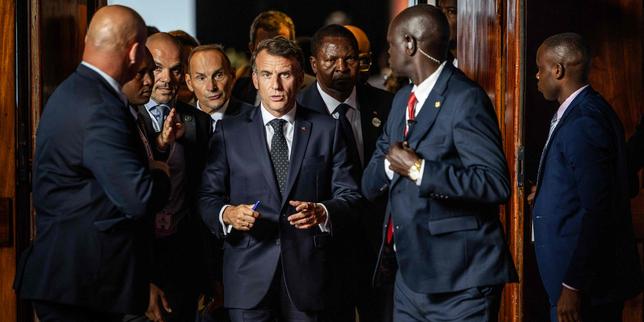
Emmanuel Macron stood before a room of African entrepreneurs, tech disruptors, and titans of industry for the Africa Forward summit. He wasn't just giving a speech. He was performing a delicate surgical operation on a relationship that has been scarred by decades of suspicion, colonial ghosts, and a new, aggressive competition from the East.
Consider a young developer in Nairobi or a logistics mastermind in Dakar. To them, the French President is often a figure from a history book that hasn't quite been closed. They don't want "aid." They don't want a lecture on democratic values delivered from a podium of gold leaf. They want capital. They want markets. They want the kind of respect that shows up in a bank account, not a press release.
Macron knows this. He has to.
The Ghost at the Banquet
For years, the French approach to Africa was defined by Françafrique—a murky web of political influence and military interventions. That era is dying, but the carcass is heavy. As French troops withdraw from the Sahel and Russian mercenaries or Chinese infrastructure projects fill the void, Paris finds itself in a race against irrelevance.
The Africa Forward summit is the pivot. It’s an admission that the old tools of diplomacy—the handshake between aging presidents—are useless in a world where 60% of Africa’s population is under the age of 25.
Macron’s "operation seduction" is targeted at the boardrooms, not the bunkers. By inviting the private sector into the heart of French power, he is trying to rewrite the script. He isn't talking to the generals; he is talking to the creators of the next unicorn startup. He is betting that if he can tie the French economy to the explosive growth of African innovation, the political resentment will eventually lose its edge.
But resentment is a stubborn tenant.
A Language of Numbers
Hypothetically, imagine a woman named Amara. She runs a fintech firm in Lagos. She has been invited to the Élysée. She walks through the corridors of power, noticing the way the sunlight hits the tapestries. She is polite, but she is calculating. She knows that while France offers a gateway to Europe, the terms have historically been lopsided.
When Macron speaks of "partnership," Amara is looking for the fine print.
The summit focused on three specific pillars: infrastructure, digital sovereignty, and the energy transition. These aren't just buzzwords. They are the battlegrounds. If France can provide the high-end engineering and the venture capital that Africa needs to bypass traditional industrial hurdles, it stays in the game. If it fails, it becomes just another European museum, beautiful to visit but unnecessary for business.
The numbers provide the heartbeat of this struggle. Africa needs roughly $100 billion a year in infrastructure investment just to keep pace with its own growth. France cannot write that check alone. No one can. Instead, Macron is trying to position France as the "honest broker"—the one who organizes the capital, sets the standards, and provides the expertise without the predatory debt traps often associated with other global powers.
It is a high-stakes gamble. It requires the French public to accept that their future is tied to a continent they have often looked down upon, and it requires African leaders to believe that the leopard has truly changed its spots.
The Invisible Stakes
Silence fell over the room when the talk turned to visas and mobility. This is where the human element grinds against the gears of policy. You cannot ask an entrepreneur to partner with your tech ecosystem if they have to wait six months for a visa that might be denied by a faceless bureaucrat in Nantes.
Macron’s rhetoric often hits a wall here. He talks of a "shared destiny," but the physical borders remain rigid. During the summit, the tension was palpable. African business leaders were vocal: trade is a two-way street. If French companies want access to the surging markets of Nigeria, Ethiopia, and South Africa, then African talent must have a seat at the table in Paris, Lyon, and Marseille.
The "Choose Africa" initiative, which has already mobilized billions of euros in support for small and medium enterprises, is the carrot. But the stick is the memory of what happened before. Every time a French official speaks of "helping" Africa, a collective wince ripples through the younger generation of the continent. They don't need help. They need a level playing field.
The New Map
The world is no longer binary. The Cold War is over, but a new, fragmented competition has taken its place. In this landscape, soft power is the only power that lasts.
Macron is attempting to use the French language and a shared Mediterranean history as a bridge rather than a barrier. He is leaning into the idea of "sport-power" and cultural industries, recognizing that the battle for influence is won in the minds of creators as much as in the ledgers of oil companies.
By hosting the summit at the Élysée, he turned the palace into a showroom. He showed that France is willing to open its most sacred doors to the "new Africa." But as the guests filed out past the Republican Guard, the question remained: was this a genuine shift in the tectonic plates of history, or just a very expensive bit of theater?
The answer won't be found in the closing statements. It will be found in the venture capital flows of the next five years. It will be found in whether Amara from Lagos decides to list her company on the Euronext or seeks a warmer welcome in Dubai or Beijing.
France is no longer the landlord of the continent. It is just another suitor at a very crowded party, clutching a bouquet and hoping that its old mistakes can be forgiven in exchange for a new kind of prosperity.
The sun set over the Seine, casting long, sharp shadows against the limestone walls of the palace. Inside, the lights stayed on late. There was still so much to prove, and the clock of the world was ticking faster than the diplomats could keep up with. Respect is not something you can grant via decree; it is something you earn, day by day, deal by deal, in the cold light of a changing world.