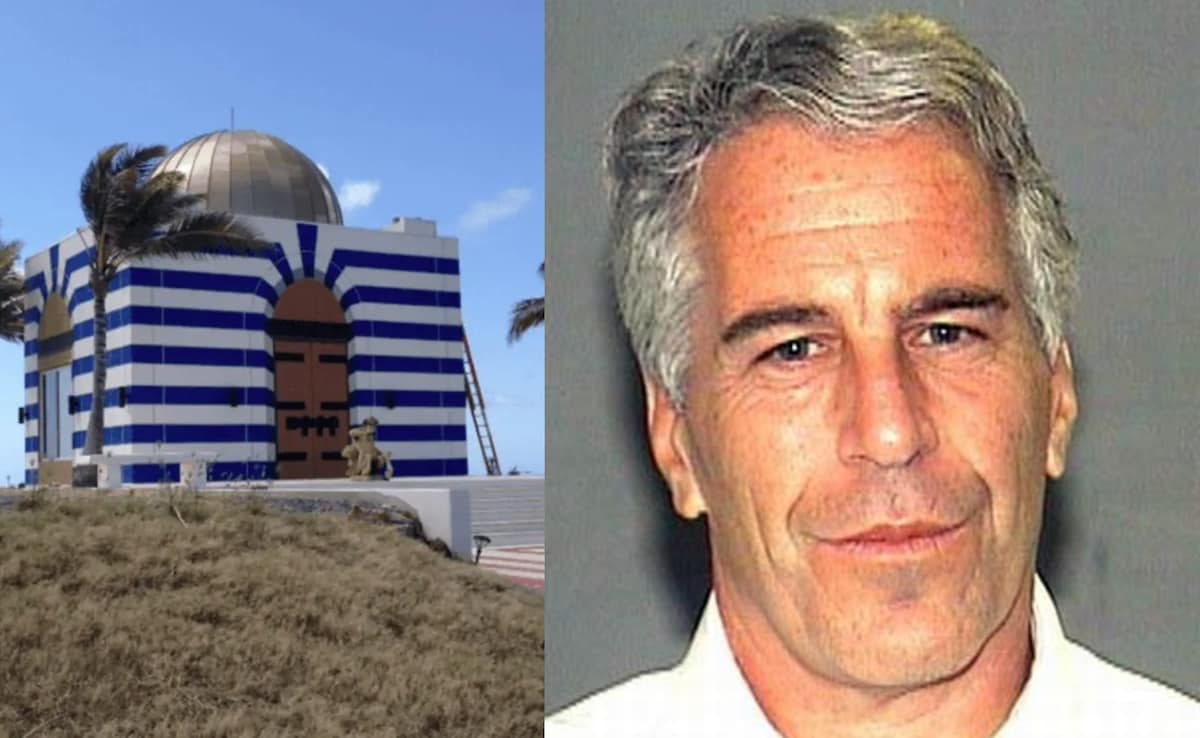
The sun over Little St. James did not care for the laws of men or the sanctity of the divine. It beat down on the Caribbean turquoise with a blind, white intensity, illuminating a sprawling temple that seemed to rise out of the rock like a fever dream. To a casual observer flying overhead, the blue-domed structure was an architectural curiosity, a whisper of the Middle East transplanted into the heart of the Virgin Islands. But to those who understood the weight of history, the building wasn't just an eyesore. It was a heist.
Jeffrey Epstein did not build a mosque for prayer. He built a monument to the idea that everything—even the untouchable—has a price tag.
The recent unearthing of details regarding the "mosque" on Epstein’s private island reveals a story that goes far deeper than the eccentricities of a billionaire. It is a narrative about the systematic stripping of cultural identity. Reports indicate that the site was adorned with artifacts sourced from the holiest sites in Islam, including items linked to Mecca and Medina. This wasn't a collection. It was a desecration.
Imagine a craftsman in a small workshop near the Great Mosque of Mecca. He spends months, perhaps years, perfecting a piece of intricate calligraphy or a marble fixture meant to be seen by millions of pilgrims. His work is an act of devotion, a physical manifestation of a faith that spans centuries and continents. He believes his creation will sit in the presence of the divine. Instead, it ends up as a backdrop for the predatory whims of a man who viewed the world as a buffet of experiences to be consumed and discarded.
The Architecture of Deception
The structure itself was a masterclass in visual manipulation. While it featured a blue dome and gold accents reminiscent of the Dome of the Rock in Jerusalem, it was stripped of any actual religious function. It lacked a mihrab—the niche that indicates the direction of Mecca. It was a hollow shell. A stage set.
Epstein’s obsession with "collecting" extended beyond people. He treated the artifacts of the Islamic world as trophies of his own reach. There is a specific kind of arrogance required to take an object meant for communal worship and place it in a private sanctuary of vice. It is the ultimate expression of power: the ability to turn the sacred into the ornamental.
But how does a man like Epstein acquire such things? The world of high-end antiquities is often a labyrinth of "gray markets" and middlemen who don't ask questions as long as the wires clear. For decades, the movement of cultural heritage from the Global South to the private vaults of the West has been a quiet, persistent bleeding. In this case, the wound was inflicted on the very heart of the Islamic world.
Consider the journey of a single stone. It begins in a sacred quarry, is shaped by hands that tremble with reverence, and is placed in a site where billions of people find their spiritual center. Then, through a series of handshakes in dimly lit galleries or encrypted emails, it is crated, shipped, and bolted onto a wall in the Caribbean. It loses its voice. It becomes a silent witness to things it was never meant to see.
The Invisible Stakes
We often talk about the "cost" of Epstein’s crimes in terms of the lives he shattered. That is the primary, undeniable tragedy. But there is a secondary cost that we are only beginning to calculate—the erosion of the idea that anything is off-limits.
When a person can buy pieces of the holiest sites on Earth to decorate a private island known for systematic abuse, the message is clear: nothing is permanent. Nothing is protected. The past is just raw material for the present. This is not just a "news story" about a bad man doing bad things. It is a mirror held up to a global system that allows the ultra-wealthy to bypass the boundaries of culture, religion, and law.
The presence of these artifacts on Little St. James suggests a level of logistical sophistication that should terrify us. It implies a network of enablers who knew exactly where these pieces were going and what they represented. They weren't just selling stone and metal; they were selling the dignity of a faith.
A Void in the Blue Dome
The tragedy of the "Epstein Mosque" is that it was never a mosque at all. It was a tomb for the objects it housed.
In the Islamic tradition, an object from a holy site carries baraka—a sense of blessing or divine grace. To remove it is to sever its connection to that grace. On that island, surrounded by the Caribbean heat, those artifacts were stripped of their meaning. They became cold. They became mere "assets."
There is a profound irony in the fact that the dome was blue. In many cultures, blue is a color used to ward off the "evil eye" or to represent the infinite nature of the sky. Here, it served as a lid, sealing in the secrets of a man who believed he could outrun his own shadow.
But secrets have a way of surfacing. Like the artifacts themselves, the truth has a weight that cannot be ignored forever. The discovery of these items isn't just a footnote in a criminal investigation; it is a call to look closer at the ways in which our world treats the sacred as a commodity.
We are left with the image of a silent, blue-domed building standing on a ridge, overlooking a sea that has seen centuries of plunder. The artifacts are still there, or perhaps they have been moved to an evidence locker, or hidden away once more by those who fear their exposure. But they no longer belong to the man who bought them. They belong to a history that he tried to rewrite and failed.
The sun continues to rise over the Caribbean, but it no longer shines on a private kingdom. It shines on the wreckage of an ego that thought it could own the holy. The artifacts, once stolen, are now a testimony. They are the only things on that island that were ever truly clean.
The gold on the dome is peeling now, flaking away in the salt air. Underneath the gilding, there is only hollow concrete and the memory of a theft that went far deeper than money.