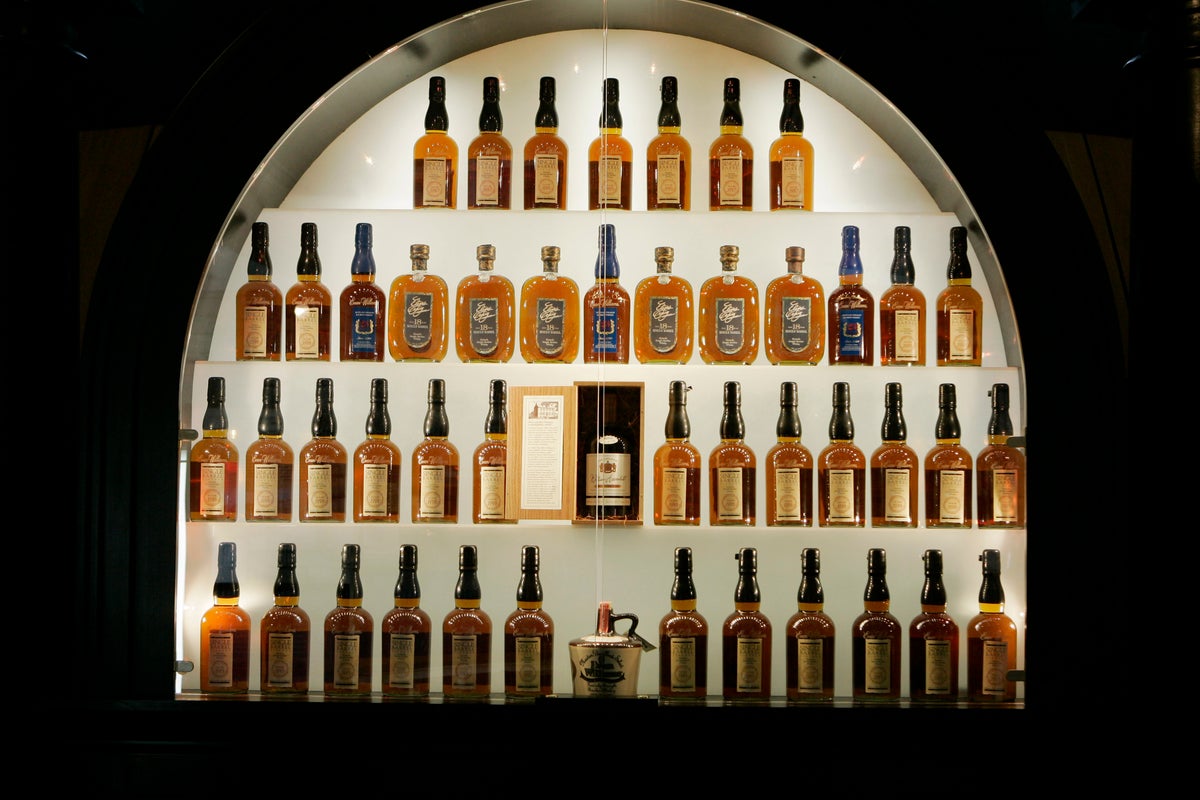
The air inside a Kentucky rickhouse doesn't just smell like whiskey. It smells like patience and a very specific kind of gamble. It is a thick, humid perfume of charred oak, caramelizing sugars, and the sharp sting of ethanol—the "angel’s share" escaping into the rafters. For decades, this scent was the smell of a sure bet. But lately, as you walk between the towering stacks of seven-high barrels, there is a new, colder note underneath the vanilla.
It is the scent of a surplus. Read more on a connected subject: this related article.
To understand why the bluegrass state is currently shivering despite a record-breaking summer, you have to look at the math of time. Bourbon is not vodka. You cannot decide to make more today and sell it tomorrow. When a master distiller pulls the lever to fill a charred white oak cask, they are making a prophecy about what the world will want to drink in 2030, 2034, or 2040.
For the last fifteen years, that prophecy was easy: more. Always more. But the prophecy just hit a wall. More analysis by Reuters Business highlights comparable views on this issue.
The Cracks in the Crystal Cask
Consider a hypothetical distiller named Elias. Elias spent the last decade watching his family’s mid-sized distillery transform from a sleepy regional operation into a global powerhouse. He watched the "Bourbon Boom" turn brown water into liquid gold. To keep up, he took out loans that would make a high-stakes gambler sweat. He built new warehouses. He installed massive copper columns that gleam like cathedral spires.
Now, Elias is looking at a spreadsheet that doesn't care about heritage.
The numbers show a cooling. Domestic spirits growth has flattened. International trade spats and shifting Gen Z habits—heavy on the "sober curious" and light on the three-finger pours—have created a mismatch. Kentucky currently has more than 12.5 million barrels of bourbon aging in the dark. That is roughly three barrels for every single human being living in the state.
It is a staggering amount of inventory. It is also a terrifying amount of overhead. When the news broke that major players like Sazerac and even the titans at Heaven Hill or Beam were beginning to throttle back production, it wasn't just a corporate adjustment. It was a signal fire. They are cutting the "mash in" to prevent a glut that could crash the price of every bottle on the shelf.
The Billion Dollar Paradox
You might expect the industry to be in a defensive crouch, clutching its wallets and praying for a return to the cocktail craze of 2012. Instead, the opposite is happening. Even as they cut daily production, Kentucky’s distillers are doubling down on a $5 billion capital investment spree.
It feels like a contradiction. Why build a bigger kitchen when you’re cooking less food?
The answer lies in the "Premiumization" trap. The industry has realized that the days of selling cheap, mass-market bourbon are fading. The future belongs to the "allocated" bottle, the single-barrel expression, and the $150 limited release that collectors hunt like big game. To win that future, you need more than just liquid; you need an experience.
These billions are flowing into "Disneyland for Adults"—massive visitor centers, luxury tasting rooms, and high-tech fermentation labs. They aren't just selling a drink anymore. They are selling a pilgrimage. They are betting that even if we drink less, we will pay significantly more for the privilege of saying we were there when the bung was pulled from the barrel.
The Human Cost of the Slow-Down
When a distillery cuts production by 20% or 30%, the ripples don't stay inside the boardroom. They flow out into the cornfields.
Kentucky bourbon is a closed loop of local agriculture. Most of the corn is grown within a hundred miles of the stills. When the "cooks" slow down, the grain trucks stop rolling. The local coopers, the men and women who hammer the staves into barrels, see their order books thin out. The chemistry of a small town like Bardstown or Lawrenceburg is tied to the rhythmic thrum of the pumps.
Silence in a distillery is a heavy thing.
It’s not just about the lost wages. It’s about the loss of momentum. For a generation, bourbon was the comeback kid. It saved rural economies that had been gutted by the decline of tobacco and coal. To see the giants pull back feels, to the people on the ground, like a betrayal of that hard-won stability.
The Ghost of 1970
The older generation of distillers remembers the "Clear Revolution." They remember the 1970s and 80s, when bourbon was considered an old man’s drink, something dusty and forgotten while the world moved on to vodka, gin, and tequila. During those "Glut Years," distillers had so much aging whiskey they couldn't give it away. They were forced to sell high-quality, aged bourbon into cheap blends just to keep the lights on.
That memory is the ghost haunting every modern boardroom.
The current production cuts are an attempt to exorcise that ghost before it can take root. By slowing down now, the industry is trying to avoid the "Whiskey Loch"—a lake of unwanted spirits that devalues the brand. They are trying to manufacture scarcity in an age of abundance.
But there is a risk. If you slow down too much, and the market rebounds in five years, you won't have the stock to meet the demand. You’ll be left standing at the station while the train pulls out. It is a game of chicken played with calendars and chemistry.
The Liquid Library
If you stand in a rickhouse today, you are essentially standing in a library where the books take a decade to write. Every barrel is a story of a specific summer’s heat and a specific winter’s chill.
The crisis isn't that the bourbon is gone. The crisis is that we might have written too many stories at once, and the readers are starting to look at other genres.
The $5 billion bet is a gamble that the story of Kentucky is still worth telling, even if the price of admission is going up. It’s a hope that the human desire for authenticity—for something that was touched by fire and wood and time—will outlast the trend of the month.
Elias, our hypothetical distiller, watches the sunset over his newest warehouse. He knows the liquid inside is getting better every day, absorbing the soul of the oak. He just has to hope that when the doors finally open, there is still someone waiting on the other side with a glass and a thirst for the truth.
The gold is still in the barrels. The only question left is whether the world still values the weight of it.
Across the rolling hills of the Bluegrass, the stills are cooling, not out of defeat, but out of a calculated, breathless caution. The industry is holding its breath, waiting to see if the bubble will pop or simply exhale. In the meantime, the angels continue to take their share, indifferent to the market, slowly sipping away at the profit while the rest of us wait for the morning.