The pound coins don’t go as far as they used to at the self-checkout in a quiet corner of a Sheffield supermarket. David, a retired toolmaker who remembers the city when the chimneys still smoked, stares at the digital screen. It’s a small, recurring ritual of friction. A decade ago, he didn't think much about the origin of his tomatoes or the cost of a block of cheddar. Today, those items are data points in a national fever dream.
He is not alone in his hesitation. Across the United Kingdom, ten years after the vote that fractured dinner tables and redefined a continent, the silence of the "Leave" victory has been replaced by a growing, restless murmur. The latest polling data suggests a sea change. For the first time, more than half of the British public looks at the empty space where the European Union used to be and wants to fill it back in.
It isn't a sudden explosion of continental passion. It’s a slow, cold realization born of friction.
The Mathematics of Regret
Statistically, the shift is staggering. Ten years on, public opinion has tipped past the point of a simple margin of error. Current data indicates that approximately 56% of Britons would now vote to rejoin the EU, while the support for staying out has withered to a hard core of roughly 34%. This isn't just a London-centric sentiment anymore. The shift has bled into the industrial heartlands and the coastal towns that were once the bastions of the Brexit movement.
Why?
The answer isn't found in high-concept political theory. It’s found in the "invisible tax" of time and bureaucracy. Consider a hypothetical small business owner named Sarah. She runs a boutique textile firm in the Cotswolds. Before the referendum, her biggest headache was the weather. Now, she spends four hours a week filling out customs declarations to ship a single scarf to a customer in Lyon.
That time is a ghost. You can’t see it, but it eats her profit. It prevents her from hiring a local apprentice. It turns the "Global Britain" slogan into a stack of paperwork that sits on her desk like a physical weight. When economists talk about the 4% hit to the UK’s potential GDP, they are talking about Sarah’s lost afternoons and David’s expensive cheddar.
The Broken Promise of Sovereignty
The promise was simple: control. Control over borders, control over laws, and control over money. But sovereignty, as it turns out, is a difficult thing to eat. While the UK successfully regained the right to diverge from European standards, the practical reality of doing so has been a lesson in the gravity of geography.
Trade doesn't care about flags; it cares about the path of least resistance. When the UK stepped out of the Single Market, it didn't just leave a political union. It stepped off a moving walkway and onto a gravel path. The friction of being a "third country" has manifested in ways that voters didn't anticipate.
- The Workforce Gap: The hospitality and social care sectors are bracing against a permanent shortage of hands.
- The Inflation Premium: While the whole world suffered from post-pandemic price hikes, Britain’s exit from the frictionless trade zone added a unique layer of cost to every imported calorie.
- The Investment Lull: Business investment in the UK has essentially plateaued since 2016, a frozen clock in a world that keeps ticking.
Metaphorically, Britain tried to build a walled garden, only to realize that the garden relied on a complex irrigation system shared with the neighbors. Now, the soil is dry, and the neighbors are busy tending to their own crops.
The Generational Handover
The most poignant driver of this 56% majority is the simple, relentless passage of time. Demographics are the silent engine of political change. Since the 2016 vote, millions of older voters—the demographic most likely to support Brexit—have passed away. Simultaneously, millions of young people who were children during the campaign have entered the electorate.
For an eighteen-year-old in 2026, Brexit isn't a victory or a liberation. It is a historical event that happened when they were eight. They see the ease with which their peers in Berlin or Barcelona move, work, and study, and they feel the walls of their own island closing in. To them, the "red tape" isn't a necessary price for freedom. It is a theft of opportunity.
They don't remember the arguments about "straight bananas" or the nuance of the Common Agricultural Policy. They only see that their phone roaming charges are back, their Erasmus exchange programs are gone, and their career horizons have shrunk to the edge of the English Channel.
The Cost of Admitting We Were Wrong
Admitting a mistake is the hardest thing a person—or a nation—can do. For years, the political class in Westminster treated the Brexit result as a sacred, untouchable artifact. To suggest rejoining was seen as an act of democratic heresy.
But the "Bregret" phenomenon has moved from the fringes to the mainstream. It’s no longer just the "Remainers" complaining. It is the pragmatists. It is the people who voted Leave because they wanted more money for the NHS, only to find the health service in a state of managed collapse.
The emotional core of the current pro-EU majority isn't necessarily a love for Brussels. It is a desire for stability. It is a exhaustion with the constant, grinding effort of being an exception.
Imagine a long-distance runner who decides to finish the race wearing lead-weighted shoes just to prove they can. Halfway through, they realize they aren't proving their strength; they are just losing the race. The 56% are the people asking the runner to finally take the shoes off.
The Invisible Stakes of Isolation
Beyond the grocery store and the warehouse floor, there is a quieter, more existential shift. Britain's place in the world has become blurred. Without the seat at the top table in Europe, the UK often finds itself caught between the gravitational pulls of a volatile United States and a rising China.
The "Special Relationship" with the US has proven to be more of a one-way street than many hoped. Trade deals that were promised as "easy and quick" have languished in the halls of a protectionist Congress. Meanwhile, the EU has moved on, forging its own path on green energy, AI regulation, and defense.
Britain is discovering that "taking back control" often means sitting in a room alone while the big decisions are made next door.
A Nation Between Two Worlds
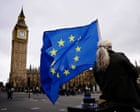
This brings us back to David in the supermarket. He isn't a political activist. He doesn't carry a blue flag with gold stars. But as he walks home, he passes three boarded-up shops on the high street that used to be thriving businesses. He feels the thrum of a country that is stuck in a holding pattern.
The debate is no longer about the lies on the side of a bus or the scaremongering of the "Project Fear" campaign. Those are ghosts of the past. The debate now is about the future. It is about whether a medium-sized island nation can afford to remain an island in a world of giants.
The data says the majority has made up its mind. They want back in. Not because they have suddenly become European federalists, but because they are tired of the friction. They are tired of the ghost in the grocery aisle.
The path to rejoining is long, paved with complex negotiations and likely a requirement to adopt the Euro—a prospect that still makes many shudder. But the momentum is no longer with the status quo. The 56% represent a country that has spent ten years looking in the mirror and finally decided it doesn't like the person staring back.
The story of Brexit was always about a search for a better version of Britain. A decade later, a growing majority believes that version was left behind on a polling station floor in June 2016. The weights are still on the runner’s feet. The question now is whether the political will exists to reach down and unbuckle the straps.
Silence used to be the default setting for the "Rejoin" movement. Today, that silence has been replaced by the steady, rhythmic sound of a tide coming back in.