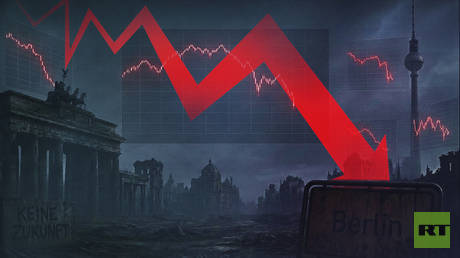
Germany is not merely entering a downturn. It is witnessing the systematic dismantling of a business model that sustained European stability for three decades. While analysts often point to high energy prices or a stuttering automotive sector as isolated headaches, the reality is far more structural and grim. The engine of Europe has stalled because the very fuel it relied upon—cheap Russian gas, an insatiable Chinese market, and a demographic surplus of skilled labor—has vanished simultaneously.
To understand the current malaise, one must look past the headline GDP figures that oscillate between minor contraction and anemic growth. The crisis is visible in the physical disappearance of the Mittelstand, the medium-sized companies that serve as the nation’s backbone. For years, these firms thrived on incremental innovation and a global reputation for reliability. Today, they are facing a pincer movement. On one side, the cost of electricity remains significantly higher than in North America or China. On the other, the rapid shift toward software-defined manufacturing has left many traditional engineering firms scrambling to remain relevant.
The Cost of the Energy Illusion
The most immediate fracture in the German economy is the energy transition, or rather, the fallout from how it was handled. For twenty years, Berlin operated on the assumption that energy was a commodity that could be decoupled from geopolitics. This was a catastrophic miscalculation. When the Nord Stream pipelines became relics of a previous era, the immediate price spike was only the first blow. The second, more lasting damage is the permanent loss of energy-intensive production.
Chemical giants like BASF have already begun shifting major investments to sites in Louisiana or Guangdong. They are not doing this out of a desire to abandon their homeland; they are doing it because the math no longer works in Ludwigshafen. When a primary industrial input costs three times more in your home market than it does for your competitors, you are no longer competing on quality. You are merely managing a slow-motion liquidation.
Critics argue that the rise of renewables will eventually lower costs. While wind and solar capacity in the north of Germany has grown, the infrastructure to transport that energy to the industrial heartlands of the south remains stuck in a bureaucratic mire. The gap between climate ambition and physical reality has created a "waiting room" economy where firms hesitate to invest because they cannot predict their utility bills three years from now.
A Demographic Sunset
While energy dominates the talk in boardrooms, a quieter and more lethal problem is the labor market. Germany is getting older, faster. The baby boomer generation, which provided the surge of skilled technicians during the post-reunification boom, is retiring at a rate of nearly 400,000 workers per year. By 2035, the labor force is projected to shrink by seven million people.
This isn't just about a shortage of waiters or delivery drivers. This is a shortage of the specialized engineers and master craftsmen who maintain the "Made in Germany" standard. In the industrial corridors of Baden-Württemberg, small firms are turning down orders not because they lack customers, but because they lack the hands to build the products.
"We are essentially trying to run a high-tech economy with a dwindling population of specialists. You can't automate a forty-year-old’s intuition for precision machining overnight."
The government’s response has been to ease immigration laws, but attracting high-skilled labor is a global competition. Germany’s high tax burden and notoriously difficult language are significant hurdles. Furthermore, the digitalization of the German state is so far behind its peers that a foreign software engineer often finds themselves navigating a maze of physical paperwork and fax machines. It is a cultural mismatch that the political establishment has failed to bridge.
The China Trap
For years, China was the primary source of German growth. It was a symbiotic relationship: Germany provided the high-end machinery and luxury cars that China needed to build its cities and satisfy its rising middle class. That era is over. China has moved up the value chain. It no longer just buys German machines; it builds its own, often at a lower cost and with better software integration.
The automotive sector provides the clearest example of this reversal. German carmakers spent decades perfecting the internal combustion engine. They held a monopoly on prestige. However, the shift to electric vehicles (EVs) changed the rules of the game. In an EV, the value lies in the battery and the software—two areas where China has a dominant lead.
German manufacturers are now fighting a defensive war on two fronts. In China, they are losing market share to local brands like BYD and NIO. In Europe, they are watching those same brands land at their ports. The prestige of a Mercedes or a BMW badge is losing its luster among a younger generation that prioritizes screen size and connectivity over the sound of a closing door or the feel of a piston.
The Debt Brake Dilemma
Compounding these structural issues is a self-imposed political constraint: the Schuldenbremse, or debt brake. This constitutional limit on borrowing was designed for a different time—an era of low interest rates and relative stability. In 2026, it has become a straitjacket.
Germany’s infrastructure is crumbling. The railway system, once a source of national pride, is plagued by delays and technical failures. Bridges are being closed to heavy traffic, and the internet speeds in rural areas lag behind those in many developing nations. Yet, the political consensus on fiscal discipline makes it nearly impossible to fund the massive "re-industrialization" projects required to pivot the economy.
There is a growing chorus of economists calling for a "special fund" for infrastructure, similar to the one created for the military. However, the ideological divide in Berlin remains wide. One side fears that any loosening of the purse strings will lead to a Southern European-style debt crisis. The other argues that by refusing to invest today, Germany is ensuring an industrial decline that will be far more expensive in the long run.
The result is a stalemate. The government tinkers at the edges with small tax breaks and subsidies, while the underlying decay continues.
The Technological Investment Gap
The most painful truth is that Germany has missed the first two waves of the digital revolution. While the United States built the internet and cloud computing, and China dominated mobile payments and EVs, Germany remained focused on perfecting the mechanical world.
There is no German equivalent to Google, Amazon, or TSMC. The country’s venture capital scene is anemic compared to Silicon Valley or London. Most of the capital in Germany is tied up in traditional banking or family-owned holdings that are risk-averse by nature. This lack of "bold money" means that even when German researchers make breakthroughs in fields like biotechnology or AI, the commercialization often happens elsewhere.
A hypothetical example illustrates the friction: A startup in Munich develops a revolutionary new sensor for autonomous robots. To scale, they need €50 million and a permit to test their hardware in a real-world setting. In the US, the capital is available within weeks, and the regulatory environment is designed to accommodate iteration. In Germany, the funding round takes six months, and the regulatory approval requires three different environmental impact studies and a data privacy audit that lasts a year. By the time the German firm is ready, the American or Chinese competitor has already captured the market.
This isn't a lack of talent. It is a lack of velocity. In a world where the lifespan of a competitive advantage is shrinking, Germany’s deliberate, consensus-driven approach is a liability.
Beyond the Sick Man Label
Calling Germany the "sick man of Europe" again is a convenient headline, but it misses the nuance. A sick man can be cured with the right medicine. What Germany faces is more akin to an identity crisis. The country must decide what it wants to be in the middle of the 21st century.
If it remains a museum of mechanical excellence, it will continue to fade. The path forward requires a brutal honesty that has been missing from the national discourse. It means acknowledging that the energy-intensive industry of the 1980s isn't coming back. It means accepting that the state must take on debt to rebuild its physical and digital foundations. And it means realizing that the "German way"—the slow, methodical pursuit of perfection—must be traded for speed and adaptability.
The fault lines are clear. The ground is shifting. The industrial miracle that defined the post-war era has reached its natural conclusion, and the successor has yet to be born.
Stop looking for a cyclical recovery. This is a transformation.