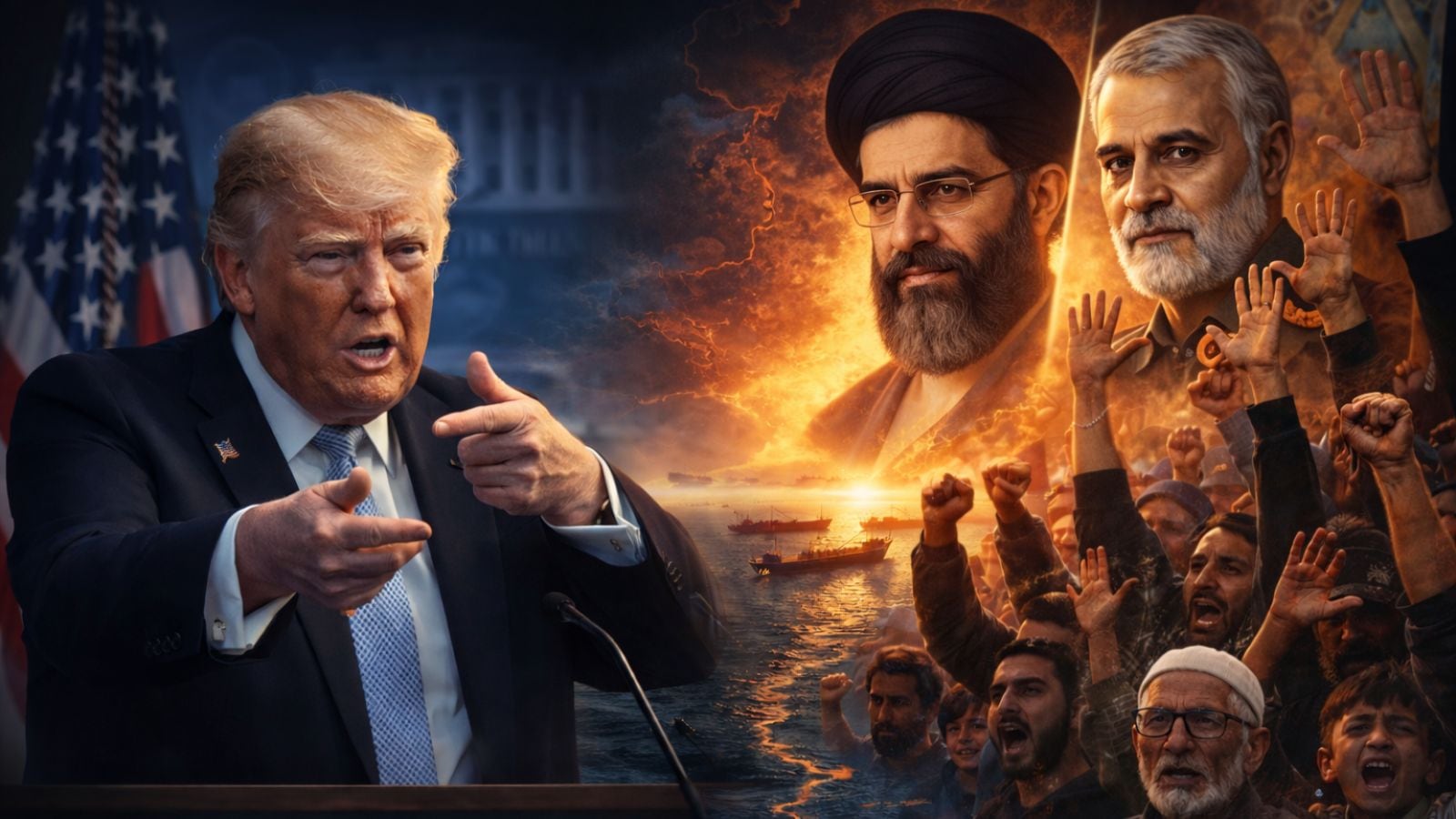
The probability of a diplomatic breakthrough between the United States and Iran is governed by three non-negotiable variables: the survival requirements of the Islamic Revolutionary Guard Corps (IRGC), the internal political calculus of the Trump administration’s "maximum pressure" doctrine, and the shifting security architecture of the Middle East. While media narratives often focus on the personalities of leadership, the reality is a zero-sum structural deadlock. Any agreement requires one party to accept a fundamental compromise to its core identity—a cost that currently exceeds the perceived benefits of sanctions relief or regional stability.
The Tripartite Framework of Iranian Resistance
To understand why "bridging differences" is a flawed premise, one must analyze the Iranian state not as a monolith, but as a system of competing incentive structures. Iranian foreign policy functions through three distinct operational pillars.
1. The Forward Defense Doctrine
Iran’s regional influence is not a luxury; it is a defensive necessity born from the Iran-Iraq War. By funding and training non-state actors (the "Axis of Resistance"), Tehran ensures that any conflict occurs on foreign soil rather than within its borders.
- The Cost Function: Abandoning these proxies—a primary US demand—would dismantle Iran’s strategic depth, leaving the clerical establishment vulnerable to conventional military superiority from regional rivals.
- The Conflict: The US views these proxies as a source of instability; Tehran views them as its only credible deterrent.
2. The Sanctions-Resistant Grey Economy
Decades of isolation have birthed a "resistance economy" managed largely by the IRGC. This internal market relies on smuggling, front companies, and illicit oil sales.
- The Internal Logic: Lifting sanctions would re-integrate Iran into the global financial system (SWIFT), which requires transparency and anti-money laundering (AML) compliance.
- The Strategic Bottleneck: Transparency is the natural enemy of the IRGC’s shadow economy. Consequently, the very entities tasked with negotiating sanctions relief are those whose domestic power would be undermined by the transparency that follows a deal.
3. The Nuclear Hedging Strategy
The nuclear program serves as the ultimate leverage. By maintaining a high enrichment capacity (60% $U_{235}$), Iran forces the West to the table while stopping just short of the "red line" that would trigger a kinetic military response.
The Trumpian Calculus: Maximum Pressure as a Feedback Loop
The Trump administration’s approach to Iran is predicated on the "Maximum Pressure" framework. This strategy assumes that economic strangulation will eventually force Tehran to choose between regime survival and a total capitulation to 12 specific demands, ranging from the cessation of missile testing to the withdrawal from Syria.
However, this logic encounters a diminishing marginal return. Once a state’s economy has been largely decoupled from Western markets, additional sanctions offer less leverage.
The Credibility Gap
A primary failure in this diplomatic theater is the "commitment problem." Because the US withdrew from the Joint Comprehensive Plan of Action (JCPOA) in 2018, Iranian hardliners argue that any future agreement is only as durable as the current US election cycle. This creates a high discount rate on any promised benefits. If the benefit of sanctions relief is $X$, but the probability of that relief lasting beyond four years is $P$, the current value of the deal to Iran is $X \cdot P$. When $P$ is low, the incentive to make permanent concessions (like dismantling centrifuges) disappears.
The Leverage Paradox
For the US, "leverage" is viewed as a buildup of economic pain. For Iran, "leverage" is the escalation of regional friction. This creates a dangerous feedback loop:
- The US increases sanctions to force a deal.
- Iran increases regional aggression (tanker seizures, drone strikes) to show that the US strategy is failing.
- The US responds with more sanctions or military posturing.
- The "bridge" between the two parties narrows as the domestic political cost of "giving in" rises for both leaders.
Regional Realignment and the Abraham Accords
The entry of the Abraham Accords into the geopolitical equation changed the math. Previously, Iran could exploit divisions between Arab states and Israel. Now, a formalizing intelligence and security bloc—comprising Israel, the UAE, Bahrain, and increasingly Saudi Arabia—creates a unified front against Iranian expansionism.
The Security Dilemma
This realignment increases Iran's sense of encirclement. When a state feels its survival is at stake, it rarely reacts by moderating its behavior. Instead, it doubles down on asymmetrical capabilities. The US seeks to leverage this regional unity to further isolate Iran, but isolation often breeds desperation rather than reform.
The "China Factor" further complicates this. Iran’s 25-year strategic partnership with Beijing provides a vital, albeit limited, economic lifeline. By acting as a "spoiler," China ensures the US remains bogged down in the Middle East, preventing the full execution of the "Pivot to Asia."
Technical Barriers: The Ballistic Missile Variable
The US insists that any "New Deal" must include Iran’s ballistic missile program. From a technical and strategic standpoint, this is the most significant hurdle.
- Asymmetric Parity: Iran lacks a modern air force. Its aging fleet of F-4s and F-14s cannot compete with fifth-generation fighters like the F-35.
- The Substitute: Ballistic missiles are Iran’s substitute for an air force. They are the delivery mechanism for its deterrent.
- The Logic of Refusal: Asking Iran to limit its missile range is equivalent to asking a conventional power to ground its air force. No state, regardless of the severity of sanctions, will voluntarily blind its primary strike capability without a comparable security guarantee—which the US cannot provide.
Structural Misalignments in Negotiation
Negotiations fail not because of a lack of communication, but because of misaligned definitions of "success."
The US Definition of Success:
- A permanent end to the nuclear path.
- Total cessation of regional proxy funding.
- A verifiable, intrusive inspection regime.
The Iranian Definition of Success:
- Recognition as a regional power.
- Removal of all primary and secondary sanctions.
- Guarantees against US-led regime change.
These two sets of outcomes are mutually exclusive under the current political configurations of both governments. For a bridge to exist, there must be an overlap in the "Zone of Possible Agreement" (ZOPA). Currently, the minimum demands of the US exceed the maximum concessions the Iranian Supreme Leader is willing to make to ensure the survival of the velayat-e faqih (guardianship of the jurist) system.
Strategic Forecast: The Path of Managed Friction
The most likely outcome is not a "Lasting Peace" or a "Grand Bargain," but a state of Managed Friction. This is a low-intensity conflict characterized by:
- Transactional De-escalation: Short-term, informal agreements where Iran slows enrichment in exchange for the release of frozen assets or limited oil waivers. This is "less-for-less" rather than "more-for-more."
- Shadow Warfare: Continued kinetic activity in the cyber and maritime domains that remains below the threshold of declared war.
- Nuclear Latency: Iran will maintain its status as a "threshold state"—possessing the knowledge and material to build a weapon within weeks, but choosing not to cross the final line to avoid a total regional conflagration.
The strategic play for the US is not to chase an elusive "perfect deal" that Iran's internal structure cannot support. Instead, the focus shifts to Containment 2.0: strengthening the air defense integration of the Abraham Accords, maintaining a credible military threat to prevent 90% enrichment, and utilizing targeted sanctions that disrupt IRGC supply chains rather than the broader Iranian populace.
Peace requires a fundamental shift in the domestic legitimacy of the Iranian state—a shift that sanctions can catalyze but cannot force. Until the IRGC finds a survival model that does not depend on regional chaos, the "bridge" remains a structural impossibility.


