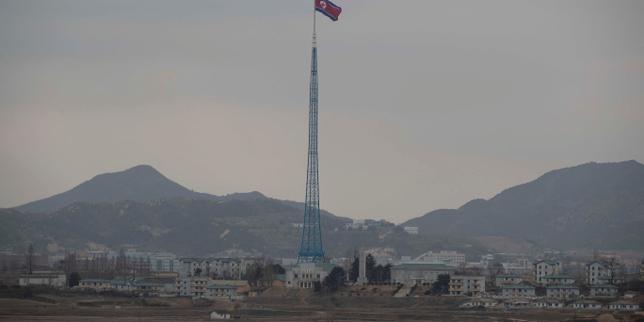
North Korea has fundamentally altered its legal and ideological architecture by codifying the Republic of Korea (ROK) as its "primary foe," an act that terminates seven decades of nominal commitment to ethnic reunification. This constitutional revision is not merely rhetorical escalation; it is a calculated dismantling of the "One Nation, Two Systems" fiction that previously governed inter-Korean relations. By excising references to "peaceful reunification" and "fellow countrymen," Kim Jong-un has shifted the Democratic People's Republic of Korea (DPRK) from a revisionist state seeking national consolidation to a conventional Westphalian state managing a permanent, hostile border.
The Triple Pivot Framework: Ideology, Sovereignty, and Kinetic Readiness
The transition from "reunification" to "permanent hostility" rests on three distinct pillars of strategic logic. Each pillar serves to insulate the Kim regime from external influence while justifying the continued acceleration of its nuclear program.
1. The De-Legitimization of Ethnic Solidarity
Historically, the DPRK used the concept of Minjok (one race) to justify its claim over the entire peninsula. However, this ideological bridge became a liability. As the economic disparity between the North and South widened into a chasm, the "one people" narrative provided a vector for South Korean cultural penetration.
The constitutional removal of "fellow countrymen" terminology functions as a prophylactic against "soft" regime change. By defining South Koreans as a separate, hostile entity rather than estranged brothers, the state can categorize any consumption of South Korean media or culture not as a personal lapse, but as an act of treasonous collaboration with a foreign enemy.
2. The Formalization of the Two-State Reality
Pyongyang is effectively adopting a "Two Koreas" policy, mirroring the historical trajectory of East and West Germany, though with a significantly more militarized posture. This shift simplifies the DPRK’s diplomatic calculus. If the South is a separate state, then any ROK-US military exercise is a violation of sovereignty between nations, not an internal dispute.
This move also targets the ROK’s Ministry of Unification. By declaring the South a foreign power, Pyongyang is signaling that all future interactions will be handled by the Ministry of Foreign Affairs or the military. This removes the "special relationship" status that previously allowed for nuanced, albeit inconsistent, humanitarian and economic exchanges.
3. Kinetic Justification and the Nuclear Threshold
The most dangerous component of this doctrine is the redefinition of the Northern Limit Line (NLL) and the territorial boundaries. Kim Jong-un has explicitly stated that any violation of "even 0.001 mm" of North Korean land, air, or sea will be met with immediate force.
By legally designating the South as the "primary enemy," the DPRK lowers the domestic legal threshold for the use of tactical nuclear weapons. Under previous doctrines, "reunification" implied a need to preserve the southern population and infrastructure for future integration. Under the new "Hostile State" doctrine, the South is a target to be neutralized, not a territory to be liberated and absorbed intact.
Strategic Incentives Behind the Timing
The timing of this constitutional overhaul correlates with three external variables that have shifted the DPRK's risk-reward ratio.
- The Moscow-Pyongyang Axis: The revitalization of the 1961 Mutual Defense Treaty with Russia provides North Korea with a strategic depth it has lacked since the end of the Cold War. Russian demand for North Korean munitions has granted Pyongyang significant hard currency, energy supplies, and likely technical assistance for its satellite and missile programs. This reduces the North's reliance on potential "thaws" with Seoul for economic survival.
- The ROK-US-Japan Trilateral Integration: The Camp David summit and the resulting intelligence-sharing agreements between Seoul, Washington, and Tokyo have convinced Pyongyang that the "Grand Bargain" of denuclearization is dead. The DPRK sees a unified front and has responded by hardening its own stance, moving from a position of defensive deterrence to one of proactive confrontation.
- The Erosion of the NLL: By refusing to recognize the NLL—a maritime border never formally agreed upon by the North—and establishing its own "Southern Border Line," the DPRK is creating a legal pretext for future maritime skirmishes. This is a classic "salami-slicing" tactic designed to test the resolve of the ROK Navy and the stability of the US-ROK alliance.
Operational Impacts on Peninsular Stability
The abandonment of reunification has immediate consequences for the operational environment along the 38th Parallel and the West Sea.
Dismantling of Symbolic Infrastructure
The destruction of the Arch of Reunification in Pyongyang and the severance of inter-Korean road and rail links are psychological operations directed at both the North Korean populace and the South Korean government. These actions serve to signal the "point of no return." From a military perspective, the physical destruction of these links simplifies defensive planning, as it removes potential invasion corridors that had to be monitored for "peaceful" transit.
The Buffer Zone Vacuum
With the 2018 Comprehensive Military Agreement (CMA) effectively defunct, the DPRK is rapidly re-militarizing the Demilitarized Zone (DMZ). The deployment of new artillery assets and the construction of anti-tank barriers indicate a shift back to high-intensity conventional positioning. The risk of a "miscalculation" increases exponentially when there are no hotlines and no shared ideological framework to de-escalate tension.
Economic Autarky and Trade Realignment
The constitutional shift confirms that the Kaesong Industrial Complex and similar joint ventures are relics of a discarded era. North Korea's economic strategy is now bifurcated:
- Direct integration with the Russian defense industrial base.
- Increased reliance on illicit maritime transfers and cyber-theft to bypass sanctions.
This economic realignment makes the North less susceptible to the "carrots" of economic aid that have been the hallmark of South Korean liberal administrations.
The Cost Function of the New Doctrine
While the "Two-State" doctrine provides ideological clarity, it introduces several systemic risks for the Kim regime.
The first limitation is the Deterrence Paradox. By labeling the South as a foreign enemy, the DPRK justifies its nuclear buildup, but it also justifies a more aggressive "Kill Chain" and "Massive Punishment and Retaliation" (KMPR) strategy from Seoul. The ROK is no longer constrained by the political optics of targeting "compatriots."
The second limitation is Internal Cognitive Dissonance. For three generations, the Kim family’s legitimacy was tied to the "Great Task" of national reunification. While the state can update its Constitution, erasing the cultural and historical concept of a single Korean people is more difficult. This creates a potential long-term friction point within the North Korean elite who may see this shift as an admission of defeat in the systemic competition with the South.
Tactical Realignment for Regional Stakeholders
The international community must adapt to a North Korea that no longer views the South as a partner for dialogue, but as a battlefield for containment.
- For Seoul: The policy of "Strategic Patience" or "Engagement" requires a total overhaul. The Ministry of Unification's role is likely to diminish, while the Ministry of National Defense must prepare for a series of "Gray Zone" provocations designed to test the new maritime and land borders.
- For Washington: The DPRK’s alignment with Russia means that the "denuclearization" framework is effectively obsolete for the medium term. Strategy must shift toward "Extended Deterrence" and "Counter-Proliferation," treating North Korea as a permanent nuclear state similar to the Cold War-era USSR, but with less institutional stability.
- For Beijing: This move is a double-edged sword. While China benefits from a distracted US, a permanent state of high-tension on its border—and a North Korea that is increasingly autonomous due to Russian support—weakens China’s leverage over Pyongyang.
The strategic play is no longer about managing a path toward a unified Korea, but about containing a nuclear-armed state that has legally and ideologically burned its bridges. The "New Cold War" on the peninsula is not a metaphor; it is the codified legal reality of the North Korean state. The move from "one nation" to "primary enemy" signifies that the DPRK has stopped playing the long game of national unification and has started the short game of high-stakes survival. Space for diplomacy has been replaced by the math of terminal ballistics and the hardening of the most militarized border on Earth. Movements within the DMZ and the West Sea will now be interpreted through the lens of international conflict, significantly reducing the reaction time for command structures on both sides.