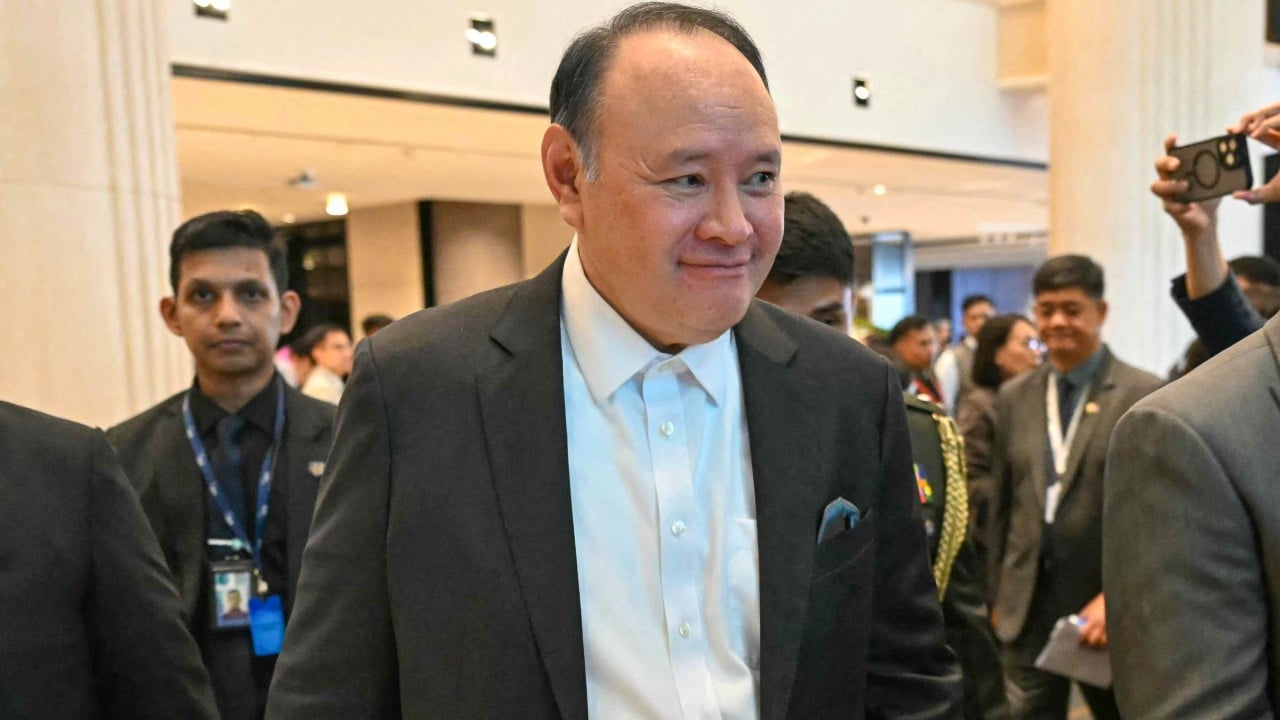
The decision by the Chinese Ministry of Foreign Affairs to impose formal sanctions on Philippine Defense Secretary Gilberto Teodoro Jr. and his immediate family marks a systemic shift from informal maritime friction to formalized lawfare. By blocking travel to mainland China, Hong Kong, and Macao, and prohibiting domestic entities from executing transactions with the Teodoro family, Beijing is attempting to apply a standardized deterrence framework to a theater defined by asymmetric interdependence. This micro-targeted economic and mobility restriction functions less as an immediate financial punishment and more as a signaling mechanism within a broader strategy of cost-imposition.
To understand the strategic reality of these sanctions, they must be separated from domestic political rhetoric and evaluated through a strict operational framework.
The Three Pillars of Beijing's Sanction Architecture
The enforcement mechanism applied against Teodoro operates across three interdependent structural axes, designed to maximize diplomatic leverage while minimizing regional economic friction.
- Jurisdictional Exclusion: Banning entry into mainland China, Hong Kong, and Macao establishes a clear geopolitical perimeter. Eliminating access to Hong Kong and Macao specifically Targets the primary financial and administrative hubs of the region, attempting to isolate the individual from proximity to regional capital flows.
- Commercial Asset Freezing: Prohibiting Chinese organizations and individuals from engaging in transactions or joint ventures with Teodoro creates a legal firewall. For a public official, this cuts off potential post-government corporate board appointments or commercial consulting opportunities linked to entities interacting with the second-largest economy in the world.
- The Familial Contagion Mechanism: Extending the travel and commercial ban to Teodoro's spouse and child serves an explicit psychological and structural purpose. It increases the personal liability of taking a hardline stance, signaling to other regional defense officials that geopolitical alignment choices carry long-term, multi-generational consequences for their immediate families.
This three-part structure demonstrates that the target of the policy is not Teodoro's current operational capabilities, but the future utility of his personal and financial capital.
The Cost Function of Defensive Rhetoric
Beijing's public justification hinges on what it characterizes as "irresponsible and fallacious remarks" that "sabotage" bilateral relations. Tracing the timeline of these statements reveals a direct correlation between high-profile multilateral defense forums and the escalation of legal retaliation.
During the Shangri-La Dialogue in Singapore, Teodoro rejected assertions by senior officers from the Chinese People's Liberation Army that Manila was acting as a geopolitical proxy for the United States. Instead, he categorized Beijing’s maritime operations as illegal territorial seizures and publicly challenged the legitimacy of its expansive claims. Earlier statements from Teodoro went further, explicitly labeling the Chinese leadership's governance model an autocracy and assigning the blame for maritime escalations directly to the ruling clique rather than the Chinese population.
The strategic friction here is defined by a fundamental asymmetry in the cost function of public rhetoric:
$$\text{Rhetorical Cost (Manila)} = \text{Diplomatic Exclusion} + \text{Targeted Sanctions}$$
$$\text{Rhetorical Cost (Beijing)} = \text{Loss of Maritime Hegemonic Legitimacy} + \text{Accelerated Allied Integration}$$
For Manila, aggressive rhetoric functions as an internationalization strategy. By explicitly defining the conflict in clear legal and systemic terms on global stages like the Shangri-La Dialogue, the Philippines lowers the political barrier for external powers—such as the United States, Japan, and Australia—to justify joint patrols and intelligence-sharing infrastructure. For Beijing, allowing these rhetorical frames to go unanswered risks validating an international legal consensus that undermines its long-term maritime objectives.
Structural Bottlenecks and Strategic Shortcomings
The immediate operational limitation of Beijing's sanction strategy against Teodoro is its total lack of direct financial leverage. Teodoro has publicly stated that he maintains zero assets within Chinese jurisdiction and holds no intentions of traveling to the country. When an individual's asset portfolio and career trajectory are entirely uncoupled from the sanctioning nation's economy, the immediate material efficacy of an economic ban drops to zero.
This reality exposes three distinct systemic bottlenecks in China's current approach to personal sanctions in Southeast Asia.
The Problem of Low Financial Interdependence at the Individual Level
Sanctions achieve deterrence by threatening the target with a net-negative shift in utility. Because Western-aligned security officials in the Philippines do not rely on Chinese banks, sovereign wealth funds, or corporate partnerships for capital accumulation, the state cannot weaponize the financial system directly against them. The threat of commercial isolation is ineffective when the baseline level of commercial interaction is already non-existent.
The Counter-Incentive Structure for Security Officials
Instead of suppressing hardline rhetoric, targeted sanctions frequently validate the political capital of the individual within their domestic and allied networks. For a defense minister under a nationalist administration, being sanctioned by an adversarial state serves as definitive proof of operational efficacy and loyalty. This creates a perverse incentive structure where the penalty actively hardens the target's political position, rendering future diplomatic compromise cost-prohibitive for them domestically.
Acceleration of Allied Security Architectures
The primary unintended consequence of this diplomatic escalation is the systematic destruction of ambiguous diplomatic space. By forcing a binary legal distinction, Beijing inadvertently accelerates Manila's integration into the United States' regional security umbrella. The Philippines remains one of the oldest treaty allies of the US in the Asia-Pacific. When individual ministers face personal legal pressure from Beijing, it streamlines the bureaucratic and political justification for expanding the Enhanced Defense Cooperation Agreement (EDCA) footprint, giving US forces greater access to strategic bases facing the South China Sea.
The Shift from Tactical Skirmishes to Systematic Attrition
The institutional deployment of these sanctions signals that the theater has evolved past isolated maritime standoffs involving water cannons and coast guard maneuvers around Second Thomas Shoal or Scarborough Shoal. It represents the introduction of a dual-track strategy combining physical gray-zone coercion with formal legal blacklisting.
The operational reality for regional defense networks is clear. Future engagements will see an increased institutionalization of these bans. Beijing is likely to use this template as a baseline deterrent against secondary defense officials, procurement officers, and maritime law enforcement commanders across Southeast Asia. The objective is to establish an unstated but legally codified threshold: any regional official who coordinates directly with external powers or utilizes highly adversarial language will face immediate, permanent exclusion from the primary economic engine of the region.
Organizations managing supply chains, defense procurement, or diplomatic missions in the Indo-Pacific must calculate their operations around this hardening legal divide. Security partnerships can no longer be viewed as purely military arrangements isolated from personal, commercial, and financial exposure.
To counter the weaponization of individual travel and financial bans, the Department of National Defense in Manila must institutionalize a comprehensive legal and financial indemnity framework for its senior leadership. This requires establishing formal sovereign guarantees that offset any potential multi-generational commercial liabilities incurred by officials and their families due to state-sponsored sanctions. Concurrently, Manila must leverage this diplomatic escalation to demand accelerated, binding security assistance commitments from Washington and regional partners, effectively transforming personal legal liabilities into tangible state-level defensive capabilities.