You can always count on a military metaphor to accidentally blow up a delicate diplomatic status quo. When General Xavier Brunson, commander of U.S. Forces Korea (USFK), sat down for a routine military podcast, he probably didn't think a quick analogy would trigger furious press releases from Beijing and a blistering propaganda campaign from Pyongyang. But that's exactly what happened.
Brunson described South Korea as a "dagger in the heart of Asia" pointing straight at China's east coast, while framing Japan as a defensive "shield."
Pyongyang wasted zero time jumping on the quote. On Wednesday, June 3, 2026, North Korea released a venomous official commentary via its state-run Korean Central News Agency (KCNA). They slammed the U.S. for treating the Korean Peninsula as a frontline playground for a new Cold War. While it sounds like classic North Korean theatrics, this blowup isn't just about Pyongyang throwing another temper tantrum. It exposes a massive, uncomfortable truth about how the U.S. military is shifting its footprint in Asia, and why America's allies in Seoul are sweating through their suits.
The Slip of the Tongue That Exposed a Strategy
To understand why everyone is losing their minds over a podcast episode, you have to look at what Brunson actually said. Speaking with the U.S. Army War College, the general tried to visualize the geopolitical map from Beijing's perspective. He stated that when China looks out from its eastern coast, it sees South Korea as a dagger piercing the center of Asia.
It’s an incredibly vivid image. It’s also an incredibly dangerous one for an American commander to say out loud.
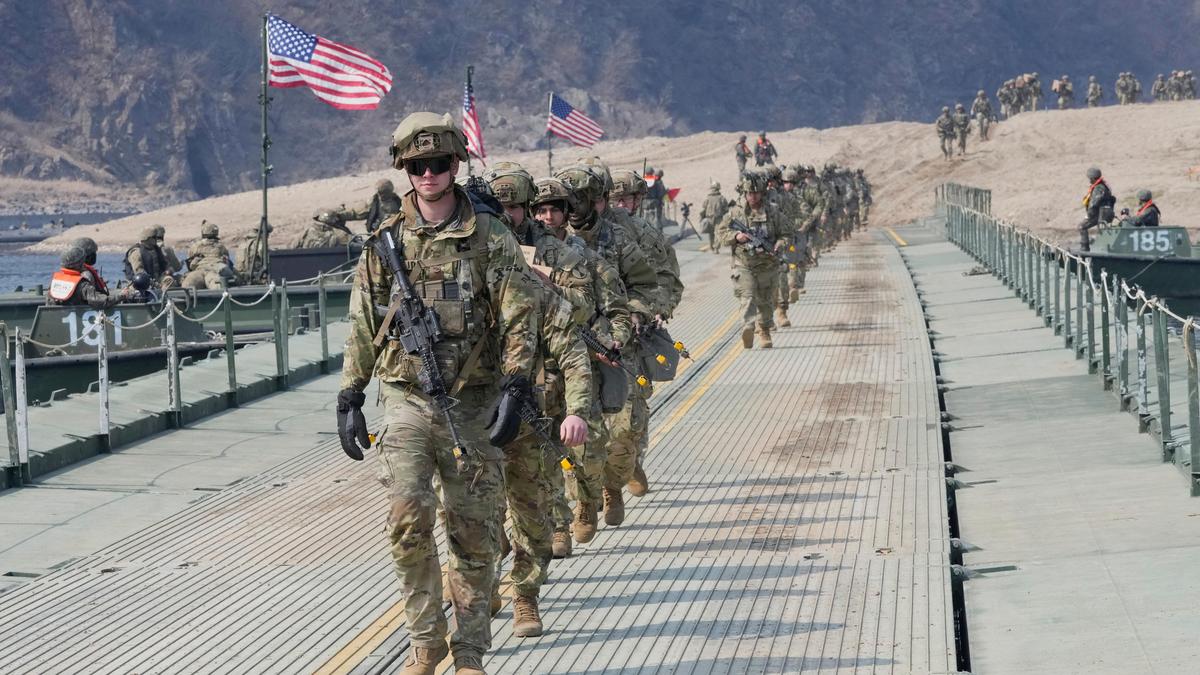
For decades, the official reason 28,500 American troops are stationed in South Korea has been simple: protect Seoul from North Korea. That's it. It’s a defensive mission meant to deter Pyongyang's nuclear ambitions. By publicly labeling South Korea as a "dagger" aimed at China, Brunson essentially said the quiet part out loud. He confirmed what Beijing has long suspected. The U.S. views its military presence in Korea not just as a shield against the North, but as an offensive weapon to box in China.
The Chinese Embassy in Seoul immediately revolted, accusing the general of "crossing the line" and displaying open hostility. Brunson tried to clear the air at the Shangri-La Dialogue in Singapore, claiming his words were taken out of context and merely described a "changing operational environment." But the damage was done. The cat was out of the bag.
Why North Korea Cares So Much About China Safety
You might wonder why North Korea is acting like China’s defensive lawyer here. After all, the comment was about South Korea and Beijing. But Pyongyang’s reaction, penned by state international affairs commentators, reveals their own deep strategic anxieties.
North Korea's state media argued that using South Korea as a geopolitical tool to contain Beijing will backfire on Washington. They warned that backing China into a corner will inevitably force neighboring regional powers to build closer security ties to push back. Translate that from diplomatic propaganda into plain English: North Korea is using this incident to justify its own deepening military alliances with China and Russia.
Think about the bigger picture. Over the last couple of years, we've watched Pyongyang get closer to Moscow, providing ammunition and forging tight defense pacts. By framing the U.S.-South Korea alliance as an aggressive anti-China coalition, North Korea sets up a perfect excuse to demand even more advanced military tech, hardware, and economic cover from both Beijing and Moscow. It’s a clever leverage play.
The Real Shift: Strategic Flexibility
Behind all the fiery rhetoric lies a technical military concept that you need to know if you want to understand Asia's current security landscape. It's called strategic flexibility.
Historically, U.S. troops in Korea were locked in place. They were there to fight a war on the peninsula if the North ever crossed the DMZ. But Washington doesn't want its forces trapped in a single theater anymore. The Pentagon wants the ability to move those 28,500 troops, their advanced aircraft, and reconnaissance assets anywhere in the Indo-Pacific if a conflict breaks out—say, over Taiwan or the South China Sea.
Look at the hardware shifts that are already happening on the ground:
- The U.S. military has been establishing long-range reconnaissance battalions built around high-tech MQ-9 Reaper drones in the region.
- F-16 fighter squadrons are being reorganized into heavily upgraded, high-capability units.
- The U.S. Army is actively training its Multi-Domain Task Forces specifically to operate inside the "First Island Chain"—the exact maritime boundary blocking China from the open Pacific.
When North Korea pointed out these specific military upgrades in its Wednesday critique, they weren't making it up. They see these moves as proof that the U.S.-South Korea alliance is morphing into a launchpad for a wider Asian conflict.
Seoul's Awkward Tightrope Walk
The absolute quietest player in this entire mess? South Korea itself. Brunson's comments put Seoul in an incredibly brutal position.
South Korea's presidential office quietly admitted they’ve been working overtime through diplomatic channels to manage the fallout with Washington. They didn't explicitly condemn Brunson, but local South Korean media outlets confirmed that officials raised serious concerns with the U.S. behind closed doors.
Why the panic? Because South Korea relies on the U.S. for its survival, but it relies on China for its economy. China is South Korea's largest trading partner. The last thing Seoul wants is to be branded as America’s literal weapon against Beijing. It invites economic retaliation, political freezing, and massive domestic backlash. Many people in South Korea genuinely worry that if U.S.-China tensions boil over, their country will end up caught in the middle of a proxy war.
Furthermore, South Korea has been pushing hard to develop its own nuclear-powered submarines to counter North Korean sub threats. Pyongyang explicitly linked those submarine ambitions to Brunson's comments, claiming that Washington is only backing Seoul's naval upgrade so those subs can eventually be used to track Chinese vessels. It makes it much harder for Seoul to frame its defense upgrades as purely defensive.
What Happens Next
The dagger controversy isn't going to trigger a war tomorrow, but it permanently alters the diplomatic chessboard in East Asia. Words matter in geopolitics, especially when they come from a four-star general running a major command.
If you are tracking security risks in Asia, keep your eyes on how Beijing acts next. Don't expect China to just let this go with a single angry letter from their embassy. Look for increased Chinese naval patrols around the Korean Peninsula and potential economic pressure points placed on South Korean companies.
At the same time, expect North Korea to use this rhetorical ammunition to tighten its grip on its neighbors. They’ve already signaled that closer cooperation with anti-U.S. forces is the direct consequence of Washington’s regional strategy. The dagger metaphor might have been an off-the-cuff visual for a podcast audience, but it gave America's adversaries a perfect narrative to justify their next dangerous moves.