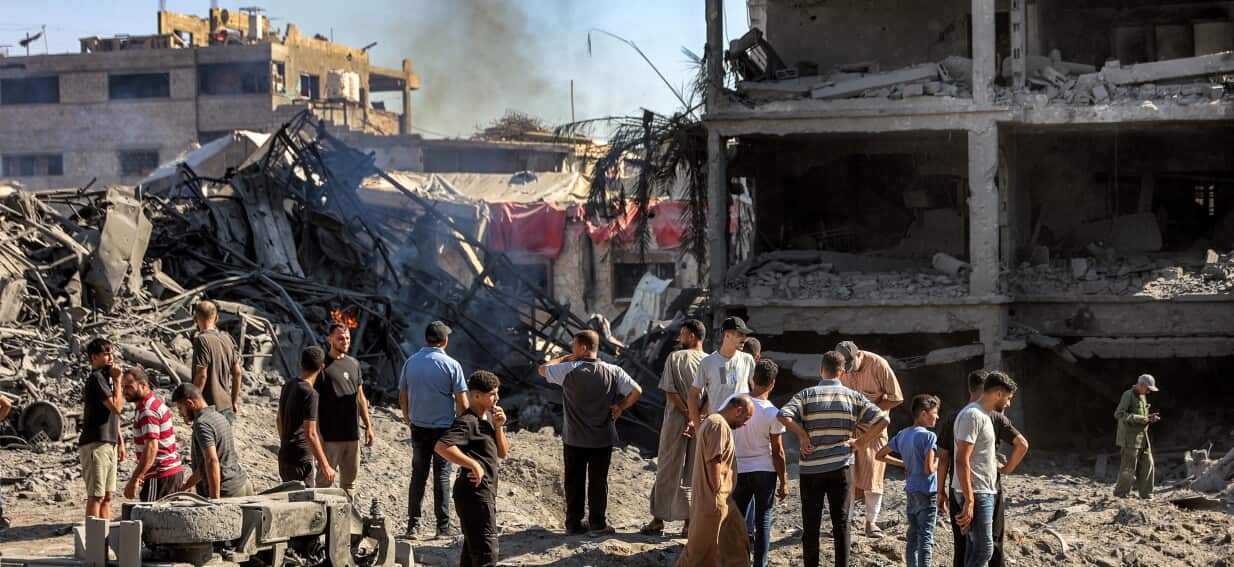
The European Union’s promise of billions of euros to rebuild the Gaza Strip is crashing into a harsh geopolitical reality. While Western powers pledge massive financial packages to reconstruct shattered infrastructure, United Nations officials privately and publicly warn that local authorities, specifically Hamas, are actively hampering the distribution and implementation of humanitarian relief. This friction creates an impossible bottleneck. Money cannot rebuild a territory when the logistics of aid are treated as a tactical chessboard by local militant factions and blockaded by regional adversaries. The core crisis is not a lack of funding, but a total breakdown in distribution control.
The Friction Between Pledges and Distribution
International donor conferences frequently produce staggering headlines about billions of dollars in aid. Wealthy nations gather, sign pledges, and promise to restore water networks, hospitals, and housing. Yet, the physical reality on the ground in Gaza rarely reflects these massive numbers. The disconnect lies in the pipeline.
For aid to transform into a building or a functioning medical center, it must pass through a gauntlet of political clearances. On one side, Israel maintains strict oversight on "dual-use" items—materials like cement, steel, and electronics that could be diverted for military fortifications or underground tunnels. On the other side, Hamas exercises administrative control over the territory, dictating terms to local non-governmental organizations and demanding oversight on who receives employment and resources.
When the UN attempts to bypass these political structures to deliver direct humanitarian assistance, it runs into immediate resistance. Local officials demand registration data, insist on vetting distribution lists, or slow down the movement of convoys through bureaucratic delays. This is not mere red tape. It is a deliberate effort to ensure that the governance structure in power remains the primary gatekeeper of survival for the population.
The Problem of Dual Use Materials
Rebuilding a city requires millions of tons of concrete and steel. Under current security frameworks, every shipment of these materials faces intense scrutiny.
- Cement Trackers: International agencies must employ complex monitoring systems, including video surveillance and independent auditors, to prove that a sack of cement goes into a civilian apartment block rather than a reinforced bunker.
- Supply Chain Surcharges: The cost of compliance drives up the price of aid. A project that should cost one million dollars ends up costing three times that amount just to satisfy the security requirements of donor nations and neighboring states.
- The Smuggling Economy: Because official channels are slow, an underground economy thrives. This parallel market undermines official UN efforts and gives local factions even more leverage over who gets access to essential goods.
The European Union Caught in a Strategic Trap
Brussels finds itself in a familiar, uncomfortable position. European taxpayers are effectively funding the maintenance of a status quo that nobody actually wants. By pledging billions to rebuild Gaza, the EU fulfills its humanitarian mandate and prevents an absolute societal collapse on the fringes of the Mediterranean. However, without a fundamental shift in who governs the territory, European money inadvertently relieves the local authorities of the financial burdens of governance.
If international donors pay for schools, healthcare, and water, local militant groups can divert their own revenues toward weapon procurement and administrative control. It is a cycle of destruction and reconstruction that has repeated itself across multiple conflicts over the last two decades.
European diplomats are fully aware of this moral hazard. They attempt to mitigate it by channeling funds strictly through verified UN agencies like UNRWA or the UNDP, avoiding direct interaction with Hamas, which the EU designates as a terrorist organization. But on the ground, complete separation is an illusion. You cannot repair a road or run a hospital without interacting with the local police, the local municipality, and the ministries that control the grid.
The UN In An Impossible Position
The United Nations operates under a mandate of neutrality, but neutrality becomes a liability when dealing with zero-sum territorial conflicts. UN officials on the ground face constant pressure. If they speak out too forcefully against Hamas interference, their staff faces harassment, their offices face closure, and their access to needy populations is cut off entirely. If they remain silent, Western donors accuse them of complicity or weakness, threatening to defund the operations entirely.
This tightrope walk has become increasingly unstable. Recent internal reports suggest that the level of interference has crossed a line from administrative friction to active disruption. Warehouses have been subjected to unauthorized inspections, and aid workers have faced intimidation regarding procurement contracts.
The strategy of managing the crisis through incremental compromises has reached its limit. Every concession made to ensure immediate food distribution further embeds the structural bottlenecks that prevent long-term recovery and economic independence for the people living in the strip.
The Mechanics of Aid Diversion
Diversion rarely looks like armed fighters hijacking a food truck in broad daylight. It is much more subtle, woven directly into the fabric of local commerce and administration.
Taxation and Licensing
Local authorities impose fees on transport companies, fuel distributors, and local contractors who work with international agencies. An aid agency might buy fuel from a local vendor, but that vendor pays taxes directly to the governing administration. Through this mechanism, a percentage of every European euro funneled into the economy indirectly supports the cash flow of the ruling faction.
Employment as Patronage
With unemployment rates in Gaza among the highest in the world, a job with a UN agency or an international NGO is a golden ticket. Pressure is routinely applied to ensure that lucrative local contracts and employment opportunities are awarded to individuals sympathetic to or aligned with the ruling authorities. This turns humanitarian aid into a powerful tool for political patronage, reinforcing the very power structures that Western donors wish to circumvent.
The Failing Strategy of Containment
For years, the international community believed that Gaza could be managed as an isolated economic and security problem. The formula was simple: maintain a tight blockade to limit military capabilities, provide just enough humanitarian aid to prevent starvation, and rebuild periodically after major escalations. This policy of containment has proven to be a catastrophic failure.
It has created an economy entirely dependent on charity, while failing to prevent the growth of sophisticated military infrastructure. The billions promised by the EU will merely reset the clock until the next inevitable flare-up, unless there is a radical restructuring of how the territory is governed and how its borders are managed.
True reconstruction requires freedom of movement for people and goods, robust economic sovereignty, and a governing authority that prioritizes civic development over ideological conflict. Without these conditions, foreign aid acts as little more than a temporary bandage on a deep, infected wound.
A Realignment of Accountability
The current model of aid distribution is broken because it separates funding from political accountability. The EU and other global donors cannot continue to write blank checks for reconstruction without demanding binding guarantees regarding aid independence.
This requires a new mechanism where aid distribution is tied directly to verifiable benchmarks of non-interference. If local authorities disrupt a project or attempt to manipulate distribution lists, the funding for that sector must stop immediately, with the responsibility for the stoppage placed squarely on the shoulders of the local government. It is a harsh approach that risks short-term hardship for the population, but continuing the current cycle guarantees long-term misery and perpetual conflict. The international community must stop playing the role of the passive financier in a broken system.