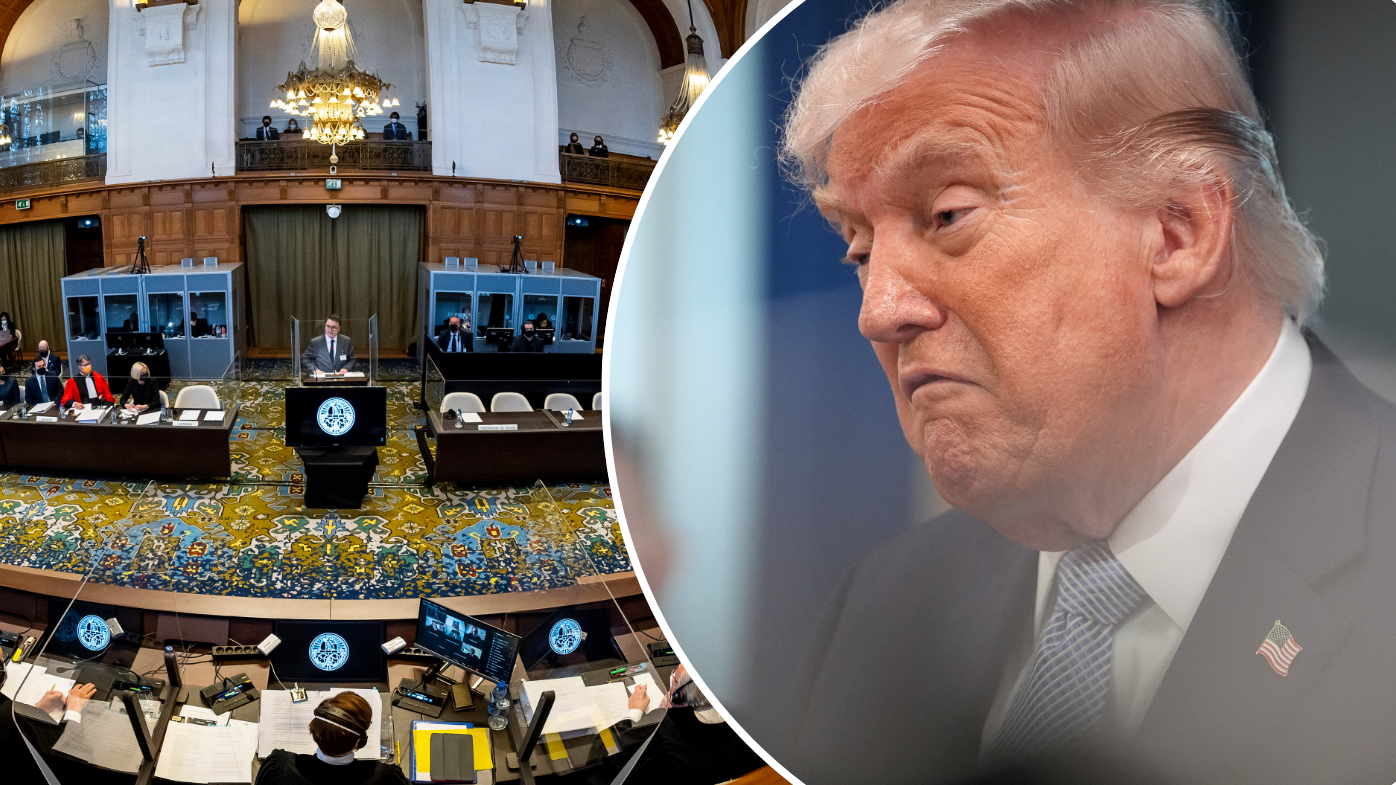
The room is quiet, save for the rhythmic, metallic ticking of a clock that feels far too small for the weight of the history it’s measuring. You aren't in a courtroom yet. You are in the silent space between a decision and its consequence. Somewhere, a commander-in-chief signs a document or utters a command. Across an ocean, dust settles on a ruined street. This is the friction point where the absolute power of a world leader meets the rigid, unyielding stone of international law.
We often talk about war crimes as if they are ghosts from another century, relics of Nuremberg or the dark forests of the Balkans. We speak of them in the abstract, using sanitized legal phrasing like "command responsibility" or "distinction." But the reality is visceral. It is the smell of scorched earth. It is the silence of a village that used to be loud. When the question arises—can a former president like Donald Trump actually be charged with a war crime—we aren't just asking about a man. We are asking if the laws we wrote to protect the vulnerable actually apply to the person holding the pen.
Justice is rarely a straight line. It is a labyrinth.
The Shield of the State
To understand why a world leader remains so difficult to touch, you have to look at the concept of the "official act." Imagine a suit of armor made of paper, yet stronger than steel. This is sovereign immunity. For decades, the legal consensus held that a president couldn't be prosecuted for actions taken as part of their official duties. The logic was simple: if a leader feared a jail cell every time they authorized a drone strike or a border policy, the gears of government would grind to a halt.
But armor has joints. Vulnerabilities exist where the personal overlaps with the political.
The International Criminal Court (ICC) in The Hague operates on a different frequency than domestic courts. While a local judge might grapple with constitutional protections, the ICC was built on the premise that certain horrors transcend national borders. The Rome Statute, the treaty that birthed the court, explicitly states that "official capacity" is no defense against genocide, crimes against humanity, or war crimes.
There is a catch. A massive, glaring complication.
The United States is not a member of the ICC. We helped design the architecture of the building, then refused to walk through the front door. We signed the treaty, but never ratified it. Under the Trump administration, the relationship between Washington and The Hague turned from cold to hostile. Sanctions were placed on ICC officials. The message was unmistakable: American soil, and American leaders, are off-limits to foreign robes.
The Shadow of the Drone
Let’s look at a hypothetical scenario to ground these legal abstractions. Suppose a commander orders a strike on a target categorized as a military necessity, but the intelligence is flawed. The result is a hospital in ruins.
Under standard military law, the burden of proof is staggering. You have to prove intent. You have to prove that the leader knew the target was civilian and ordered the strike anyway, or displayed "reckless disregard" so profound it bordered on the criminal. In the chaos of a situation room, where information is filtered through a dozen layers of bureaucracy, finding that "smoking gun" of intent is like trying to catch smoke with a fishing net.
Critics of the Trump administration’s foreign policy often point to the surge in drone strikes and the loosening of oversight rules designed to protect non-combatants. They talk about the 2017 raid in Yemen or the strike that killed Qasem Soleimani. But legal experts will tell you that a bad policy is not always a war crime. A cruel decision is not always an illegal one.
The law requires a specific kind of darkness in the heart of the act.
The Invisible Hand of Domestic Law
If the ICC is a distant thunder, domestic prosecution is the storm at the door. Could a former president be tried in a U.S. court for a war crime? The War Crimes Act of 1996 exists for this very reason. It allows for the prosecution of U.S. nationals who commit grave breaches of the Geneva Conventions.
But here, we run into the Great Wall of Immunity.
Recent Supreme Court rulings have expanded the definition of presidential immunity to a degree that makes the War Crimes Act look like a toothless tiger. If a president can claim that an order—even a horrific one—was an "official act" within the "outer perimeter" of their duties, the court system becomes a fortress. To breach it, a prosecutor would have to prove the action had absolutely no connection to the office of the presidency.
How do you separate the man from the office when the man is the one giving the orders?
It is a paradox that leaves the victims of conflict in a state of permanent waiting. They are waiting for a version of justice that may not have been built for them. They are looking for accountability in a system designed to ensure stability first and morality second.
The Weight of Precedent
History is a heavy coat. Every time we choose not to prosecute, we add a stitch to the fabric. We tell the next person in the Oval Office that the lines are blurry, and the consequences are negotiable.
Consider the international reaction. When the U.S. avoids the scrutiny it demands of other nations, it creates a "sovereignty gap." It suggests that international law is a tool for the powerful to use against the weak, rather than a universal standard. If a leader in a developing nation is hauled before a tribunal for the same types of "official acts" an American president performs, the entire moral foundation of the post-WWII order begins to crack.
This isn't just about Donald Trump. It’s about the precedent of the untouchable.
If the law cannot reach the highest office, then the law is merely a suggestion for those at the bottom. We are currently living through a period where the boundaries of executive power are being rewritten in real-time. The ink is still wet. The arguments being made in high-ceilinged courtrooms today will dictate whether a future leader feels emboldened to cross a line that was once considered sacred.
The Human Cost of the Silence
Behind every legal brief is a person whose life was changed by a signature they will never see.
Think of a father in a conflict zone, standing over a pile of rubble that used to be his kitchen. He doesn't care about the Rome Statute. He doesn't care about the nuance of sovereign immunity or the "outer perimeter" of presidential authority. He cares that his world was destroyed by a force that claims to be above the law.
When we argue about whether a president can be charged, we are really arguing about whether that father’s life has a value that the law is required to recognize.
Justice, in its purest form, is supposed to be blind. But in the theater of global politics, justice often has its eyes wide open, checking the passport and the rank of the person standing in the dock. We are trapped in a cycle where the scale of the power involved makes the application of the law nearly impossible. The bigger the act, the harder it is to categorize as a simple crime.
The Fragility of the Guardrails
The guardrails are thinner than we thought. For a long time, we relied on "norms"—the unwritten rules of decency and restraint that kept the worst impulses of power in check. But norms are not laws. They are ghosts. They vanish the moment someone decides not to believe in them anymore.
Without the threat of a gavel, the only thing holding back a war crime is the conscience of the person in power. And history has shown us, time and again, that conscience is a fickle navigator.
If a president believes they are truly immune—not just from political fallout, but from the actual, physical cell of a prison—then the nature of the presidency changes. It ceases to be an office of public trust and becomes a kingdom of permanent indemnity.
We are standing on the edge of that shift.
The legal battles surrounding Donald Trump are the first real test of this new reality. They are not just about specific documents or specific phone calls. They are about the soul of accountability. If the conclusion is that a president is beyond the reach of the law for actions taken while in power, then the Geneva Conventions are just old paper, and the "never again" we promised after 1945 was a lie we told ourselves to sleep better at night.
The clock continues to tick in that quiet room. Each second is a choice. We are deciding, right now, if the person who commands the most powerful military on earth is a citizen or a sovereign. The answer will be written not just in legal journals, but in the ruins of the next conflict, and in the eyes of those who survive it.
Power without consequence is not leadership. It is an invitation to the dark.


