The international press loves a clean, cinematic story about a brilliant con man. When the joint investigation by the Organized Crime and Corruption Reporting Project (OCCRP) and Indonesian publication Tempo dropped, the media collectively swooned over the narrative of Gaurav Srivastava—an Indian-origin businessman who supposedly managed to infiltrate Indonesia's highest political circles by simply whispering that he worked for the Central Intelligence Agency.
According to the mainstream consensus, Srivastava single-handedly hoodwinked future Indonesian President Prabowo Subianto, secured preliminary defense agreements for multi-billion-dollar fighter jets, and orchestrated multi-million-dollar loans, all based on a fake spy persona.
It is a comforting fairy tale for lazy journalists. It allows public institutions to pretend that global defense procurement is a pristine, highly regulated environment that occasionally gets disrupted by an exceptionally charismatic rogue.
The reality is far more cynical, far more transactional, and deeply embedded in how international arms sales actually operate. You do not walk into a room with a nation's defense minister and secure letters of intent for 36 F-15 fighter jets and UH-60 Black Hawk helicopters by playing dress-up. The "fake CIA agent" narrative is a convenient smoke screen. It hides the brutal mechanics of geopolitical matchmaking, corporate knife-fighting, and deniable diplomacy.
The Myth of the Gullible Sovereign
Let’s dismantle the core premise of the mainstream reporting immediately: the idea that the Indonesian defense establishment and the inner circle of Prabowo Subianto were simply naive victims of a smooth talker.
Prabowo Subianto is not a bureaucratic novice. He is a hardened former special forces commander, a seasoned political operator, and a member of one of Indonesia’s most powerful dynasties. The concept that his administration handed out five preliminary defense agreements to an absolute outsider based entirely on an unverified verbal claim of CIA employment defies basic logic.
Imagine a scenario where a foreign businessman approaches a sovereign defense ministry promising access to restricted American military hardware. In the real world, defense ministries do not check a person's intelligence credentials by asking for a badge. They measure value through a single metric: the ability to move the needle in Washington.
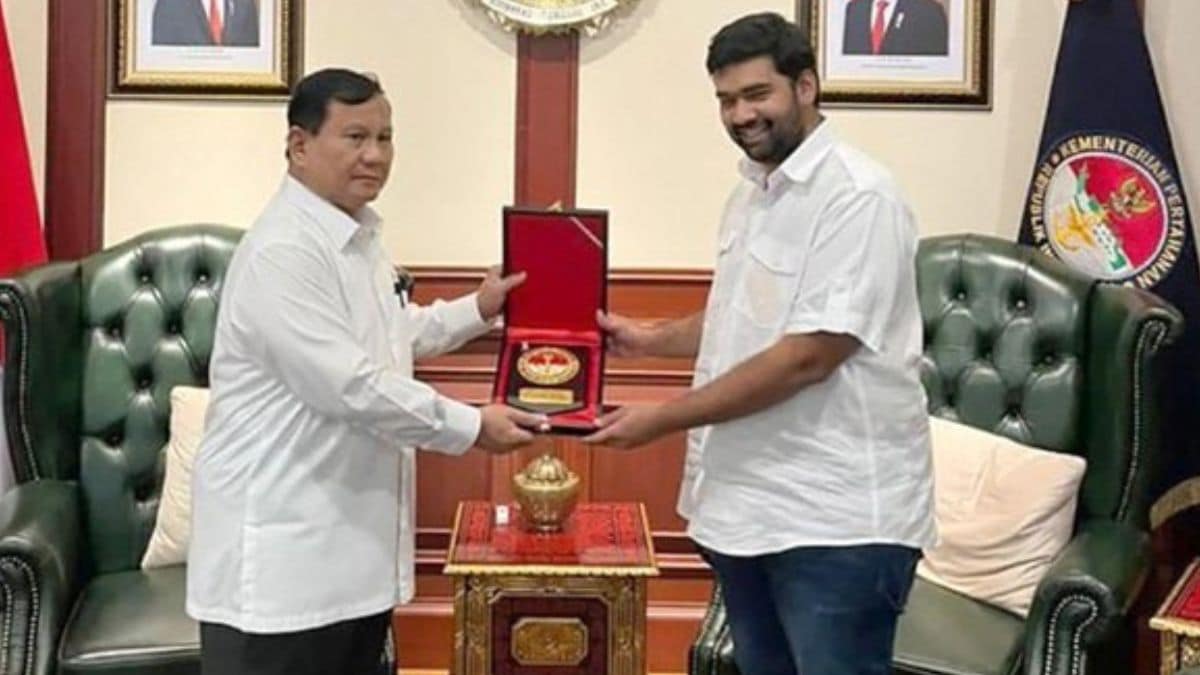
For two decades, Prabowo was subject to a US visa ban over historical human rights allegations. Yet, in October 2020, he successfully traveled to Washington, DC, to meet with senior Pentagon officials. Who accompanied him to those high-profile meetings? Gaurav Srivastava. Former acting US Defense Secretary Christopher Miller confirmed Srivastava’s presence in those high-level procurement discussions.
To the Indonesian elite, it did not matter whether Srivastava had a formal desk in Langley. What mattered was that he was sitting in the room in Washington while American defense contractors pitched military equipment to the Indonesian delegation. He demonstrated the one currency that matters in global arms deals: proximity. When Srivastava was photographed alongside Prabowo at signing ceremonies or introducing him as his "dearest friend" at the Global Food Security Forum in Bali, he wasn't tricking the Indonesian elite. He was delivering the exact political optics they required to signal their alignment with Western defense networks.
The Sanctioned Partner and the Weaponization of Lawsuits
Every explosive headline about Srivastava posing as a spy traces back to a single source: civil lawsuits filed in California and New York by his former business partner, Dutch commodities trader Niels Troost.
The media has swallowed Troost's legal complaints hook, line, and sinker, treating recorded phone calls and explosive allegations of fraud as objective truth. To understand the true nature of this dispute, you have to look at who is doing the accusing.
Niels Troost is not an innocent bystander who got swindled by a fake secret agent. He is a major oil trader who found himself under intense scrutiny and eventual sanctions by the United Kingdom, the European Union, and Switzerland for his involvement in trading Russian oil above the G7 price cap.
When a multi-million-dollar commodities operation gets hit with international sanctions, the corporate partnership assets become radioactive. The civil litigation between Troost and Srivastava is a textbook corporate asset-protection war played out in the public eye.
According to the lawsuits, Troost transferred a 50 percent stake in his company to Srivastava because he believed Srivastava’s alleged intelligence connections could shield the business from regulatory heat. When the sanctions landed anyway, the partnership imploded, resulting in a flurry of litigation designed to destroy Srivastava’s global credibility.
By framing Srivastava as a "brazen con man," the narrative conveniently diverts attention away from the underlying mechanics of the business: moving vast amounts of capital and commodities through complex international networks during a period of intense global sanctions. It is a classic legal strategy. If you are caught in a regulatory storm, turn your former partner into a public caricature to invalidate their claims on the corporate treasury.
The Shell Company Obsession
A major point of outrage in the OCCRP-Tempo investigation was the discovery that the four corporate entities controlled by Srivastava that received the preliminary Indonesian defense agreements were "shell companies" with zero history in aerospace procurement. The reports noted with great solemnity that these firms were later deregistered for failing to pay taxes.
This revelation exposes a profound ignorance of how international defense brokering operates.
Primary defense manufacturers like Boeing or Lockheed Martin do not sign direct, unmediated distribution contracts with foreign governments in volatile political markets. Instead, the entire industry relies on a specialized layer of intermediaries, consultants, and special purpose vehicles (SPVs).
These entities are intentionally designed to be ephemeral. They are created to hold specific letters of intent, insulate the parent manufacturers from liability, navigate local procurement laws, and manage the complex offset agreements required by foreign defense ministries.
When a country like Indonesia wants to buy billions of dollars worth of F-15s, the initial bureaucratic legwork is always handled by private networks. The fact that Srivastava’s companies were shell entities is not proof of a scam; it is standard operating procedure for international defense arbitrage. Once the US Defense Security Cooperation Agency officially approves the sale—as it did in 2022 for Indonesia’s potential $13.9 billion F-15 package—the temporary procurement vehicles have served their purpose and are routinely dissolved or bypassed. They are designed to be disposable tools for a specific diplomatic window.
The $51 Million Loan Anatomy
To fully grasp that this was a game of high-stakes corporate finance rather than a simple spy impersonation routine, look at the alleged $51 million loan arranged by Srivastava from his joint venture with Troost to the Arsari Group. The Arsari Group happens to be controlled by Hashim Djojohadikusumo, the billionaire younger brother of Prabowo Subianto.
The legal complaints claim Srivastava orchestrated this loan under the guise of funding a "covert US government program," only to divert a significant portion of the funds to purchase a $25 million mansion in Los Angeles.
Let’s apply basic financial literacy to this claim. You do not move $51 million across international banking compliance systems, into the accounts of a billionaire brother of a defense minister, based on a vague verbal story about a secret government program. International banks operating under strict anti-money laundering (AML) and Know Your Customer (KYC) regulations require exhaustive documentation, board resolutions, and clear commercial justifications to clear transactions of that magnitude.
The transaction occurred because there was an explicit commercial and political alignment between the parties involved. In global arms procurement, capital flight and political access are deeply intertwined. Intermediaries regularly facilitate liquidity structures for foreign elites to cement relationships before major state contracts are finalized. The subsequent falling out and allegations of diverted funds are typical of high-risk sovereign advisory work when political headwinds shift.
The Rules of Geopolitical Matchmaking
The true lesson of the Srivastava affair is not that a businessman lied about his resume. The lesson is that the global defense market is so fundamentally fragmented and reliant on informal networks that an aggressive private actor can position themselves between two sovereign superpowers.
Consider the geopolitical vacuum that existed between 2020 and 2022. Indonesia wanted to modernize its aging air force and shift away from Russian military dependence, but its defense minister was politically toxic in Washington due to historical bans. The official state-to-state diplomatic channels were rigid, slow, and constrained by public opinion.
This is precisely where the global intermediary thrives. They operate in the gray zone where official diplomats cannot go. They buy influence through massive political donations—Srivastava famously donated over $1 million to Democratic Party committees and secured photographs with President Joe Biden. They fund elite think tanks to build policy credibility, just as Srivastava co-hosted events with the Atlantic Council before they abruptly cut ties when the public relations fallout began.
By establishing a footprint in Washington’s political donor class and simultaneously maintaining a physical presence at Prabowo’s estate in West Java, an intermediary creates an artificial bridge. They tell Washington they speak for Jakarta, and they tell Jakarta they speak for Washington. If the pieces fall into place, the deal goes through, the intermediary takes a massive cut through an SPV, and the mainstream press calls them a visionary tycoon. If the partnership sours and the lawsuits fly, the exact same mechanics are re-labeled as a con job.
The defense agreements secured by Srivastava’s firms ultimately did not result in final purchases by the Indonesian government. But that is the nature of the brokerage business. Dozens of preliminary memorandums are signed for every single contract that reaches execution.
Stop looking at international defense procurement as a transparent meritocracy managed by pristine state actors. It is a market driven by access, insulated by disposable corporate structures, and fueled by private capital. Gaurav Srivastava didn't break the system; he simply operated exactly how it was designed to run, right up until the moment his partner's sanctions blew the cover off the entire operation.