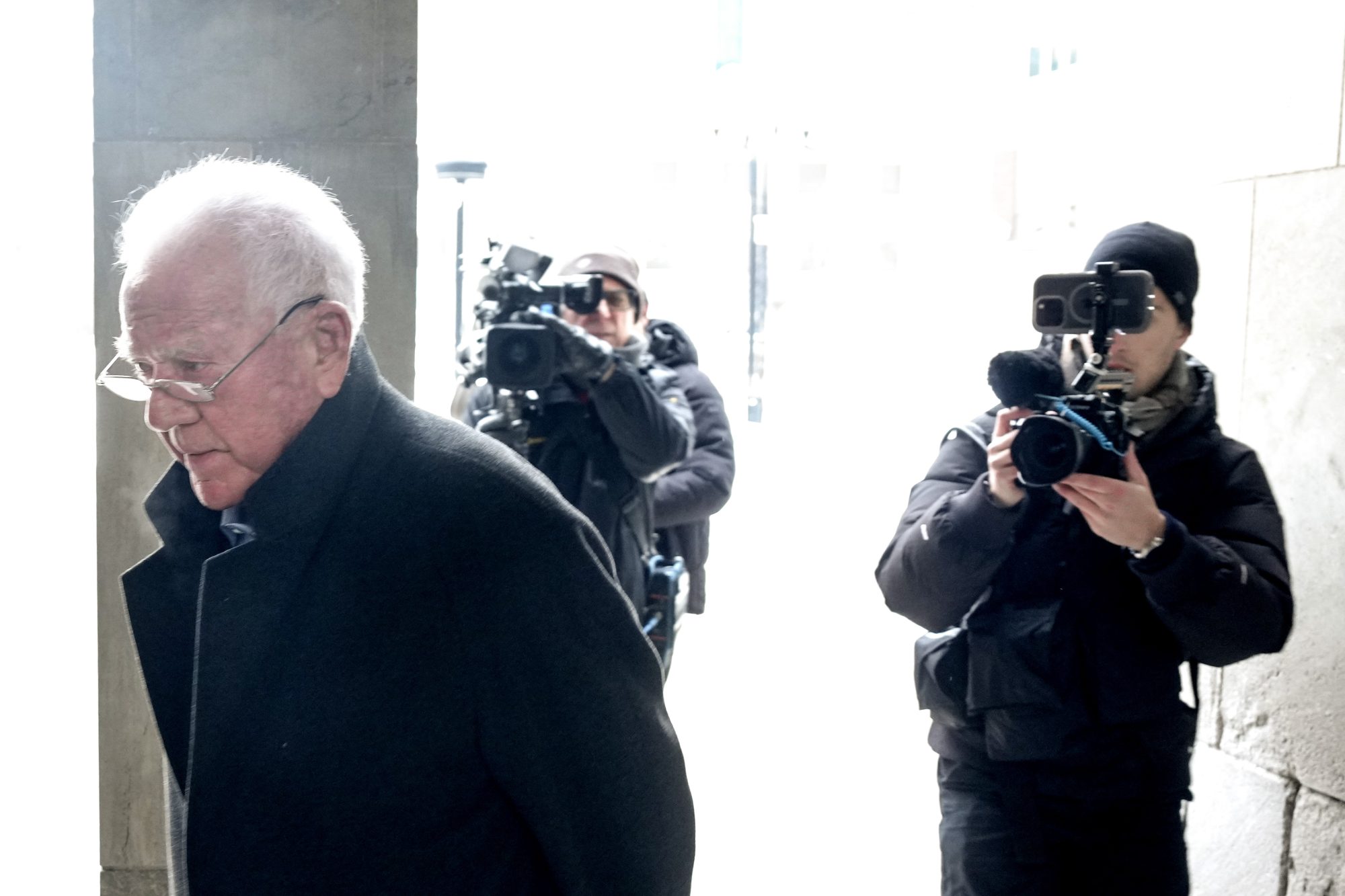
An Ontario courtroom is about to deliver a verdict that exposes the profound vulnerabilities of prosecuting historical sexual assault allegations against the ultra-wealthy. Ontario Superior Court Justice Anne Molloy will rule on the remaining five charges against 93-year-old auto-parts billionaire Frank Stronach. This decision marks a significant moment in Canadian legal history, but not for the reasons the public might assume. What began as a sweeping, multi-complainant prosecution has systematically eroded over four months of testimony. The state's case has buckled under cross-examination, exposing a series of investigative systemic gaps, incomplete police note-taking, and structural hurdles that complicate the pursuit of justice decades after an alleged event occurs.
The initial public narrative felt familiar. A powerful corporate titan, a garage-born billionaire who built Magna International into a global manufacturing empire, faced a reckoning from his past. When Peel Regional Police initially brought forward 18 charges involving 13 complainants in 2024, the sheer volume suggested an overwhelming pattern of behavior. Yet, as the Toronto trial progressed, the Crown withdrew multiple counts. They acknowledged a lack of sufficient evidence to support convictions beyond a reasonable doubt. By the time closing arguments concluded, the 12 charges involving seven women originally brought to this specific trial had dwindled to five counts involving just three complainants. This drastic reduction reveals a harsh reality about the Canadian legal system. Volume at the arrest stage does not guarantee viability at the trial stage.
The Disintegration of the Crown Case
To understand the fragility of this prosecution, one must examine how the evidence fell apart under scrutiny. Justice Molloy openly declared during the trial that she could not possibly convict Stronach based on the testimony of one remaining complainant. The judge described that specific account, which included an allegation of rape in a Toronto condominium, as fatally flawed and not even remotely reliable. Consequently, the Crown withdrew the attempted rape charge, leaving a lesser count of indecent assault, which still faced immense credibility challenges.
The unraveling of these specific counts points to a broader systemic issue. Prosecutors face a delicate balancing act when managing high-profile, multi-complainant cases. There is often a rush to present a unified pattern of conduct, bundling distinct allegations together to demonstrate a historical habit. However, if one block in that foundation is proven to be deeply unreliable or fabricated, the integrity of the entire prosecution faces immediate skepticism. Defence lawyer Leora Shemesh seized upon these inconsistencies, arguing that the entire case was built on disingenuous evidence and a reckless investigation by law enforcement.
The remaining core of the trial relies on accounts connected to Rooney’s, a popular Toronto restaurant and nightlife venue owned by Stronach in the 1980s. One complainant, a former employee, testified that after reaching out to Stronach regarding her termination, he met her for dinner. She stated he initially seemed like a fatherly mentor but later invited her to his nearby apartment, where she alleges he groped her while helping her put on her coat. The other two remaining complainants similarly trace their initial encounters with the billionaire back to that same nightlife complex.
The Failure of Investigative Protocol
A central battleground in this trial was not just what happened in the 1980s, but how the police collected data in 2024. The defence launched a blistering attack on the investigative methods of the Peel Regional Police. They brought to light incomplete, sloppy, and missing notes from pretrial interviews between investigators, prosecutors, and the complainants.
In any criminal proceeding, police notes are a critical baseline. They preserve the raw, unpolished memory of a witness before they enter the formal environment of a courtroom. When officers fail to take detailed records, it creates an information vacuum. The defence argued this lack of documentation was unacceptably negligent. It left open the dangerous possibility that complainants had altered their narratives over time or had been inadvertently coached during preparatory sessions.
The Crown fought back against this characterization, asserting that minor discrepancies and shifts in detail are natural when individuals attempt to recall traumatic events that happened 40 years ago. Prosecutor Jelena Vlacic maintained that the core of the women's allegations remained solid and believable. She urged the court to view the inconsistencies as peripheral rather than central to the acts of assault themselves.
This friction highlights the fundamental mismatch between human memory and the strict demands of criminal law. The human brain does not record trauma like a digital video file. Memories fade, timelines blur, and peripheral details morph. Yet, a judge operating in a criminal court must demand precision. The standard of proof is not balance of probabilities; it is proof beyond a reasonable doubt. When police work is messy, it widens the gap where doubt can comfortably reside.
The Power Dynamics of Multi-Million Dollar Defences
This trial demonstrates the immense tactical advantage available to defendants with unlimited financial resources. A typical historical assault trial in Ontario rarely sees this level of forensic deconstruction. Stronach’s legal team had the resources to dissect decades of public records, corporate histories, and corporate timelines to challenge the specific dates and geographic locations provided by the complainants.
When a complainant says an event occurred in a specific room of a specific building in 1982, a well-funded defence team can unearth architectural blueprints, property deeds, and employment records to prove the building did not exist or was under renovation at that exact time. This luxury of deep-dive investigation is rarely available to the average defendant, nor is it always matchable by under-resourced public prosecution service branches.
The strategy was clear. The defence aimed to demonstrate that the details the complainants initially relayed to police either changed significantly upon entering the witness box or were contradicted by historical facts. In a judge-alone trial, this approach targets the absolute core of the judicial process: the evaluation of credibility. Justice Molloy is a highly experienced jurist known for her analytical mind. She will not convict on a vibe or an assumption of historical corporate misbehavior. She requires a seamless line of credible testimony.
The Looming Shadow of the Second Trial
Whatever Justice Molloy decides, it will not mark the end of Stronach’s legal battles. The initial judicial strategy split the massive corporate case into two distinct proceedings to ensure a manageable trial process. Stronach faces a second criminal trial in Newmarket, Ontario. That proceeding involves an additional six complainants and is scheduled to begin in May 2027.
The delay of that second trial until 2027 introduces another complicating factor: the advanced age of the defendant. Stronach is currently 93 years old. By the time a jury is empaneled in Newmarket, he will be nearly 95. The legal system must grapple with the logistical and ethical realities of prosecuting nonagenarians for actions alleged to have occurred in the mid-to-late 20th century. Fitness to stand trial, cognitive longevity, and the sheer physical toll of prolonged litigation all become active variables.
The systemic lesson here is that delayed justice alters the nature of the truth itself. When a society permits or causes decades to pass before allegations are brought to a courtroom, the tools available to achieve an objective truth become blunted. Documents are lost. Witnesses pass away. The corporate entities that once shielded or enabled powerful individuals transform or disappear.
The upcoming ruling from Justice Molloy will provide a definitive answer on these five specific charges, but it leaves open a far more unsettling question about how the justice system handles the intersection of extreme wealth, historical trauma, and police execution. When the state fails to execute flawless investigative protocols from the very first interview, it jeopardizes the platform upon which victims seek accountability, leaving the final outcome to hang on the thin thread of decades-old recollections under the knife of elite cross-examination.
You can watch an overview of the initial trial layout and background details in this Billionaire Frank Stronach's sexual assault trial set to begin today in Toronto broadcast, which outlines the multi-jurisdictional division of the charges and the corporate history of the defendant.


