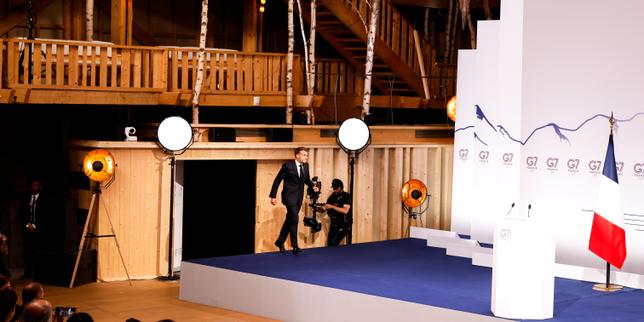
Emmanuel Macron stood before the cameras at the close of the G7 summit to project an image of Western unity and French leadership. Behind the polished rhetoric of the press conference lay a far more volatile reality. The French president attempted to frame the summit as a triumph of coordinated diplomacy on Ukraine, global trade, and security. A closer inspection of the actual agreements reveals that these announcements are fragile compromises masking deep-seated divisions among member states. Macron is wrestling with a severe domestic political crisis following a bruising European election defeat, meaning his performance was as much about survival at home as it was about strategy abroad.
The official narrative coming out of the summit highlighted a historic agreement to use frozen Russian assets to back a fifty-billion-dollar loan for Ukraine. This was presented as a decisive blow against Moscow and a testament to Western resolve.
When you strip away the celebratory language, the financial architecture of this deal is incredibly shaky. The mechanism relies on using the future interest generated by roughly three hundred billion dollars of immobilized Russian central bank assets, most of which are held in Europe. The core legal and logistical problem is risk allocation. If the war ends, or if the assets are unfrozen as part of a peace settlement, the stream of interest disappears. Who carries the debt if the collateral vanishes?
United States officials pushed hard for European nations to absorb the brunt of this financial risk, arguing that since the assets sit in European repositories like Euroclear, Europe should guarantee the loan. France and Germany pushed back vigorously, demanding a shared risk distribution across all G7 members. The final text glossed over this dispute with vague wording, leaving the actual implementation to technical committees. It is a classic bureaucratic delay tactic. The money will not flow immediately because the underlying legal dispute remains unresolved.
Macron’s domestic vulnerability cast a long shadow over every session in Italy. Having just dissolved the French National Assembly and called a snap legislative election, he arrived as a leader who could lose his parliamentary majority within weeks. This political weakness changed the way his counterparts treated him.
Foreign leaders are transactional by nature. They do not invest heavy political capital in agreements with a head of state whose mandate might be functionally crippled in a month. Observers at the summit noted a distinct shift in dynamics, with power migrating toward leaders with more stable domestic footing. Macron attempted to use the international stage to demonstrate that he remains the indispensable architect of European foreign policy. The reality is that his colleagues were already looking past him, quietly drafting contingency plans for a France led by a hostile prime minister from the political opposition.
This domestic distraction weakened France's ability to shape the summit’s agenda on critical economic matters. Take trade policy toward China. The United States has been aggressive in demanding blanket tariffs on Chinese green technology, electric vehicles, and semiconductors. Macron has historically advocated for European strategic autonomy, trying to find a middle path that protects European industries without triggering an all-out trade war that would devastate export-heavy economies like Germany.
With Macron’s attention divided, the final G7 statement leaned heavily toward the American position. The text issued warnings to Beijing over industrial overcapacity and market-distorting practices. This aggressive stance risks retaliatory measures from China, which could target European agricultural exports—a sector that forms the backbone of Macron’s remaining political support in rural France. By failing to moderate the G7’s economic stance, Macron may have inadvertently accelerated a trade conflict that French businesses are ill-prepared to fight.
Global South relations emerged as another area where Macron’s press conference rhetoric clashed with structural failures. The French president spoke passionately about building a more equitable partnership with developing nations, particularly across Africa. He pointed to initiatives aimed at reforming global financial systems and providing debt relief.
These promises ring hollow to the leaders invited to the summit as observers. Countries like Brazil, India, and Kenya have grown weary of Western promises that fail to materialize into actual capital. The G7's focus remains overwhelmingly Eurocentric, consumed by the war in Ukraine and the containment of China. Macron’s attempt to position France as a bridge between the West and the Global South is failing because Paris refuses to back its rhetoric with significant concessions on agricultural subsidies or voting rights in institutions like the International Monetary Fund.
The Subtext of the Migration Debate
The summit's handling of migration exposed the ideological divisions running through the current crop of Western leaders. Host Prime Minister Giorgia Meloni pushed hard to include language focusing on deterrence, border enforcement, and agreements with third countries to stop migrant departures. Macron tried to soften this approach by emphasizing the need for legal migration pathways and humanitarian standards.
The resulting compromise was a messy hybrid that satisfied no one. Meloni secured a commitment to establish a G7 coalition to fight human trafficking, a move she can use to validate her domestic policy. Macron was forced to accept a text that shifted noticeably toward a security-first framework. This concession illustrates how much ground traditional centrist leaders are losing to populist forces across the continent. Macron can no longer dictate the terms of the European debate on migration; he is playing defense, trying to minimize damage to his progressive credentials while conceding the structural argument to the political right.
Energy and Climate Policy Regression
Climate change was another area where the conference offered lofty goals but delivered minimal substance. The G7 reaffirmed its commitment to transition away from fossil fuels, but the text included significant loopholes inserted at the behest of nations worried about immediate energy security.
France under Macron has placed its bets entirely on nuclear energy as the solution to carbon neutrality. While he successfully lobbied to have nuclear power recognized in the final text as a clean energy source, this victory does not solve the immediate challenge of funding renewable energy projects in developing economies. The G7 refused to commit new, hard capital to international climate funds, relying instead on the hope that private investors will step in to fill a multi-trillion-dollar gap. It is an unhelpful strategy that ignores the high interest rates and political risks that prevent private capital from entering these markets in the first place.
The Illusion of AI Governance
Macron also used his press conference to tout progress on international regulations for artificial intelligence. He praised the G7 for endorsing an international code of conduct for organizations developing advanced AI systems.
This code of conduct is entirely voluntary. It possesses no enforcement mechanisms, no penalties for non-compliance, and no independent oversight bodies. It functions as a public relations shield for major technology companies, many of which are headquartered in the United States and wield more economic influence than several G7 member states. Macron’s celebration of this agreement ignores the reality that while the West signs non-binding codes, technology companies are continuing to deploy systems that rewrite the rules of labor markets, data privacy, and information security without public accountability. France will host the AI Action Summit next year, but without a fundamental shift toward legally binding treaties, that gathering will simply repeat the empty gestures seen in Italy.
The true takeaway from this G7 summit is not the list of achievements Macron presented to the press. It is the visible deceleration of Western influence. The group represents a shrinking share of global economic output and faces internal fragmentation driven by domestic political instability. Macron’s performance was an exercise in maintaining appearances while the structural foundations of his foreign policy are eroding. He sought to project power, but succeeded only in highlighting the limitations of a presidency trapped between an unyielding international landscape and an unforgiving domestic electorate.