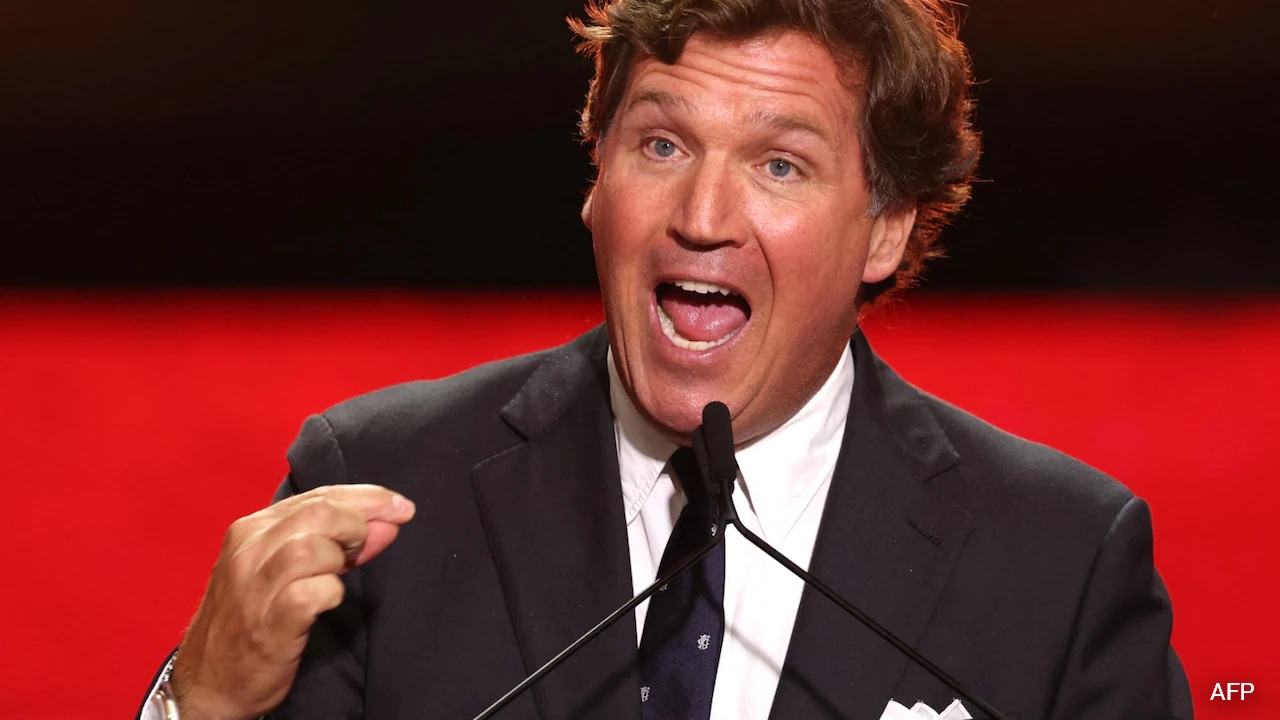
The air in the room was thick with the scent of expensive catering and stale coffee. Hundreds of donors, activists, and party loyalists sat in folding chairs, adjusting their blazers, waiting for the standard script. They expected the usual red meat. They expected the familiar rallying cries against the opposition, the predictable promises of a red wave, and the comfortable assurance that the party was a united front marching toward inevitable victory.
Instead, they watched the curtain rip open.
Tucker Carlson stood at the podium, looked out at the sea of expectant faces, and did something unthinkable in modern partisan politics. He walked away from the team.
Political parties operate like ancient tribes or modern corporate monopolies. They demand absolute brand loyalty. You wear the color. You cheer for the logo. You forgive the internal corruption because the alternative, you are told, is utter ruin. But when one of the most recognizable voices on the American right looked at the Republican establishment and explicitly stated he would no longer support the party, the tremor shook the bedrock of the conservative movement. It was not a minor policy disagreement. It was a declaration of divorce.
To understand why this matters, look past the cable news graphics and the social media outrage. Consider a hypothetical voter named John. John lives in a town where the manufacturing plant closed a decade ago. He feels abandoned by Washington, forgotten by coastal elites, and deeply skeptical of institutions. For years, John tuned into prime-time commentary because it felt like someone was finally articulating his rage. He voted Republican because he believed the party was a vehicle for that rage.
Now, the man who helped fuel that belief is telling John that the vehicle is rusted out, broken down, and headed in the wrong direction.
This creates an existential crisis for millions of voters. When the gatekeepers of an ideology tell their audience that the institution representing that ideology is hollow, the narrative fractures. Carlson’s public defection highlights a profound, simmering tension that has been building for years between the populist base and the traditional party elites.
The traditional wing of the Republican Party—the donors, the corporate strategists, the neoconservative policy hawks—views politics through a lens of economic deregulation and international intervention. The populist base views the world through a lens of cultural preservation, economic protectionism, and a deep-seated distrust of foreign entanglements. For a long time, these two factions shared a fragile marriage of convenience, held together by a mutual dislike of the political left.
That marriage is over. The paperwork has been filed.
When a prominent media figure completely disavows the party apparatus, it exposes the reality that the Republican brand is no longer a monolith. It is a battleground. The stakes are not merely about who wins the next primary or who raises the most money in the next quarter. The stakes are about the very definition of American conservatism. Is it a movement dedicated to institutional stability and corporate growth, or is it a populist revolt against institutions themselves?
Think of a major political party like an aging ocean liner. It requires a massive amount of momentum to turn, and it relies on a crew that follows orders without question. When the chief navigator stands on the deck, points to the bridge, and tells the passengers that the captains are blind and the engines are failing, panic sets in. The passengers begin looking for liferafts.
This ideological fracturing leaves the average voter in a confusing, isolated position. For decades, the binary choice of American politics provided a sense of identity. You knew who your friends were, and you knew who your enemies were. When those lines blur, when the figures you trusted tell you that your own side is betraying you, the psychological safety net disappears. Skepticism morphs into cynicism.
The traditional party machinery relies on predictable behavior. It relies on voters showing up to vote for the letter next to a name, regardless of the individual holding the office. But populism, by its very nature, is volatile and anti-institutional. It cannot be easily managed by committee meetings or focus groups. When the base is told that the party establishment is just as corrupt, just as disconnected, and just as self-serving as the opposition, the entire strategy of partisan loyalty collapses.
Consider what happens next: a political vacuum. History shows that when large groups of people lose faith in traditional political structures, they do not simply become passive observers. They look for new loyalty structures. They look for figures who promise to burn down the old systems rather than reform them. The rejection of the party apparatus is a symptom of a much larger, systemic breakdown in trust across every sector of American life.
The financial donors in Washington and New York may look at these developments and believe they can buy their way out of the problem. They believe that a fresh coat of paint, a new marketing campaign, or a charismatic new candidate can stitch the coalition back together. They are wrong. You cannot fix a structural flaw with a cosmetic solution. The resentment running through the base is not theatrical; it is foundational.
We are watching the reorganization of American political life in real-time. The old map, defined by traditional left-versus-right dynamics, is dissolving. A new map is being drawn, defined by an entirely different conflict: the insider versus the outsider, the center versus the periphery, the institution versus the individual.
The crowds will still gather at the conventions. The banners will still be raised, and the balloons will still drop from the ceilings. But the energy in the room has shifted. The applause is louder for the critics than it is for the candidates. The loyalty to the party line has evaporated, replaced by a fierce, unpredictable allegiance to individuals who promise to disrupt the status quo.
The silence that followed the declaration of non-support was not the silence of apathy. It was the silence of a crowd realizing that the walls of the house they inhabited for decades were suddenly crumbling around them.

/https://tf-cmsv2-smithsonianmag-media.s3.amazonaws.com/filer/c6/97/c697b065-e0bd-4970-81ea-819779296b91/u765404inp.jpg)
