The asphalt on Paseo de la Reforma retains heat long after the sun dips behind the skyscrapers. It radiates through thin-soled shoes, a heavy, breathless warmth that smells of charred corn, diesel exhaust, and anticipation.
When the final whistle blew, the city broke open. Julián Quiñones and Raúl Jiménez had forced the ball into the net, sealing a 2-0 opening victory against South Africa. Tens of thousands of people flooded the streets, a sea of green jerseys screaming until their throats burned. It was the familiar, desperate catharsis of a football-mad nation hosting the world's biggest tournament for the third time.
But if you looked down, away from the flares and the waving flags, you saw him.
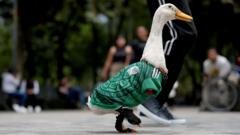
He was two years old. He stood roughly twelve inches tall. He was wearing a custom-tailored Mexican national team jersey, complete with a tiny, white collar, and miniature green socks pulled taut over webbed feet.
Merlin. A Pekin duck.
While twenty-two men ran themselves into exhaustion on the pristine grass of the stadium, this domestic duck waddled calmly through the absolute chaos of Mexico City's post-match euphoria. He didn’t panic at the air horns. He didn’t flinch at the roaring crowds. He just kept pace with his family, stepping rhythmically over discarded bottle caps and flattened cardboard.
By midnight, the million-dollar athletes were inside air-conditioned hotel rooms. Merlin was on TikTok, racking up views by the millions. The world had found its unofficial mascot, born not in a corporate boardroom or a marketing brainstorm, but on the unforgiving pavement of the historic center.
The Economy of a Cart
To understand how a duck ends up in a football jersey on a major avenue, you have to look at the weekends that came before the tournament.
Carla Gómez doesn't have a corporate sponsorship. She has a metal cart. Every Saturday and Sunday, rain or blistering sun, she pushes that cart through the Alameda Central, past the marble grandeur of the Palace of Fine Arts, and into the massive expanse of the Zócalo square. She sells bottled water and soft drinks to tourists who are parched from the high-altitude sun.
Her son, Cristian, is always there. And so is Merlin.
Merlin was originally a gift for Cristian, an ordinary pet meant for an ordinary home. But the family quickly realized that leaving him behind in an empty room felt wrong. He was part of the unit. He became the boy’s inseparable shadow. When Carla pushed the cart, Merlin walked beside it, acting as a strange, feathered sentry for their modest livelihood.
Long before FIFA ever knew his name, Merlin was already a hyper-local street celebrity. He was a sales engine. Passersby would stop, startled by the sight of a pristine white duck navigating the chaotic currents of Mexico City pedestrian traffic. Squeals of delight turned into photo requests. Photo requests turned into sales of bottled water.
"We don't like to leave him alone at home," Carla explains, her voice carrying the protective, fierce edge of a mother who knows how hard the city can be. "He's our baby. He's the baby, the sole heir to all my possessions, and now an idol."
It is a joke, but only barely. In the informal economy of the capital, Merlin wasn't just a pet. He was the anchor of their daily survival.
The Magic of the Absurd
There is an inherent gravity to the World Cup. It represents billions of dollars in infrastructure, geopolitical posturing, and the immense psychological pressure of national expectation. For Mexico, co-hosting alongside Canada and the United States, the stakes feel crushing. Every match is an interrogation of national pride.
Then comes the duck.
Consider what happens next when the absurd collides with the hyper-commercialized reality of modern sports. Within days of going viral on Reforma Avenue, the corporate machine noticed. FIFA representatives reached out. Suddenly, Carla and Cristian were standing in front of professional lighting rigs, watching their water-selling pet pose for official promotional photographs and commercial shoots.
The internet demanded Merlin be placed inside the stadiums. Commenters dubbed him a national treasure. In a tournament defined by hyper-optimized athletes and tightly controlled public relations, a duck in socks offered something money couldn't buy: pure, unmanufactured joy.
Yet, despite the sudden whirlwind of international attention, Carla remains remarkably grounded. When asked about the official mascots—the tournament’s stylized jaguar or the local axolotl symbols—she handles it with the quiet diplomacy of someone used to navigating the street.
"We are very respectful," she said, ensuring no feathers were ruffled in the official mascot offices. "We respect the axolotl as much as the jaguar. We don't like controversy, honestly."
For her, the world hasn’t actually changed. The global spotlight is just a louder version of the noise they encounter every single weekend.
The Prophet of Group A
If Merlin’s first act was surviving the crowds, his second was prophecy.
Harkening back to the legendary days of Paul the Octopus, Merlin was recently presented with two miniature flags ahead of the second Group A fixture: Mexico and South Korea. With the calm deliberation of a seasoned pundit, the duck waddled forward and tapped his beak against the Mexican flag.
It is easy to dismiss this as mere spectacle. But football has always survived on superstition, luck, and the desperate search for good omens. For a nation that hosted the tournament in 1970 and 1986—years etched into the cultural memory as eras of legendary matches and heartbreaking finishes—Merlin represents a living, breathing lucky charm.
The family is leaning into the magic. They hope the momentum carries through the upcoming clash with the Czech Republic on June 24.
"Mexico, we are with you," Carla said, her small cart still stationed not far from the historic plazas where her life unfolds every week. "And Merlin is your number one fan."
The tournament will eventually pack up its bags. The massive stadiums will quiet down, the temporary corporate banners will be torn down, and the international stars will fly back to their European clubs. The tourists will leave the Zócalo.
But on the following Saturday, a metal cart will still squeak across the pavement near the Palace of Fine Arts. A woman will call out the price of cold water. A young boy will guide the way. And beside them, perhaps slightly more worn but no less dignified, a white duck will take his steps on the warm asphalt, completely unaware of the world he captivated, simply content to stay close to the people who give him a home.