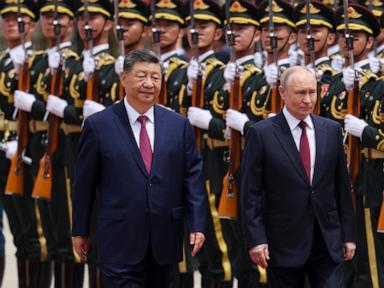
Mainstream media outlets love a neat, predictable narrative. When Vladimir Putin lands in Beijing just four days after Donald Trump wraps up his high-stakes summit with Xi Jinping, the copy practically writes itself for the talking heads. They scramble to describe it as a coordinated show of force, a calculated display of "limitless" friendship designed to stick a collective thumb in America’s eye. They paint China as a defiant, ideological partner-in-crime standing shoulder-to-shoulder with Moscow against Western pressure.
It is a comforting, dramatic story. It is also completely wrong.
Having analyzed these geopolitical chess boards for over two decades, I have watched Western analysts repeatedly mistake transactional desperation for an unbreakable axis. If you look past the carefully staged red carpets, the military bands, and the children waving flags outside the Great Hall of the People, you see a completely different dynamic.
This back-to-back scheduling is not a demonstration of shared Sino-Russian defiance. It is an masterclass in cold, calculated asymmetric leverage. Beijing is not building an unbreakable wall with Russia; it is running an ideological extraction racket, systematically turning a desperate, sanctioned neighbor into a hyper-dependent economic colony.
The Myth of the Equal Partnership
The lazy consensus insists that Putin’s 25th official visit to China is a demonstration of mutual strength. In reality, the power dynamic has never been more warped.
Consider the raw economic data. Bilateral trade between Russia and China crossed $240 billion, more than doubling pre-Ukraine war levels. Western analysts point to this number as proof of an ironclad alliance. What they ignore is the structural asymmetry. Russia needs China to survive; China views Russia as a cheap, high-risk commodity warehouse.
By squeezing Russia out of European markets, Western sanctions handed Xi the ultimate buyer’s monopoly. China now absorbs roughly 50% of Russia’s crude oil exports. Moscow is functionally selling its crown jewels at a steep "sanctions discount." Putin did not fly to Beijing from a position of power; he arrived to beg for economic lifelines while trying to salvage the stalled Power of Siberia 2 gas pipeline.
Putin’s team can claim there is "no connection" between Trump’s departure and his arrival all they want. The reality is that Xi hosted Trump to discuss trade tariffs and the ongoing US-Iran war, and then immediately used that leverage to dictate terms to a weakened Russian delegation. Xi is not a partner. He is the ultimate landlord, and Putin's rent is past due.
Dismantling the Illusion of Neutrality
Publicly, Beijing postures as a neutral arbiter in global conflicts, whether in Ukraine or the Middle East. Privately, they are practicing a ruthless form of multi-aligned opportunism.
Let's address the flawed premise behind the question often asked by nervous Western diplomats: "Is China preparing to enter a formal military alliance with Russia?"
The answer is a brutal no, because doing so would be a massive strategic downgrade for Beijing.
- No Liability: Formal alliances require mutual defense obligations. Xi has zero intention of tying China’s economic future to Moscow's military quagmires.
- Asset Liquidation: China treats Russia like a distressed asset. They will buy the oil, absorb the natural gas, and flood Russian markets with Chinese consumer electronics and vehicles, but they will not risk secondary Western sanctions on their major financial institutions to bail Putin out.
- The Washington Card: Xi uses Putin as a lever to scare Washington into concessions. By holding the keys to Russia's economic survival, Beijing forces the US to treat China as an indispensable global manager.
Imagine a scenario where the US-Iran war escalates further, threatening the Strait of Hormuz. Russia desperately wants this escalation to drive up global oil prices and divert Western military hardware away from Europe. China, the world's largest energy importer, relies heavily on a stable Middle East. The idea that Xi and Putin share identical strategic goals falls apart under the slightest economic friction.
The High Cost of the Extraction Game
Every contrarian strategy has its vulnerabilities, and Beijing’s current playbook carries a massive, underreported downside. By turning Russia into an economic vassal state, China is systematically destroying its remaining credibility with the European Union.
I have spoken with European trade officials who are utterly exhausted by Beijing’s double game. You cannot realistically claim to be a stabilizing global superpower while simultaneously financing the industrial base of the nation disrupting European security.
By keeping Russia on life support just enough to keep the West distracted, China is fast-tracking the decoupling of its own tech and manufacturing sectors from Western markets. Xi is trading long-term institutional trust with his largest wealthy consumer markets for short-term, cheap energy from a collapsing kleptocracy. It is an aggressive, high-risk trade, and the margins are shrinking.
The Actionable Order for Global Strategy
Stop analyzing the Sino-Russian relationship through the outdated lens of the Cold War. There is no communist bloc. There is no shared ideological crusade.
If you are a corporate strategist, an investor, or a policy analyst trying to map out global risk, ignore the joint statements signed at the Great Hall of the People. They are diplomatic theater designed to generate headlines.
Instead, track the pricing differentials of Siberian crude oil entering Chinese ports. Monitor whether Chinese tech giants are establishing permanent corporate infrastructure in Moscow, or if they are merely skimming profits through shell companies in Central Asia. The data shows they are keeping one foot out the door.
Xi Jinping is not building a new world order alongside Vladimir Putin. He is managing a controlled liquidation of the Russian economy, ensuring that when the dust settles, Beijing owns the infrastructure, the resources, and the terms of surrender.