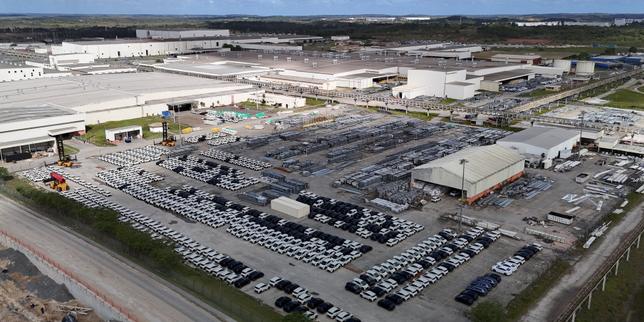
The corporate press loves a good economic resurrection story. Ever since BYD took over the ghost town left behind by Ford in Camaçari, Bahia, a lazy consensus has dominated the business media. The narrative is comforting: an aggressive, green Chinese giant swoops into Northeast Brazil, pours billions into a defunct industrial complex, and single-handedly engineers a modern reindustrialization miracle.
It is a beautiful fiction. It is also entirely wrong.
I have spent years watching multinational corporations set up shop in emerging markets, promises of "technology transfer" and "economic revivals" trailing behind them like parade confetti. I have seen companies blow millions chasing localized supply chains that never materialize. The reality of BYD's aggressive push into Bahia is not an industrial renaissance. It is a brilliant, ruthless exercise in regulatory arbitrage and low-value assembly.
If you think Bahia is becoming the next Silicon Valley, you are asking the wrong question. The question isn't how much BYD is investing, but what exactly they are leaving behind.
The Maquiladora Myth: Assembly is Not Industry
The core misunderstanding centers on what a factory actually does. Traditional automotive journalism treats a car plant like a monolith: parts go in, cars come out, the local economy wins.
But there is a massive structural gulf between true manufacturing and what is happening right now in Camaçari.
+-------------------------------------------------------------+
|               THE VALUE CHAIN ILLUSION                      |
+-------------------------------------------------------------+
|  HIGH VALUE (Retained in China)                              |
|  - R&D, Software Architecture, Advanced Battery Chemistry   |
+-------------------------------------------------------------+
|  LOW VALUE (Exported to Brazil)                             |
|  - Complete Knock-Down (CKD) Assembly, Local Welding, Paint |
+-------------------------------------------------------------+
BYD is currently operating what the industry calls a Complete Knock-Down (CKD) setup. The high-value intellectual property—the software architecture, the advanced battery cell chemistry, the powertrain engineering—is developed and manufactured in Shenzhen. The components are packed into containers, shipped across the ocean, and bolted together in Bahia.
This is not a high-tech hub. It is a glorified maquiladora.
To call this a "reindustrialization" of Northeast Brazil ignores the mechanics of modern automotive supply chains. True industrialization requires a deep, domestic web of tier-one and tier-two suppliers. When Ford pulled out in 2021, that local ecosystem died. BYD is not resurrecting it; they are bypassing it. Why spend a decade developing local metallurgy and component vendors when you can just ship the entire supply chain from China in a box?
The Subsidy Trap: Who is Really Paying for the Green Revolution?
Let us talk about the money. The media framing suggests Chinese capital is bankrolling the Bahia comeback. In reality, Brazilian taxpayers are underwriting their own disruption.
The political maneuvering behind the Camaçari plant is a masterclass in extracting fiscal favors. BYD did not choose Bahia out of corporate altruism. They chose it because the federal and state governments extended aggressive tax incentives originally designed for traditional internal combustion manufacturers.
- Tax Exemptions: Massive reductions on import duties for components.
- State Level Subsidies: Aggressive VAT (ICMS) breaks tailored to keep the Camaçari complex alive.
- The Irony: Domestic Brazilian industries operate under one of the most complex, punishing tax burdens in the world, while an external monopoly receives a red carpet.
This creates an artificial market distortion. The Dolphin Mini did not become Brazil's top-selling electric vehicle solely through manufacturing efficiency. It achieved dominance because it sits on a foundation of government-sponsored price advantages. When state-level fiscal incentives are the primary driver of profitability, you do not have a sustainable industrial hub. You have a project that lives and dies by the stroke of a politician's pen.
The Battle Scars of Localized Labor
The most critical crack in the savior narrative lies in human capital. Proponents point to the promise of thousands of regional jobs. But building an EV requires an entirely different skill set than assembling a gas-chugging Ford EcoSport.
I have managed operations where Western or Asian management styles collide with Latin American labor realities. The friction is always underestimated.
In Bahia, this friction turned toxic. Labor authorities and federal prosecutors stepped in after investigations revealed hundreds of Chinese workers brought in by sub-contractors were working under degrading, illegal conditions to build out the facility. While a multi-million dollar settlement was reached at the end of 2025, the underlying operational tension remains.
Local Brazilian workers have already staged protests over basic on-site conditions—citing issues ranging from transport logistical failures to workplace amenities. This is what happens when an ultra-fast, top-down industrial culture meets a highly unionized, legally protected labor environment. The culture clash isn't an annoying footnote; it is an active bottleneck to achieving the 150,000-vehicle-per-year production target.
Dismantling the Consensus
"BYD is bringing the green transition to the masses in Latin America."
Let us look at the numbers. While a $24,000 Dolphin Mini is cheap compared to a Tesla, it is still an unattainable luxury for the vast majority of the Brazilian population. The average monthly wage in the Brazilian Northeast hovers well below R$3,000.
An EV boom concentrated in wealthy enclaves of São Paulo and Rio de Janeiro, assembled by low-wage labor in Bahia, using parts imported from China, is not an egalitarian green transition. It is an economic siphon.
The Strategic Reality
Does this mean BYD's Brazilian venture will fail? Absolutely not. As a corporate strategy, it is brilliant. They have successfully:
- Blocked Western competitors from gaining a foothold in Latin America's largest market.
- Secured a strategic export platform to bypass potential tariffs in other regional markets.
- Convinced the local government to subsidize the infrastructure needed to distribution-print their vehicles.
But stop calling it an economic revival for the Northeast.
True economic development leaves behind deep, independent local capability. It leaves behind domestic patents, local capital accumulation, and a supply chain that can survive if the parent company decides to pivot. When the music stops, and if the subsidies dry up, an assembly plant can be abandoned just as quickly as Ford abandoned it.
The shiny new cars rolling off the line in Camaçari are impressive pieces of tech. Just remember that the brain, the profits, and the real industrial power remain firmly rooted in Shenzhen. Bahia is just holding the wrench.