Deconstructing a complex street food dish like chaat requires analyzing it not merely as a recipe, but as a multi-phase structural system. The traditional preparation relies on a delicate equilibrium of contrast: hot against cold, crisp against soft, fatty against acidic. When modifying this system to incorporate a nutrient-dense structural base like kale, the primary challenge is managing moisture migration and enzymatic breakdown. Standard culinary narratives treat the addition of kale as a simple health substitution. In reality, introducing a highly fibrous, moisture-rich brassica alters the entire kinetic behavior of the dish, requiring specific chemical and mechanical interventions to prevent structural collapse.
Optimizing this system requires balancing three distinct thermodynamic and textural variables: the crispness retention of the fried pastry casing, the cellular breakdown of the raw greens, and the viscosity of the liquid emulsifiers.
The Three Pillars of Chaat Architecture
To understand why standard interpretations of samosa kale chaat fail, one must map the dish using a strict functional framework. Every ingredient serves a specific mechanical purpose within the sensory matrix.
1. The Rigid Structural Substrate (The Samosa)
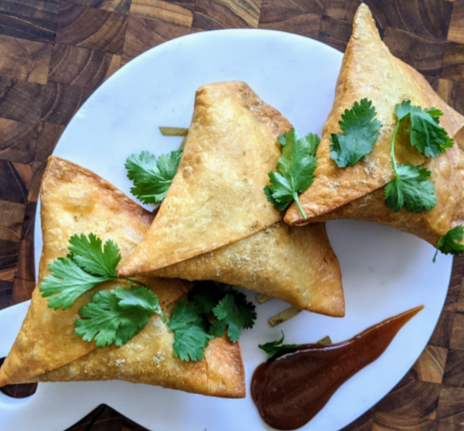
The samosa functions as the thermal and textural anchor of the dish. The pastry shell, typically a shortcrust dough (maida) enriched with lipids (ghee or oil), owes its structure to localized gluten development and starch gelatinization during deep-frying.
- The Core Mechanism: The frying process expels moisture from the outer crust, creating a porous, hydrophobic barrier.
- The Failure Point: When broken open for chaat, the interior steam from the spiced potato and pea filling escapes. If the surrounding matrix contains unmanaged free water, the crust rapidly reabsorbs moisture via capillary action, rendering the pastry sodden within minutes.
2. The Fibrous Foundation (The Kale Matrix)
Substituting traditional crisps (papdi) or puffed rice with kale introduces a significant biochemical hurdle: cellulose toughness and bitter sulfur compounds (glucosinolates).
- The Core Mechanism: Raw kale possesses a thick waxy cuticle and rigid cellular walls that resist mastication and prevent flavor absorption.
- The Failure Point: Simply chopping raw kale creates an unpleasant, dry texture that detaches from the rest of the dish. Conversely, over-dressing the kale prematurely triggers osmotic pressure, drawing water out of the plant cells and creating a pool of liquid at the base of the plate that degrades the samosa crust.
3. The Viscous Emulsifiers and Fluid Elements (Yogurt and Chutneys)
The liquid phase consists of sweetened yogurt (dahi), tamarind chutney (saunth), and mint-coriander chutney. These are not merely flavor enhancers; they are functional colloids.
- The Core Mechanism: The yogurt provides a fat-protein emulsion that coats the palate, buffering the heat from capsaicin. The chutneys provide organic acids (tartaric acid from tamarind, citric acid from lemon) that stimulate salivation and balance the heavy lipids of the fried pastry.
- The Failure Point: If the yogurt's viscosity is too low, it runs off the ingredients, pooling at the bottom. If its acidity is unchecked, it curdles upon contact with the warm samosa filling.
The Mass Transfer Problem: Preventing Textural Sogginess
The primary failure mode in any chaat assembly is phase separation and structural degradation—commonly referred to as sogginess. This is governed by mass transfer, where water moves from areas of high water activity (the chutneys and wet greens) to areas of low water activity (the fried pastry).
[Chutneys / Plasmolyzed Kale] ---> High Water Activity (\alpha_w)
                                    |
                                    v  (Capillary Migration)
                                    |
[Fried Samosa Pastry Shell]   ---> Low Water Activity (\alpha_w)
To retard this process, the culinary architect must manipulate the surface tension and application timing of the components.
First, the kale must undergo a controlled mechanical and chemical breakdown before assembly. This is achieved through targeted massaged marination, a process known as plasmolysis. By introducing a precise quantity of sodium chloride (salt) and lipids (olive oil or mustard oil) to the torn leaves, you create an osmotic gradient. The salt draws out just enough cellular water to soften the rigid cell walls without fully collapsing the leaf structure, while the oil coats the surface, creating a temporary hydrophobic shield that prevents the kale from absorbing the water-based chutneys later.
Second, the yogurt must be stabilized. Standard commercial yogurt contains a high percentage of whey, which separates easily under acidic or thermal stress. Utilizing strained yogurt (such as Greek yogurt or hung curd) increases the protein density (casein micelles), yielding a thicker structural matrix that stays suspended on top of the rugged kale and samosa fragments rather than migrating downward.
Systemic Recipe Formulation and Execution
Executing this dish requires precise staging. The following protocols treat the assembly as an engineered sequence, ensuring maximum textural contrast at the point of consumption.
Component Preparation
1. The Engineered Kale Base
- Material Selection: Use Lacinato (dino) kale rather than curly kale. Lacinato exhibits a more uniform, planar surface area, allowing for even lipid distribution and predictable mastication.
- Mechanical Reduction: De-stem the leaves entirely. The fibrous stems contain xylem vessels that are unpalatable in a raw state. Chiffonade the leaves into narrow 5mm ribbons to maximize surface area for flavor adhesion while minimizing chewing resistance.
- Chemical Modification: For every 100 grams of processed kale, apply 1.5 grams of kosher salt and 5 milliliters of cold-pressed oil. Massage manually for exactly 90 seconds. The leaves will decrease in volume by approximately 40% and shift to a deep, translucent green. Allow this matrix to rest for 10 minutes, then express any expelled surface water.
2. The Thermal Component (The Samosa)
- Thermal Optimization: The samosas must be fried or reheated until the internal core temperature reaches 74°C (165°F) to ensure the potato starches remain in a fully gelatinized, fluid state.
- Deconstruction Protocol: Do not pulverize the samosa. Break it into exactly three or four stable fragments immediately prior to assembly. This exposes the steaming interior to allow immediate venting, minimizing the internal condensation that softens the lower crust.
3. The Fluid Phase (The Dahi and Chutneys)
- Yogurt Stabilization: Whisk 200 grams of hung curd with 5 grams of fine sugar and 1 gram of roasted cumin powder. The sugar does not merely sweeten; it interacts with the water molecules, reducing the free water available for migration. Ensure the mixture is chilled to 4°C (39°F) to maximize its viscosity.
- Chutney Viscosity Check: The tamarind chutney must be reduced to a syrupy consistency (resembling maple syrup), which indicates a high brix level (sugar concentration) that slows down its movement through the structural layers.
The Assembly Hierarchy
The order of assembly determines the rate of structural decay. The layers must be built from the ground up based on their structural resilience and moisture profiles.
Layer 5: Micro-Textural Modifiers (Sev, Pomegranate, Chaat Masala)
Layer 4: Fluid Phase Colloids (Chilled Yogurt, Tamarind & Mint Chutneys)
Layer 3: Thermal Anchor (Deconstructed Warm Samosa Fragments)
Layer 2: Mechanical Buffer (Cooked Chickpeas / Chana)
Layer 1: Hydrophobic Structural Base (Massaged Lacinato Kale Matrix)
- The Base Layer: Lay down the massaged kale matrix as the foundational floor. Its oil-coated surfaces will act as a barrier against any pooling liquids.
- The Buffer Layer: Add a sparse layer of warm, seasoned chickpeas (chana). These legumes are starchy and highly absorbent; they act as a functional sponge, catching excess moisture from the top layers before it reaches the bottom of the dish.
- The Thermal Placement: Nestled on top of the chickpeas, arrange the broken samosa fragments. This positions the crisp pastry safely above any potential fluid pooling while remaining close enough to the base to blend during consumption.
- The Colloid Application: Drizzle the stabilized yogurt directly over the warm samosa pieces and kale. Follow immediately with the sharp lines of tamarind and mint chutneys. Applying the cold yogurt directly to the hot samosa creates a sharp thermal contrast that defines high-quality chaat.
- The Micro-Textural Finish: Flash-deposit fine chickpea flour vermicelli (sev) and fresh pomegranate seeds over the top. The sev adds immediate, fleeting crunch, while the pomegranate seeds provide pressurized, localized bursts of acidity upon mastication, cutting through the heavy lipid profile of the dish.
Analytical Limitations of the Strategy
While this framework yields a texturally superior dish compared to standard methods, it possesses hard operational boundaries.
The primary limitation is time-to-consumption. Despite the hydrophobic oil coating on the kale and the stabilization of the yogurt, the system exists in a state of kinetic instability. Once the acid-heavy chutneys contact the exposed starch matrices of the samosa crust and the chickpeas, the degradation of the crisp pastry accelerates exponentially.
The structural half-life of this dish—the point at which 50% of the maximum crispy-to-soft contrast is lost—is approximately seven minutes from the introduction of the fluid phase. Consumption must occur within this window.
A secondary limitation involves temperature management. Serving a dish that contains both a hot core (74°C samosa) and a cold shell (4°C yogurt) introduces rapid thermodynamic equalization. If left sitting, the entire system settles into an unappealing, lukewarm equilibrium.
The Definitive Operational Play
To deploy this dish successfully in either a commercial or high-stakes domestic setting, discard the conventional method of pre-mixing or tossing components in a bowl. Treat the preparation as an as-needed assembly line. Maintain the kale base, stabilized yogurt, and chutneys in separate, temperature-controlled zones (4°C) until the exact moment of service. Drop the samosas into a flash-fryer or high-convection oven at 200°C for 3 minutes to maximize outer crust dehydration. Execute the 5-layer vertical assembly within a maximum window of 45 seconds, and serve immediately on a pre-chilled plate to delay thermal dissipation.