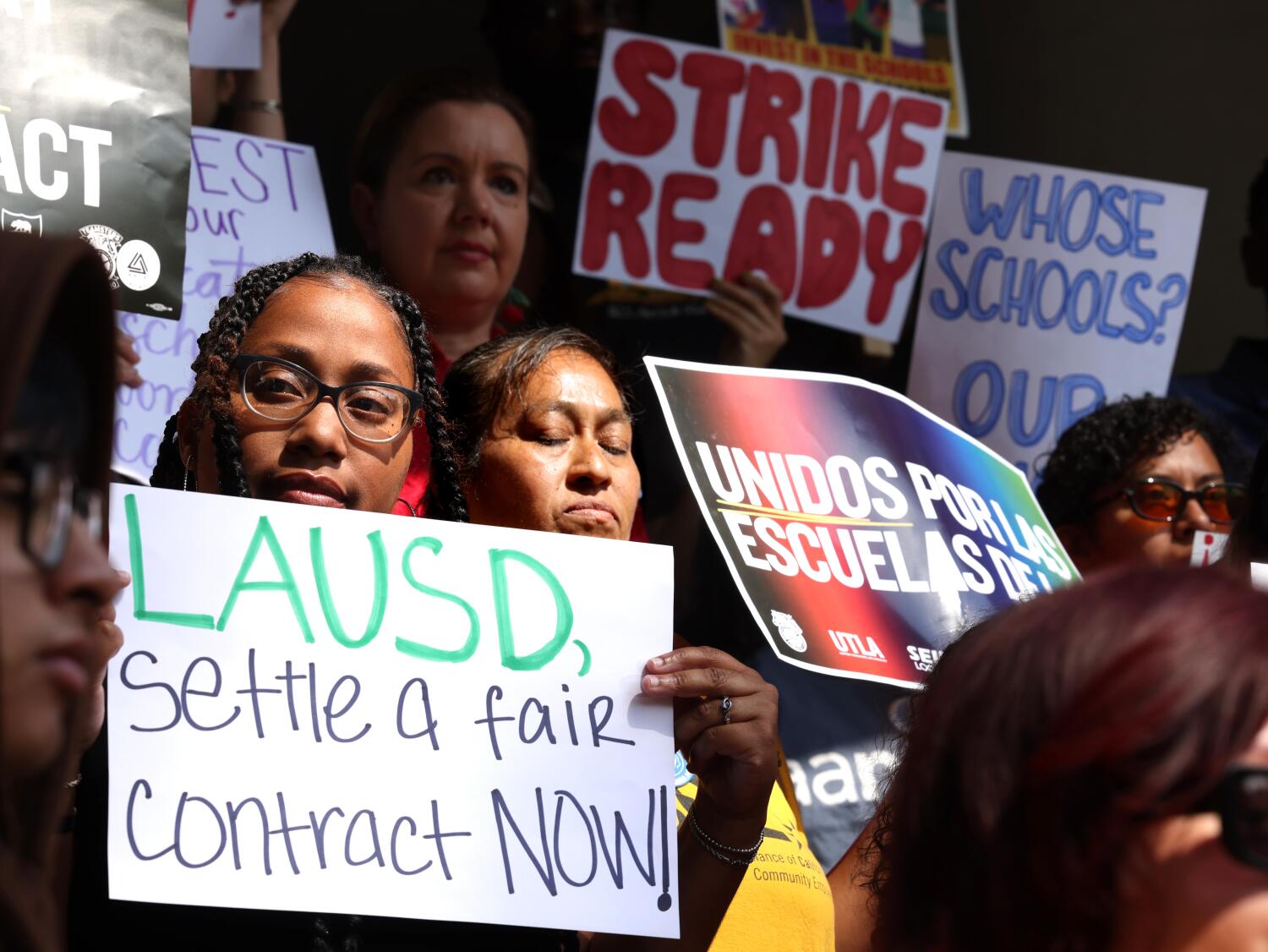
The resolution of the Los Angeles Unified School District (LAUSD) labor dispute represents more than a logistical restart of classes; it serves as a case study in the structural tension between fixed public budgets and the inflationary pressures on human capital. When a labor strike ends with a tentative agreement, the immediate relief of resumed service often obscures the underlying reallocation of resources and the long-term fiscal constraints imposed by the settlement. The stability of a $9 billion-plus biennial budget depends not on the absence of conflict, but on the calibration of wage growth against the district’s declining enrollment and fluctuating state tax receipts.
The Tri-Component Conflict Model
To understand why the LAUSD strike reached an impasse and subsequently a resolution, one must analyze the interaction between three specific pressures: cost-of-living parity, operational staffing density, and pension-driven fiscal overhang.
- Cost-of-Living Parity: For the SEIU Local 99 members—comprising cafeteria workers, bus drivers, and custodians—the negotiation was an exercise in real-wage preservation. In an environment where regional CPI (Consumer Price Index) increases have outpaced public sector wage growth for multiple cycles, the union’s demand for a 30% increase was a structural correction rather than a standard merit increase.
- Operational Staffing Density: Beyond hourly rates, the dispute centered on the "hours-worked" variable. Many support roles in the district are historically part-time or seasonal. Increasing hours for these roles creates a permanent shift in the district's fixed-cost base, as fringe benefits and healthcare eligibility are often triggered at specific hourly thresholds.
- Pension-Driven Fiscal Overhang: Every percentage increase in base salary compounds the long-term liabilities of the California Public Employees' Retirement System (CalPERS) and the California State Teachers' Retirement System (CalSTRS). The district is not just negotiating current cash flow; it is negotiating the terminal value of its debt obligations 30 years into the future.
The Mechanism of the Tentative Agreement
The "tentative" nature of the deal indicates a ceasefire based on a high-level consensus on the Wage Floor and Benefit Retention. While specific details often remain under embargo until member ratification, the architecture of such deals typically follows a front-loaded compounding structure.
A 30% increase over several years is rarely linear. It usually involves a retroactive payment to address the "lost time" during negotiations, followed by staggered percentage increases. This creates a "Step-Up" effect in the budget:
- Year 1: Immediate liquidity drain via retroactive checks.
- Year 2-3: Incremental pressure as the base salary floor rises.
- Year 4: The new "Steady State" where the total payroll is permanently 30% higher, regardless of future revenue fluctuations.
The district’s ability to offer this without immediate insolvency suggests a reliance on one-time COVID-era relief funds or an optimistic projection of state-level COLA (Cost of Living Adjustment) from the California Governor’s budget. However, relying on one-time funds for permanent salary increases creates a "fiscal cliff" the moment those funds are exhausted.
Evaluating the Leverage of the Sympathy Strike
A critical variable in this conflict was the alliance between SEIU Local 99 and United Teachers Los Angeles (UTLA). This cross-union solidarity shifted the power dynamic from a localized disruption to a total system shutdown.
In a standard labor model, the employer can often weather a strike from a single department by outsourcing or temporary reallocation. However, when the teachers (UTLA) refuse to cross the picket lines of the support staff (SEIU), the district loses its primary product: instruction. This creates a Maximum Pressure Point. The district’s daily loss of state funding—which is tied to Average Daily Attendance (ADA)—becomes an untenable burn rate.
The financial incentive for the district to settle is driven by the fact that every day the schools are closed, millions of dollars in ADA revenue are permanently forfeited. Unlike a factory that can make up production via overtime later, a school day lost is revenue that cannot be clawed back unless the entire school calendar is extended, which requires further negotiations and costs.
Structural Risks in Post-Settlement Environments
The resumption of school on Tuesday does not signify a return to the status quo. It initiates a new phase of operational risk.
The Compression Effect
As the wages for entry-level support staff rise significantly, the district faces "wage compression." This occurs when the pay gap between unskilled labor and skilled labor (or mid-level management) narrows. To maintain morale and hierarchy, the district will inevitably face pressure to raise salaries for the next tier of employees, leading to a "cascading cost" that was likely not fully modeled in the initial SEIU agreement.
The Enrollment Paradox
LAUSD is currently navigating a secular decline in student enrollment. As the student population shrinks, the per-pupil funding remains stagnant or decreases in real terms. Simultaneously, the labor agreement has increased the fixed cost per student.
- Total Budget / Total Students = Cost Per Seat.
- If the numerator (Budget) increases by 30% and the denominator (Students) decreases by 2-5% annually, the Cost Per Seat accelerates at an unsustainable rate.
Logistics of the Re-entry Phase
Opening schools on a Tuesday after a multi-day shutdown requires a complex synchronization of the supply chain.
- Nutrition Services: Inventory for school lunches must be replenished. Perishables timed for a previous week must be discarded and replaced, representing a sunk cost of hundreds of thousands of dollars.
- Transportation: Bus routes must be reactivated. For a district the size of LAUSD, this involves the coordination of thousands of vehicles and drivers who have been off the clock and potentially disconnected from the centralized dispatch system.
- Safety and Sanitation: A three-day vacancy in urban school facilities often requires a rapid sanitation sweep before students return.
The "win" for the union in this scenario is the demonstration of their essentiality. The "win" for the district is the cessation of the ADA revenue drain.
The Political Economy of Public Education Labor
The intervention of local political leadership, such as the Mayor’s office, functions as a non-economic catalyst. While the Mayor of Los Angeles has no formal authority over the LAUSD (which is an independent taxing entity), the office provides "Political Cover." By mediating the deal, the Mayor allows both the Superintendent and the Union President to retreat from their maximalist positions without appearing to "blink" first.
This mediation, however, often prioritizes immediate labor peace over 10-year fiscal solvency. The pressure to "get the kids back in school" overrides the actuarial reality of how these raises will be funded in 2028 or 2030.
Strategic Forecast for Urban Districts
The LAUSD settlement will serve as the benchmark for every other major urban school district in the United States. We are entering a period of Labor Belligerence in the public sector.
- Unions will increasingly use "Coordinated Bargaining" where different locals strike in tandem to ensure total system paralysis.
- Districts will be forced to choose between "Service Reduction" (closing schools, cutting programs) or "Tax Levies" to fund the new labor floor.
- The "Total Compensation" model—including healthcare and pensions—will come under scrutiny as the cash-on-hand required for salary increases eats into the reserves meant for long-term liabilities.
The most probable outcome for LAUSD is a three-year period of relative peace, followed by a severe budgetary contraction. As the one-time federal subsidies expire, the district will be forced to reconcile a 2023-level wage structure with a 2026-level revenue reality. This will likely result in "Involuntary Attrition"—where the district simply stops replacing retiring workers—to lower the headcount and rebalance the books.
The strategic imperative for district leadership moving forward is the aggressive automation of non-instructional tasks and the consolidation of facilities. If the unit cost of labor is fixed at a higher rate, the only remaining variable for fiscal health is the reduction of total labor hours across the system. The strike ended the walkout, but it accelerated the timeline for a fundamental restructuring of how the district operates its physical and human infrastructure.
To maintain the integrity of the system, the district must now pivot from crisis management to Operational Efficiency Auditing. Every department must justify its headcount against the new wage reality. The "tentative" deal is a high-cost insurance policy against immediate chaos, purchased with the district's future flexibility.