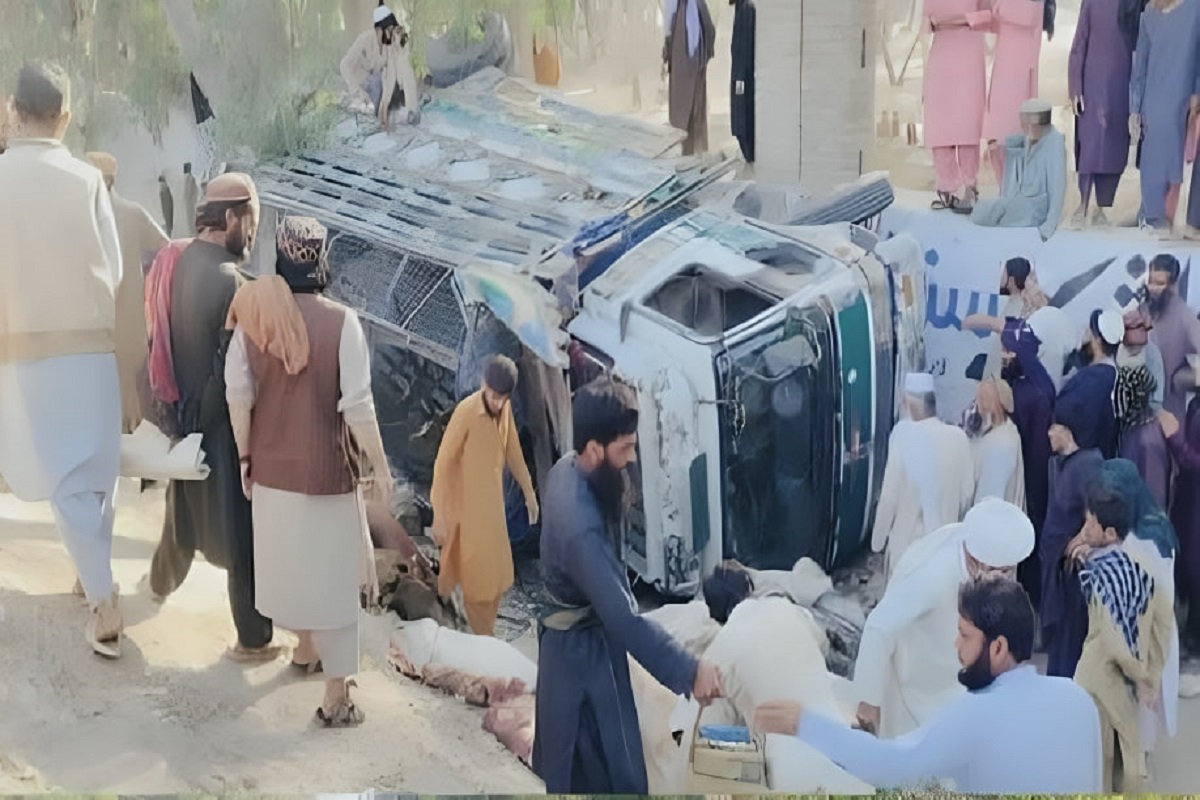
The dust in Zabul province does not settle; it hangs. It clings to the clothes of travelers, coats the windshields of ancient, overworked vehicles, and fills the back of the throat with the metallic taste of a harsh, unforgiving geography. On a stretch of highway in southern Afghanistan, this dust became a shroud.
To the casual observer scanning a news feed, the report reads like a cold mathematical equation: one truck, a sharp turn, eighteen dead, ten of them children. The mind processes the numbers, registers a brief pang of distant sympathy, and moves on to the next headline. But statistics are a defense mechanism. They insulate us from the heavy, suffocating weight of reality.
Behind those numbers is the smell of burning rubber, the sudden, terrifying shift of gravity, and the silence that follows an unimaginable roar.
The Economy of a Truck Bed
In the West, a truck bed is for cargo, lumber, or perhaps a weekend move. In rural Afghanistan, it is a bus. It is a lifeline. When infrastructure is fractured by decades of conflict and economic isolation, public transport is not a matter of timetables and air-conditioned cabins. It is a matter of whatever moves.
Imagine a family. Let us call the father Mohammad. He does not have a sedan or the money for private transit. He has a destination—perhaps a market, a clinic, or a relative’s home across the province. When a heavy cargo truck pulls over, offering space in the back for a fraction of a traditional fare, it is not a risky choice. It is the only choice.
Families climb over the metal tailgates. Parents pull their children close, bundling them against the wind and the churning dust of the unpaved roads. Ten children settled into that specific truck bed. They likely giggled as the engine roared to life, holding onto each other, feeling the vibration of the massive diesel engine beneath their feet.
They were not statistics yet. They were a family on a journey.
When the Ground Gives Way
The roads in southern Afghanistan are deceptive. They are ribbons of packed earth and broken asphalt, carved through terrain that changes without warning. Drivers operate under immense pressure, navigating routes with vehicles that have seen far better days, often carrying loads well beyond their intended capacity.
Then comes the moment of imbalance.
A sharp turn taken slightly too fast. A sudden shift in the unanchored weight in the back. A blown tire, or perhaps a section of the roadbed crumbling under the massive weight of the vehicle.
Physics is brutal. It does not care about the innocence of the passengers.
When a heavy truck rolls over, time stretches. The initial tilt triggers an instant, collective gasp. Then, the world turns upside down. Tons of steel crush against the earth, grinding everything beneath and within it. The momentum carries the wreckage forward, plowing through the dirt, throwing passengers into a chaotic swirl of metal, debris, and suffocating dust.
And then, the sound stops.
The Aftermath in the Desert
The immediate aftermath of a rural highway disaster is defined by isolation. There are no sirens fading in from the distance. No fleets of ambulances arriving within minutes with flashing lights and organized trauma teams.
Instead, there is the desert.
Witnesses from nearby villages or passing drivers are the first responders. They pull over into the dust, running toward the overturned chassis with bare hands. What they find is a scene of profound devastation. Eighteen bodies scattered across the dirt. Ten of them small, fragile, and utterly still.
The grief in these moments is not quiet. It is loud, echoing across the barren landscape as survivors realize what has been lost in a matter of seconds. For the local authorities who eventually arrive, the task shifts from rescue to recovery, lifting bodies onto the backs of other vehicles, documenting the names of those who will never return home.
The Invisible Factors
Why does this happen? To blame the driver or the specific turn is to miss the larger, more systemic tragedy. This is the cost of a broken infrastructure.
Decades of instability mean that highway safety protocols are virtually non-existent in these remote regions. Vehicle inspections are a luxury. Road maintenance is sporadic at best. When a country's economy is strained to the breaking point, safety becomes a secondary concern to basic survival and movement. People take risks because the alternative is immobility.
Consider the reality of traveling in Zabul. The province is rugged, mountainous in parts, and deeply rural. To get from one district to another requires navigating passes that would challenge modern, well-maintained SUVs. Doing so in an overloaded commercial truck is a daily gamble with fate.
On this particular day, eighteen people lost that gamble.
Moving Beyond the Headline
It is easy to look at a tragedy in a far-off place and view it as a symptom of a world entirely separate from our own. We read about the overturning of a truck in Afghanistan with the same emotional detachment we might reserve for a weather report.
But the grief of a mother holding a lifeless child in the Zabul dust is identical to the grief of a mother in London, New York, or Tokyo. The pain is universal. The vulnerability is shared.
The next time a brief bulletin mentions a transport disaster in a remote corner of the world, remember the dust. Remember the ten children who were simply looking at the sky from the back of a truck, watching the landscape roll by, completely unaware that the road beneath them was about to end.