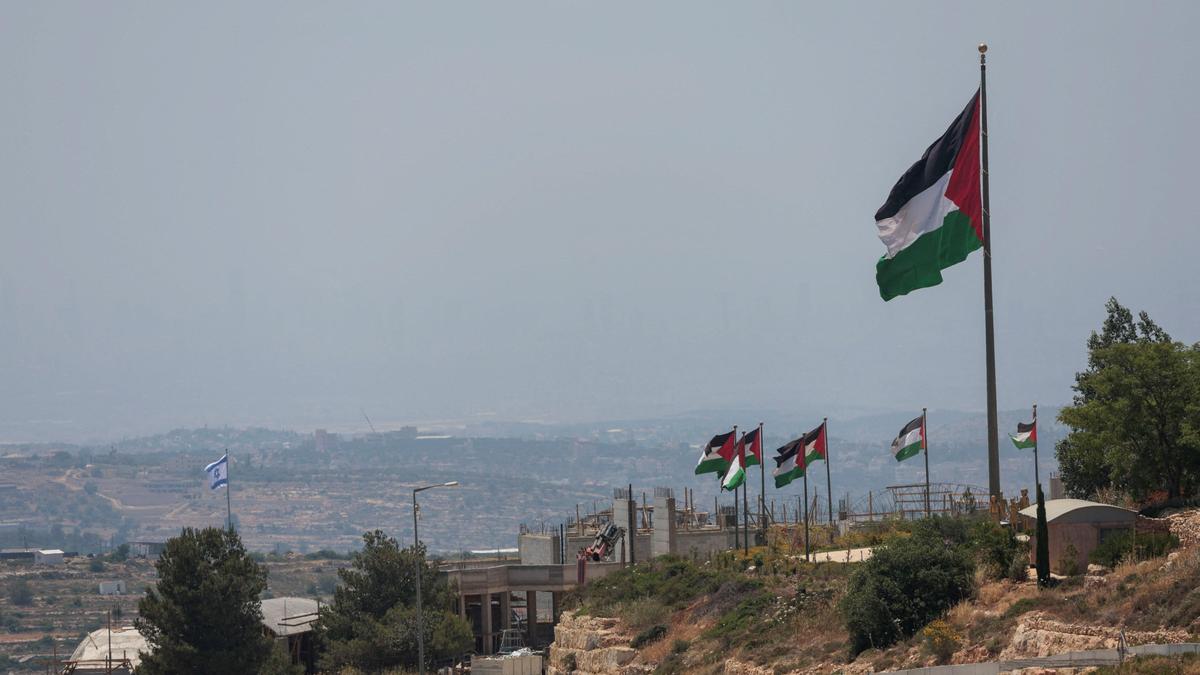
The morning air in the hills north of Jerusalem does not care about geopolitics. It smells of wild thyme, baked limestone, and the sharp, metallic tang of diesel exhaust. For decades, these ridges have maintained a fragile, uneasy silence, punctuated only by the bleating of goats and the distant hum of traffic.
Then came the bulldozers.
They arrive not as a sudden invasion, but as a persistent, grinding reality. To look at a map of the West Bank is to look at a puzzle where the pieces are constantly stretching, reshaping, and crowding each other out. Government offices issue announcements filled with dry, bureaucratic jargon—zoning permits, state land declarations, municipal boundaries. But on the ground, that paperwork translates directly into the sound of pneumatic drills shattering ancient rock.
This is not just an expansion of housing. It is a fundamental rewriting of the landscape, executed one concrete foundation at a time.
The Arithmetic of the Horizon
Consider a family living in a small village nestled in the valley. For generations, their worldview was defined by the open horizon, the terraced hillsides, and the shared knowledge of who owned which olive grove. Wealth was not stored in bank accounts; it was rooted in the dirt.
Now, imagine looking out your kitchen window and seeing a new ridge line forming above you. First comes the security fence, a ribbons of razor wire cutting through ancestral grazing lands. Next are the access roads, paved with pristine black asphalt that slices through old dirt tracks. Finally, the cranes arrive, lifting pre-fabricated concrete walls into place with mathematical precision.
The scale of modern settlement planning is staggering. We are no longer talking about scattered clusters of mobile homes on remote hilltops. The current initiatives focus on massive, high-density urban developments designed to attract thousands of new residents. Thousands of apartments. Hundreds of public parks. Shopping centers. Schools.
The numbers provided by international monitors and local planning committees tell a story of acceleration. When a government approves thousands of new housing units in a single administrative session, it is making a statement that reaches far beyond the immediate neighborhood. It changes the arithmetic of the region. Every new structure cements a reality that becomes exponentially harder to undo with diplomatic negotiations.
The Friction of Two Realities
The conflict here is often viewed through the lens of international law, high-level diplomacy, and UN resolutions. Critics point to the Fourth Geneva Convention, arguing that transferring a civilian population into occupied territory violates the bedrock principles of modern global order. Proponents counter with historical ties, security imperatives, and administrative rights over disputed land.
But leave the legal chambers behind for a moment. Step onto the roads where these two populations actually intersect.
The infrastructure of expansion creates a strange, parallel universe. There are roads designed for one group, built to bypass the towns of another. You can drive from a modern, air-conditioned suburb with manicured lawns directly into a major metropolitan center via a series of tunnels and bridges, completely insulated from the reality of the people living in the valley below.
This spatial separation breeds a profound psychological distance. When you don't share the same roads, the same water grid, or the same legal system, the people on the other side of the concrete wall cease to be neighbors. They become abstract variables. Security threats. Obstacles.
The tension manifests in the daily commute. A journey that should take fifteen minutes stretches into hours at a military checkpoint. For a Palestinian laborer, the expansion means tighter restrictions, less room to breathe, and the constant, suffocating feeling of being hemmed in. For an Israeli settler moving into a newly approved housing development, the expansion represents safety, affordability, and the fulfillment of a historical or religious connection to the land.
Two entirely different human experiences, unfolding on the exact same coordinate points.
The Silent Architecture of Exclusion
The true weight of this expansion lies in its permanence. A temporary military outpost can be dismantled in an afternoon. A four-story apartment building made of reinforced concrete, anchored into the bedrock of a Judean hill, is built to last for generations.
Water becomes a central battleground in this quiet war of attrition. Developing large suburban communities requires massive amounts of resources. As deep wells are drilled to supply the swimming pools and green lawns of new settlements, the surrounding agricultural villages often find their traditional springs drying up. The water table does not recognize political borders, but the distribution infrastructure certainly does.
This is how displacement happens in the modern era. It rarely involves dramatic, late-night expulsions. Instead, it is a slow, bureaucratic choking out. It is the denial of a building permit for a family home, coupled with the sight of an entire apartment complex rising legally just five hundred meters away. It is the gradual loss of access to fields, the rising cost of utilities, and the realization that the future for your children in this place is shrinking by the day.
The Fractured Future
Diplomats in distant capitals still speak of a two-state solution, using phrases that sound increasingly hollow to anyone standing on the hills of Samaria. The geography required for a viable, contiguous Palestinian state is being systematically dismantled. The new construction plans are strategically located to link existing settlement blocs, creating a solid wall of development that effectively bisects the territory.
What remains is a patchwork quilt of isolated enclaves.
The people who live here, on both sides of the divide, understand this implicitly. They see the map changing in real-time. The anxiety is palpable, hovering over the region like the summer dust. There is a terrifying uncertainty about what happens when the last open hillside is paved over, when the final boundary line is drawn, and when there is simply no more room left to retreat.
The sun begins to set, casting long, dramatic shadows across the valley. The orange glow hits the white stone of the new apartment buildings, making them shine like beacons on the ridge. Below them, in the darkening valley, the older stone houses of the village turn on their lights, one by one. The two worlds sit in silence, staring at each other across a canyon of concrete and unyielding history, waiting for tomorrow's machines to start again.