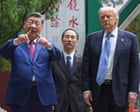
Donald Trump didn't just walk into the Great Hall of the People to shake hands and take photos. He went to Beijing to reset a relationship that's been lopsided for decades. While the media focuses on the red carpet and the military honors, the real story is the massive shift in how the U.S. and China talk about money and security. Trump just told Xi Jinping that the "one-sided and unfair" trade relationship has to go, and surprisingly, he didn't blame China for taking advantage of it. He blamed previous U.S. administrations.
That's a massive rhetorical shift. It’s also a tactical play that gives Xi a way to save face while the two superpowers negotiate over $250 billion in new deals.
The Massive Scale of the Beijing Agreements
The numbers being tossed around during this visit are staggering. We're talking about roughly $253 billion in trade deals and investment packages. Critics say many of these are non-binding memorandums of understanding or deals that were already in the works, but the optics matter. It signals a willingness to move capital in a way we haven't seen in years.
Companies like Boeing, General Electric, and Qualcomm are leading the charge. For example, China Aviation Supplies Holding Company signed for 300 Boeing jets. That’s a deal worth $37 billion at list prices. It’s not just about selling planes, though. It’s about narrowing a trade deficit that Trump calls "embarrassingly high." He’s right about the math. The U.S. trade deficit with China hit $347 billion last year. You can’t ignore a number that big and expect a healthy economy.
Goldman Sachs and China Investment Corp also announced a $5 billion "cooperation fund" to invest in U.S. manufacturing and healthcare. This isn't just a shopping list. It's a strategic realignment. The goal is to tie Chinese capital to American jobs so that both sides have too much to lose if things go south.
North Korea is the Elephant in the Room
Trade is the fuel, but North Korea is the fire. Trump didn't hold back during his meetings with Xi. He pushed China to do more, and he did it with a sense of urgency that felt different from his predecessors. "Time is quickly running out," he warned.
China provides about 90% of North Korea’s trade. They have the most influence, even if they're hesitant to use it all for fear of a total collapse on their border. Trump's approach is to link these two issues. He’s basically saying that if China helps on the security front, the U.S. might be more flexible on trade. It’s a classic leverage play.
Xi Jinping’s response was measured. He spoke about "win-win cooperation" and the need for dialogue. But don’t let the diplomatic jargon fool you. Behind closed doors, the pressure is on. The U.S. wants China to cut off oil exports to Pyongyang and freeze their bank accounts. Every day that passes without a solution makes the region more unstable.
Why the Narrative of the Visit Matters
Most news outlets are obsessed with the "State Visit-Plus" treatment Trump received. They're talking about the private tour of the Forbidden City and the opera performances. That's fine, but it's secondary. The real value is the personal rapport between the two leaders.
You see, Trump treats international relations like a series of business deals. He respects strength and he respects winners. By treating Xi as an equal and a "very special man," he’s trying to build a foundation where they can actually solve problems instead of just shouting at each other across the Pacific.
Common Misconceptions About the Visit
- It’s all just for show: While the ceremony is high, the $250 billion in deals involves real companies and real shipments.
- China is the enemy: Trump’s rhetoric has shifted. He’s treating them as a tough competitor rather than a villain.
- The trade deficit will vanish: It won't. These deals are a start, but structural changes in how China manages its currency and intellectual property are still needed.
The Reality of Market Access
One thing that doesn't get enough attention is the struggle for American companies to actually operate inside China. It's not just about selling goods; it's about being allowed to own your own factories and protect your tech. Trump pushed Xi on this. He wants "fair and reciprocal" access.
In the past, China forced U.S. companies into joint ventures where they had to hand over their blueprints to local partners. That’s a recipe for long-term disaster. If this visit results in even a slight loosening of those rules, it’s a win for American innovation. We need to see if the rhetoric translates into actual policy changes in Beijing's Ministry of Commerce.
Security Beyond the Peninsula
While North Korea is the immediate threat, the South China Sea remains a massive point of friction. The U.S. wants to ensure freedom of navigation in those waters. China wants to assert its historical claims. Trump and Xi didn't solve this in one afternoon. Nobody expected them to. But by keeping the lines of communication open, they’re at least preventing a localized skirmish from spiraling into a global conflict.
What Happens When Air Force One Leaves
The real test of this summit starts next week. It’s easy to sign a paper in a gold-leafed room in Beijing. It’s much harder to follow through when the cameras are gone.
Watch the U.S. Treasury’s next report on currency manipulation. Watch the pace of North Korean missile tests. Watch the stock prices of the companies that signed these mega-deals. If the Boeing planes actually start landing in Shanghai and the North Korean coal shipments stay docked, then we know this trip was a success.
The U.S. business community is cautiously optimistic. They’ve seen these "deals" before, only for them to evaporate under regulatory pressure. But there’s a sense that Trump’s directness has shaken things up. He’s not talking like a diplomat. He’s talking like a guy who wants to see the balance sheet improve by the end of the quarter.
Keep an eye on the follow-up meetings between Secretary of State Rex Tillerson and his counterparts. Those technical discussions will determine if the $250 billion is real money or just a headline. If you're an investor, look at the sectors involved: energy, tech, and aviation. These are the pillars of the new U.S.-China economic relationship. Don't get distracted by the tweets or the formal dinners. Follow the money and the movement of military assets in the region. That’s where the real history is being written.