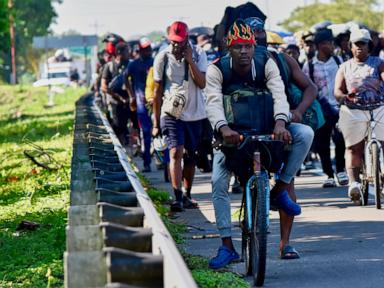
The traditional narrative of a unified migrant "caravan" moving toward the United States border has undergone a structural collapse. While media outlets continue to track the physical movement of thousands from southern Mexican cities like Tapachula, they consistently misinterpret the objective function of the participants. The current migration surge is not a singular vector toward the U.S. border; it is a fragmented survival strategy characterized by Displacement Arbitrage—a process where migrants trade geographical location for legal status or personal safety within Mexico, rather than immediate entry into the United States.
The Tri-Modal Migration Framework
To understand why large groups are mobilizing despite a decrease in immediate intent to reach the Rio Grande, we must categorize migrant behavior into three distinct logic models. Each group operates under different risk-reward calculations.
1. The Legal Regularization Cohort
This group views the "caravan" as a collective bargaining chip rather than a transportation method. For these individuals, the primary bottleneck is the Mexican National Institute of Migration (INM). By forming a large, visible mass, they create a logistical crisis for local authorities. The objective is to force the issuance of the Forma Operativa Múltiple or other temporary transit permits that allow them to move freely within Mexico. Their goal is not the U.S. border, but the acquisition of legal standing that prevents deportation and enables work in northern Mexican industrial hubs like Monterrey or Tijuana.
2. The Security-Seeking Segment
Migration through southern Mexico is governed by a high-threat environment dominated by cartel extortion and kidnapping. For this segment, the caravan is a defensive formation. The cost of hiring a coyote (smuggler) has inflated due to increased enforcement, making the "free" protection of a large group the only viable way to bypass localized criminal checkpoints. Once this group reaches a zone perceived as safer—often central Mexico—the collective breaks apart as individuals pivot toward disparate local labor markets.
3. The Traditional Border-Bound Minority
While historically the dominant group, those with the specific intent and capital to reach the U.S. border now represent a shrinking percentage of the total volume. Tightened U.S. asylum policies (such as the CBP One app requirements) have introduced a massive temporal barrier. Migrants who understand that a border appointment may take six to eight months are choosing to settle in Mexico temporarily to build the necessary capital to sustain that wait time.
The Economics of Stagnation: The Tapachula Bottleneck
Tapachula functions as a pressure cooker where the supply of labor far exceeds the local economic carrying capacity. When the INM slows the processing of visas, the city experiences an artificial inflation of essential goods and a collapse in daily wages.
The decision to leave in a mass group is a rational response to this economic ceiling. The "cost of staying" includes:
- Wage Compression: The influx of tens of thousands of workers into a secondary economy drives the daily rate for informal labor below the cost of caloric replacement.
- Resource Depletion: Migrants arrive with a finite amount of capital. Every day spent waiting in Tapachula for a permit is a day where their "exit capital" (funds for the final leg of the journey) is cannibalized by rent and food.
- Legal Decay: The longer a migrant stays in one location without a permit, the higher the probability of detention.
By moving north, even without a clear path to the U.S., migrants are performing a geographic hedge. They are betting that the labor markets in central or northern Mexico will offer a higher ROI on their remaining capital than the stagnant economy of the south.
Structural Failures in Data Interpretation
Standard reporting focuses on the "size" of the caravan as a metric for border pressure. This is a flawed indicator. To accurately measure the impact of these movements, analysts must look at the Velocity of Dispersion.
If a caravan of 5,000 people leaves Tapachula, but only 500 arrive at the northern border two months later, the system has experienced a 90% absorption rate within the Mexican interior. This absorption is the result of three specific friction points:
- The Fatigue Gradient: The physical toll of walking hundreds of miles leads to "attrition by exhaustion." Migrants with families frequently opt for permanent settlement in the first city that offers stable, albeit low-wage, employment.
- The Information Feedback Loop: As migrants move north, they receive real-time data from peers already at the border regarding wait times and deportation rates. This data often triggers a pivot from "border-crossing" to "domestic-settlement."
- Mexican Enforcement Elasticity: The Mexican government frequently employs a strategy of "exhaustion through relocation." By allowing caravans to move, then breaking them up and busing individuals back to the south or to different states, they prevent the formation of a permanent "migrant city" that would draw international condemnation.
The Pivot to Mexican Integration
We are witnessing a fundamental shift in the regional migration architecture. Mexico is no longer merely a transit country; it is becoming a destination of necessity. This shift is driven by the Convergence of Barrier Mechanics:
- U.S. Policy Barrier: The transition from physical "walls" to digital "queues" (CBP One) has successfully shifted the waiting room from American soil to Mexican soil.
- Mexican Labor Demand: Northern Mexican states are experiencing a labor shortage in the manufacturing and agricultural sectors. Migrants are increasingly aware that a job in a Mexican maquiladora provides a better risk-adjusted return than an illegal border crossing that results in immediate expulsion.
- Language and Cultural Proxity: For the high volume of Venezuelan, Colombian, and Central American migrants, the cost of integration into Mexican society is significantly lower than the cost of integrating into the U.S., particularly when considering the lack of legal work authorization in the latter.
This "Mexicanization" of the migrant flow represents a massive demographic transfer that will redefine the industrial landscape of the Mexican north over the next decade.
Tactical Constraints and Operational Realities
Despite the logic of moving north, these groups face significant operational limitations that the "caravan" model cannot solve:
- Logistical Fragility: Caravans lack a centralized supply chain. They rely on the "charity of the corridor"—local NGOs and churches. As the frequency of these movements increases, donor fatigue sets in, leading to a breakdown in the support structure.
- Command and Control Deficit: Most caravans are leaderless or led by activists with political rather than logistical objectives. This leads to inefficient route selection and a failure to anticipate government blockades.
- Internecine Competition: The diverse nationalities within these groups (Haitians, Venezuelans, Cubans, Africans) often have competing interests. Haitians, for example, frequently face higher linguistic and racial barriers, leading them to form smaller, more mobile splinter groups that avoid the high-profile main body of the caravan.
Strategic Trajectory: The Rise of the "Buffer State"
The evolution of the southern Mexican caravan indicates that the U.S.-Mexico border has effectively moved south to the Isthmus of Tehuantepec. The Mexican government’s management of these flows—characterized by a cycle of containment, tactical release, and eventual absorption—serves a dual purpose. It satisfies U.S. pressure to limit northern movement while providing a flexible labor pool for Mexico’s domestic economic ambitions.
The primary risk to this system is a breakdown in the "absorption capacity" of Mexican cities. If the industrial north reaches a saturation point where it can no longer provide sub-living wages or basic services, the friction that currently slows these caravans will vanish. At that point, the "Displacement Arbitrage" model will fail, and we will see a return to high-velocity, high-volume pressure at the U.S. border.
The current movement out of the south is not a march toward Washington; it is a search for an equilibrium point within Mexico where the cost of living meets the opportunity for legal existence. Analysts should monitor the Residency Application Rate within the Mexican COMAR (Commission for Refugee Assistance) as a more accurate leading indicator of border pressure than the physical headcount of a marching crowd.
Investors and policymakers must shift their focus from the "border" to the "corridor." The real story is the rapid urbanization of the Mexican interior by a disenfranchised but highly motivated labor force. The long-term stability of the region depends on whether Mexico can transform this human capital into a formal economic engine, or if these "caravans" remain a permanent, roaming underclass trapped in a cycle of geographic displacement without economic resolution.
The strategic play for regional stakeholders is to stop treating the caravan as a security event and start treating it as a labor-market distortion. Formalizing the transit permits and pre-matching migrant skill sets with industrial vacancies in central Mexico would dissipate the "caravan" phenomenon far more effectively than any physical barrier or deportation flight. Until this economic alignment occurs, the southern Mexican corridor will remain a zone of perpetual motion, where the goal is no longer the destination, but the escape from the stagnation of the starting point.