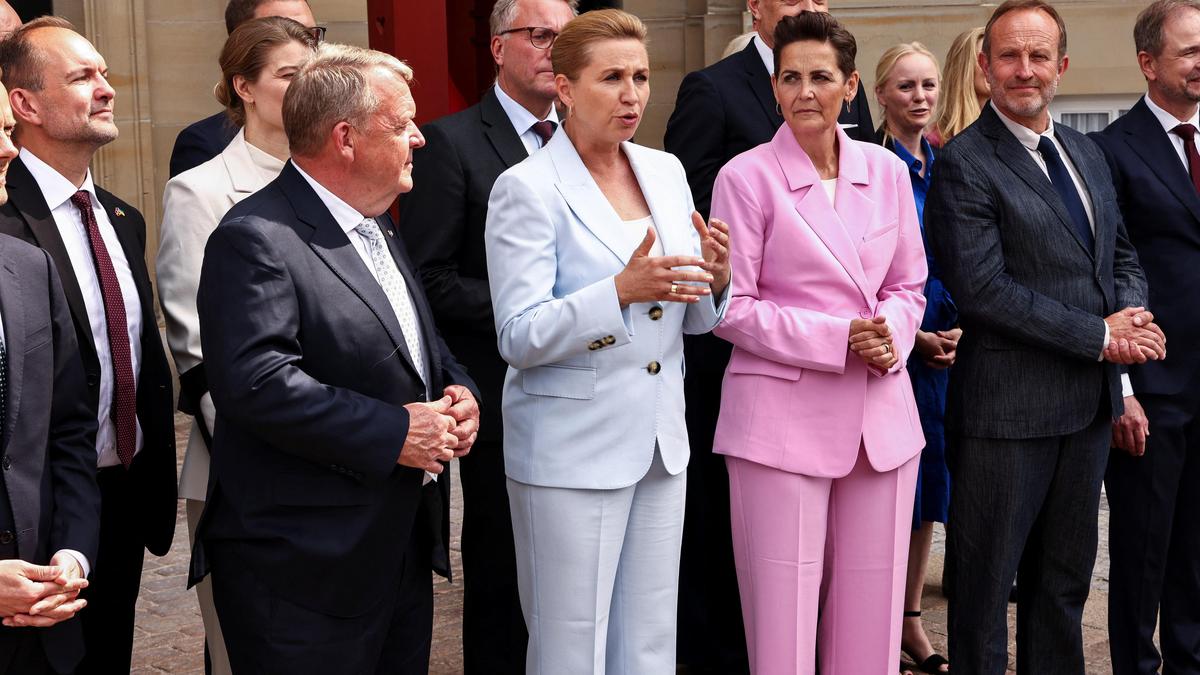
The international press is swooning over Copenhagen. Prime Minister Mette Frederiksen just marched out of Amalienborg Palace to present her third government, flaunting a historic milestone: 11 women and 10 men. For the first time in Danish history, the cabinet has a female majority. The media narrative was written before the ink even dried on the royal decree. It is a triumph for progressivism, a victory for gender equality, and a shining beacon of modern governance.
It is also a masterclass in political misdirection.
While editorial boards celebrate the gender tally, they are missing the brutal math that actually governs Denmark. This cabinet is not a monument to progressive triumph; it is a fragile, desperate compromise born from a paralyzed parliament. By focusing entirely on identity, mainstream analysis ignores the unstable coalition dynamics, the economic pressures of a high-inflation environment, and a splintered 179-seat Folketing that could collapse this historic executive before the year ends.
The Mirage of the Identity Milestone
I have watched political operations spin mediocre structural compromises into historic victories for two decades. This is text-book optics over operations. The superficial victory of having an 11-to-10 female majority masks a deeper, colder institutional reality.
Look at where the actual power resides. Lars Løkke Rasmussen, the leader of the Moderates and a seasoned political mercenary, retains his grip on the Foreign Ministry. Nicolai Wammen and Peter Hummelgaard—two men—are playing musical chairs with the most powerful domestic portfolios, shifting between Finance and Justice in a blatant audition to succeed Frederiksen as leader of the Social Democrats.
The media treats the cabinet like a corporate board that successfully hit its ESG metrics. But government is not a board meeting. It is a mechanism for raw power distribution. The progressive coalition partners—specifically the Social Liberal Party and the Socialist People's Party (Green Left)—pushed their female leaders, like Pia Olsen Dyhr and Samira Nawa, into high-profile slots. But this was not a grand feminist awakening by Frederiksen; it was the cost of doing business in a 69-day negotiation process, the longest and most agonizing coalition-building exercise in modern Danish history.
The Parliamentary Math is Flawed
The question global observers are asking is: How will a female-led majority change Danish policy? This is entirely the wrong question. Gender does not vote on legislation; seats do. The brutal reality of the March 24 election is that Frederiksen’s Social Democrats turned in their weakest performance since 1903, capturing a measly 38 seats.
Danish Parliament (Folketing) Power Dynamic:
Total Seats: 179
Four-Party Coalition: 82 Seats (Minority)
Votes Needed to Pass Laws: 90
The new four-party coalition commands just 82 seats. To pass a single budget, to lower corporate taxes, or to implement their headline-grabbing policy of banning social media for children under 15, this "historic" cabinet must beg for scraps from the radical wings of Danish politics. They are completely dependent on the Red-Green Alliance and the Alternative on the left, or opportunistic right-wing factions.
Imagine a scenario where a corporate CEO announces a diverse executive team but lacks the voting shares to approve any operational budget. The company would be paralyzed. That is the exact trap Frederiksen is in. This government is structurally weak. The female majority is an excellent shield against criticism, but it is an ineffective sword for cutting through parliamentary gridlock.
The Policy Paradox
The media presents this government as a progressive leap forward, yet the policy platform published by the Prime Minister’s Office reads like a populist, center-right manifesto wrapped in a welfare blanket.
To hold this fragile alliance together, Frederiksen had to promise a highly restrictive immigration policy to appease the right, combined with corporate tax cuts to satisfy the business community and the Moderates. Simultaneously, she promised cheaper food and higher subsidies for low-income pensioners to keep her left-wing supply partners happy.
You cannot lower corporate taxes, increase welfare spending, protect a bloated public sector, and manage an economy struggling with stubborn living costs all at once without blowing out the deficit. The administration is trying to be everything to everyone. When the economic reality hits and inflation forces spending cuts, the ideological fault lines between the Social Democrats and the centrist Moderates will fracture. No amount of symbolic representation will stop a coalition from tearing itself apart when there is no money left to distribute.
The Real Power Play Behind the Scenes
If you want to understand what this reshuffle was actually about, stop looking at gender and start looking at the succession timeline. The most critical move in this entire announcement was moving Peter Hummelgaard to the Finance Ministry.
Political correspondent Christine Cordsen hit the nail on the head: this move signals that Hummelgaard is Frederiksen’s anointed heir. The Finance Ministry in Denmark is the ultimate proving ground. By placing him there, Frederiksen is stabilizing her own party’s future while she prepares for an eventual exit, potentially to a high-ranking European Union or NATO role.
The female majority provided the perfect media smoke screen for this cold, calculated internal party succession plan. While international observers applaud the progressive optics, the internal machinery of the Social Democrats is quietly consolidating power under traditional, careerist terms.
The Downside of the Contrarian Reality
Admitting that this historic milestone is mostly theater is uncomfortable. The downside of looking at this situation through a lens of pure realpolitik is that it sounds cynical. Diversity in leadership does matter for institutional trust, and a parliament with 48% women—the highest in Denmark's history—shows a genuine shift in the country's political pipeline.
But tracking pipeline demographics is different from analyzing executive survival. Celebrating the gender makeup of a cabinet that is structurally incapable of passing its own agenda without constant horse-trading is a form of analytical blindness. It values symbolism over the actual execution of state power.
Denmark faces immense geopolitical pressures, particularly regarding territorial integrity and foreign pressure in Greenland, alongside a fractured domestic economy. Navigating these challenges requires a disciplined, high-majority executive block, not a delicate 82-seat minority experiment designed primarily to survive the news cycle. Stop applauding the composition of the ship's crew when the vessel is leaking oil and heading straight into a parliamentary ice storm.