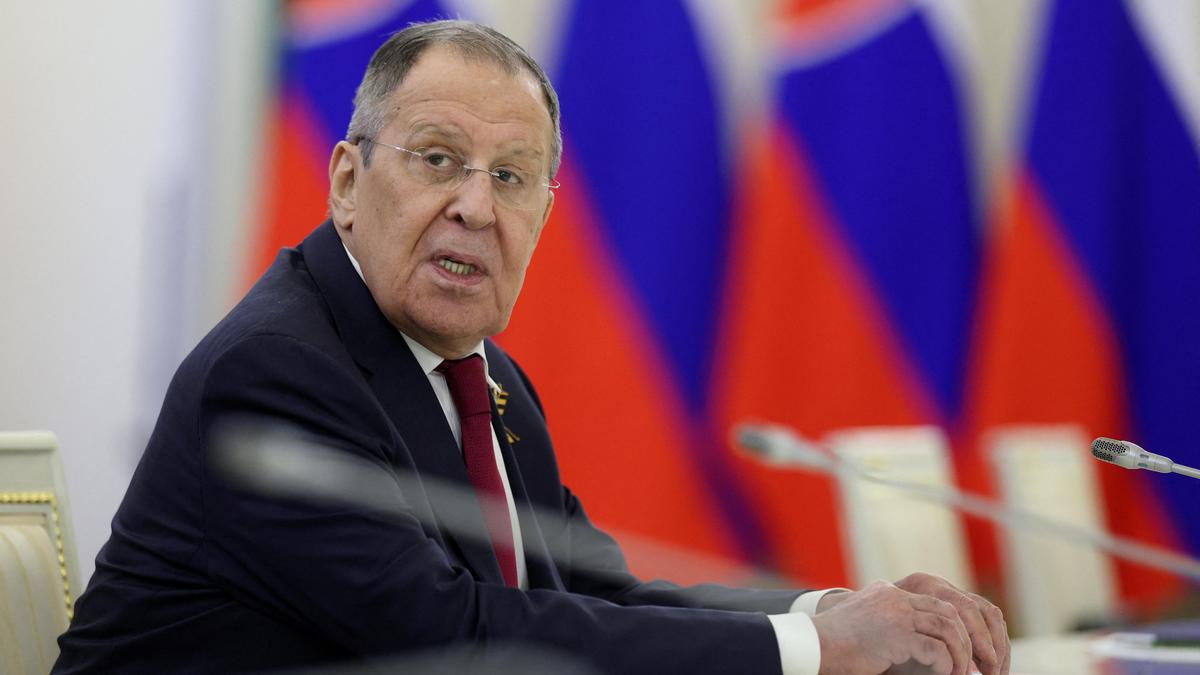
When Russian Foreign Minister Sergei Lavrov tells a room full of reporters that "nothing is happening" in U.S.-Russia relations, he isn't just venting frustration. He is describing a calculated, structural collapse of the world’s most dangerous bilateral connection. This isn’t a temporary rough patch or a heated argument. It is a total cessation of the diplomatic machinery that kept the Cold War from turning into a nuclear winter. The phone lines are silent, the backchannels are clogged with distrust, and the two greatest nuclear powers on earth have effectively stopped speaking the same language.
The "nothing" Lavrov refers to is the absence of any meaningful dialogue regarding strategic stability, arms control, or the basic de-confliction protocols that used to be the bedrock of international security. For decades, even during the height of the Cuban Missile Crisis or the Reagan-era "Evil Empire" rhetoric, there was a shared understanding that communication was a survival mechanism. Today, that mechanism has been dismantled. Washington views engagement as a reward Moscow hasn't earned; Moscow views Western overtures as a trap.
The Architecture of Silence
We are witnessing the final demolition of the post-1945 security order. To understand why "nothing" is happening, you have to look at the skeletal remains of past agreements. The New START treaty—the last remaining pillar of nuclear arms control—is currently on life support. Both sides have suspended inspections, and the technical commissions that once met to resolve disputes are defunct.
This isn't just about Ukraine. That conflict is the catalyst, but the rot goes deeper. The U.S. State Department has transitioned from a culture of negotiation to one of isolation and sanction. Meanwhile, the Kremlin has traded its long-standing desire for Western validation for a "Turn to the East" that seeks to build an entirely separate financial and political ecosystem. When there is no shared goal, there is no reason to talk.
The vacuum is being filled by military posturing. In the absence of diplomats, the generals take over. Without a framework for dialogue, every troop movement in the Baltics or every naval exercise in the Black Sea is interpreted through the lens of worst-case scenarios. This creates a feedback loop where silence breeds suspicion, and suspicion justifies further escalation.
The Myth of the Backchannel
Historical accounts of the 20th century are filled with stories of "men in smoky rooms"—intelligence officers or trusted intermediaries who settled world-shaking disputes over scotch and a handshake. Those channels are currently dry. The legal and political risks for any American official to engage "off the record" with a Russian counterpart are now so high that the practice has effectively vanished.
Domestic politics in Washington have made Russia a radioactive topic. Any attempt at nuanced diplomacy is immediately branded as appeasement or collusion. On the flip side, the Russian political elite has consolidated around a siege mentality. They view the U.S. not as a competitor, but as an existential threat whose primary aim is the fragmentation of the Russian state. When both sides believe the other is committed to their total destruction, "nothing" is the only possible outcome of a meeting.
The Cost of Zero Contact
The danger of this silence is most acute in the realm of unintended escalation. During the Cold War, there were "red phones" and established protocols to ensure that a technical glitch or a rogue radar signal didn't trigger a global catastrophe. Today, as we move into an era of AI-driven warfare and hypersonic missiles, the window for human decision-making has shrunk from hours to minutes.
- Nuclear Ambiguity: Without inspections, neither side knows for sure what the other is doing with its arsenal.
- Cyber Warfare: In the absence of rules of engagement for the digital front, attacks on critical infrastructure are becoming normalized.
- Proxy Friction: From Africa to the Middle East, Russian and American interests are clashing in ungoverned spaces without any "hotline" to prevent direct military contact.
The business of diplomacy has been replaced by the theater of the press conference. Lavrov’s remarks are a part of this theater. He speaks to the cameras because he has no one to speak to across the table. He isn't asking for a meeting; he is documenting the divorce.
The Great Decoupling
It is a mistake to think this is a temporary freeze that will melt once the current administration in Washington changes or the conflict in Ukraine reaches a stalemate. We are seeing a fundamental decoupling of the two nations. This is economic, technological, and cultural. The Russian economy has been re-tooled to function under a permanent regime of Western sanctions, pivoting its energy exports to India and China and its tech imports to the "Global South."
This decoupling removes the "golden handcuffs" that used to provide a disincentive for total war. When there is no trade, no cultural exchange, and no shared financial interest, the cost of conflict drops significantly. The U.S. no longer sees Russia as a necessary partner in global counter-terrorism or space exploration. Russia no longer sees the U.S. as a reliable steward of the global financial system.
The Illusion of a Reset
Talk of a "reset" or a "thaw" is a fantasy peddled by those who don't understand the depth of the current animosity. A reset requires a baseline of mutual interest, and that baseline has been erased. The U.S. goal is now the "strategic failure" of Russia. The Russian goal is the end of American hegemony. These are mutually exclusive outcomes.
The current state of "nothing" is actually a high-stakes waiting game. Moscow is waiting for Western fatigue and the possible fragmentation of the NATO alliance. Washington is waiting for the Russian economy to buckle or for a change in the Kremlin’s leadership. Both are betting on the other's collapse. This is not diplomacy; it is a siege.
The machinery of the 20th-century peace is gone. It was built for a different world, one where two superpowers agreed on the rules of the game even as they fought for the prize. Today, there are no rules, and there is no game. There is only a deepening silence that grows more dangerous with every passing day.
Stop looking for the secret meeting or the breakthrough summit. They aren't coming. The silence isn't a prelude to a deal; it is the new permanent reality.