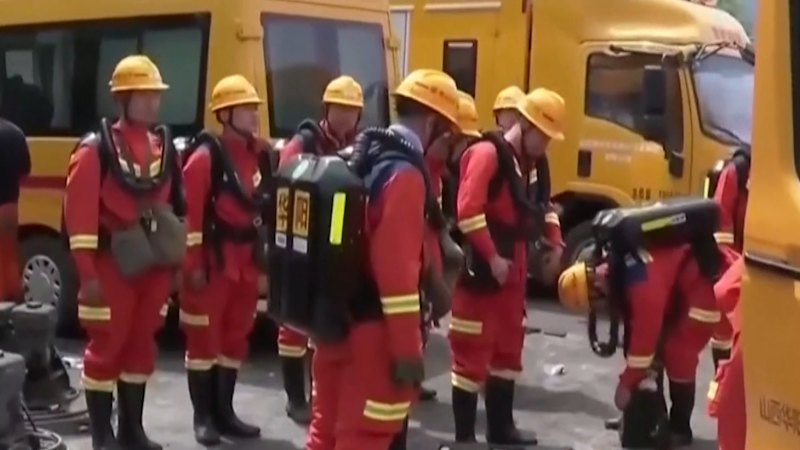
Western media covers foreign industrial disasters with a predictable, copy-paste template. A coal mine explodes in Shanxi or Guizhou. Dozens of miners tragically perish. The headline focuses entirely on the body count, followed by a somber paragraph about Beijing’s "immediate vow to punish local officials" and "enforce stricter safety protocols."
The mainstream press looks at these tragedies and sees a lack of regulation. They see greedy local bosses overriding safety switches to hit production quotas.
They are looking at the wrong problem.
The lazy consensus blames a lack of oversight, assuming that more red tape and heavier fines will stop the bleeding. In reality, the frantic wave of top-down, zero-tolerance safety crackdowns is precisely what makes these mines more dangerous. By treating safety as a criminal compliance checklist rather than an operational engineering challenge, centralized mandates inadvertently incentivize the exact behaviors that cause catastrophic failures.
The Compliance Trap: Why Stricter Rules Fail
When a fatal accident occurs, the knee-jerk reaction from central authorities is to issue blanket suspension orders for all mines in the region. Regulators descend. Bureaucrats who have never spent a day underground demand paperwork, signatures, and compliance logs.
This creates a high-stakes environment of fear. I have spent years analyzing industrial supply chains and operational risk management, and the pattern is always the same: when you penalize reporting, you don't eliminate danger; you eliminate the visibility of danger.
In a hyper-punitive regulatory environment, mine managers stop reporting near-misses. They hide minor gas leaks. They patch over structural issues with temporary fixes to pass the upcoming inspection.
Consider how a standard coal mine explosion actually happens. It is rarely a single rogue actor turning off a switch. It is almost always a failure of methane drainage or coal dust suppression systems. Methane migration is a dynamic, complex thermodynamic process. Managing it requires continuous, transparent data flow from the coal face to the engineering team.
When a regulatory regime dictates that any deviation from standard operating parameters results in an immediate shutdown and financial ruin for the operator, the incentive shifts instantly from risk mitigation to inspection management. The paperwork looks pristine. The mine explodes anyway.
The Production Pressure Paradox
China accounts for over half of the world’s coal generation. The global market operates under the assumption that the country can seamlessly transition to green energy while maintaining industrial output. It cannot.
When the central government demands record-breaking coal production to avoid winter power blackouts while simultaneously demanding zero safety incidents, it creates an irreconcilable operational paradox.
[Central Mandate: Maximize Output] ──┐
                                     ├──> [Impossible Operational Stress] ──> System Failure
[Central Mandate: Zero Accidents]   ──┘
Local officials are caught in a vice. If they fail to meet energy quotas, the local economy starves, and they are fired. If a safety incident happens, they are prosecuted.
To survive, operations are pushed to the absolute edge of their structural limits. Ventilation systems designed for a specific extraction rate are forced to handle accelerated throughput. This increases the concentration of airborne coal dust—the primary fuel for secondary, highly lethal explosions.
The Western press covers the resulting disaster as a moral failing of the operators. It is not. It is a predictable mathematical outcome of forcing a complex physical system to operate under conflicting, non-negotiable constraints.
Dismantling the Flawed Assumptions
Let's address the flawed premises that dominate public discourse around industrial safety in developing manufacturing hubs.
"More inspections automatically equal fewer deaths."
This is a dangerous lie. The National Mine Safety Administration (NMSA) can double its inspection frequency, but if those inspections focus on bureaucratic box-checking rather than real-time sensor calibration and geomechanical assessment, they add zero safety value. Instead, they consume valuable engineering hours that should be spent monitoring geology.
"Shutting down non-compliant mines solves the problem."
When the government forcibly closes smaller, older mines, production quotas do not decrease. That demand is simply transferred to the remaining operational mines. These larger facilities are forced to accelerate their extraction schedules, creating new, unforeseen stress points in their own longwall mining setups.
The Tech Fix Illusion
The current corporate trend is to throw automation and artificial intelligence at the problem. Silicon Valley pitches smart sensors and remote monitoring as the ultimate savior for dangerous industries.
Do not buy the hype.
Deploying millions of dollars of sensor technology into a coal mine is useless if the underlying organizational culture rewards the suppression of bad news. If a sensor flags a dangerous spike in gas levels, but the telemetry data is routed through a middle manager whose bonus depends on hitting a daily tonnage target, that data will be ignored, rationalized, or overridden.
Autonomous mining vehicles and automated shearers can remove humans from the immediate blast radius, which saves lives. But they do not fix the systemic instability caused by aggressive, politically driven production schedules. Technology is an accelerator of existing operational discipline, not a substitute for it.
The Hard Truth About Industrial Development
Every developed economy built its wealth on the back of dangerous, bloody industrialization. The historical safety trajectories of the United States, United Kingdom, and Germany mirror what is happening in rapidly developing sectors today.
In December 1907, the Monongah mining disaster in West Virginia killed over 360 miners. It wasn't resolved by passing a law the next day; it was resolved over decades through fundamental structural changes in labor dynamics, energy transition, and genuine engineering professionalization.
Historical Fatality Rates per Million Tons of Coal Extracted
===========================================================
Era/Region           | Safety Approach       | Outcome
---------------------+-----------------------+-------------
Early 20th Cent. US  | Pure Output Focus     | Catastrophic
Late 20th Cent. US   | Engineered Systems    | Low/Stable
Modern Emerging Hubs | Punitive Compliance   | Volatile
True safety cannot be legislated into existence by a distant committee. It requires an agonizingly slow, expensive shift toward operational autonomy, where the engineers on the ground have the absolute authority to halt production without fear of professional or criminal ruin.
Stop reading mainstream accounts that treat these industrial tragedies as simple tales of corporate villainy or regulatory laziness. They are systemic failures born from a refusal to accept the brutal trade-offs between cheap energy, hyper-growth, and human survival. Until the structural pressure to produce at all costs is removed, the next explosion is already mathematically guaranteed.