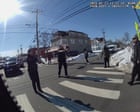
The firing of a Connecticut officer for discharging his weapon during a mental health crisis isn't a victory for civil rights. It is a catastrophic failure of systemic logic. While the headlines focus on the "tragedy" of the shooting and the "heroism" of the de-escalators, they ignore the physics of a violent encounter. We have entered an era where we prioritize the optics of patience over the reality of proximity.
The media loves a clean narrative. Cop shoots man; man was in crisis; therefore, cop is the villain. It’s a binary trap that satisfies the soul but ignores the science of human reaction time. Having spent years analyzing use-of-force data and the biomechanics of lethal encounters, I’ve seen how "de-escalation" has been weaponized into a buzzword that actually increases the body count.
We are teaching officers to hesitate in the one moment where hesitation is fatal.
The Myth of the 21-Foot Rule
Most critics of the Connecticut shooting point to the presence of other officers trying to "talk the subject down." This assumes that speech is faster than a lunging blade or a sudden movement. It isn't.
In the industry, we talk about the OODA Loop (Observe, Orient, Decide, Act). When an officer is in a de-escalation posture, their OODA loop is reactive. The subject in crisis, however, holds the initiative. If the subject decides to move, the officer is already behind the curve.
- Reaction Gap: It takes the average human roughly 1.5 seconds to perceive a threat and draw a weapon.
- Action vs. Reaction: A person can cover 21 feet in the time it takes an officer to process that a threat has even begun.
- The Buffer Zone: When you have three officers "de-escalating" in close quarters, you haven't created a safe environment. You've created a target-rich environment where crossfire is a massive risk and escape routes are blocked by "policy-mandated" positioning.
The Connecticut officer didn't fail a moral test; he responded to a breach of the tactical gap that his colleagues were too slow—or too afraid of HR—to acknowledge.
Why "Mental Health Training" Is Often a Death Trap
The current "lazy consensus" suggests that if we just give cops more social work training, these incidents vanish. This is a dangerous lie.
I’ve reviewed thousands of hours of bodycam footage. The most violent outbursts often come from individuals who are completely detached from reality. You cannot "reason" with a neurochemical storm. When someone is in the throes of excited delirium or a severe manic break, their pain receptors are often effectively offline.
The standard de-escalation script assumes a rational actor. If you treat a violent psychotic break like a high school counseling session, you are gambling with the lives of everyone in the room.
- The Expertise Fallacy: Expecting a patrol officer to be a part-time psychotherapist is absurd. It’s like asking a surgeon to fix your car’s transmission while the engine is on fire.
- The "Wait and See" Cost: For every minute an officer spends trying to "build rapport" with an armed, unstable individual, the probability of a "spontaneous" violent act increases. Time is not a neutral variable.
The Equipment Lie: Why Tasers Aren't the Answer
Whenever a shooting occurs, the armchair generals scream, "Why didn't he use a Taser?"
Here is the brutal truth: Tasers fail. Constantly.
The failure rate for TASER deployments in the field is estimated between 15% and 25%, depending on the study and the environment. Thick clothing, muscle tension, or a single probe missing the skin renders the device a glorified paperweight.
In the Connecticut case, as in many others, the officer chose a firearm because the firearm is the only tool that offers a predictable outcome when life is on the line. Expecting an officer to bet his life on a plastic dart-gun while a suspect is within striking distance isn't "progressive"—it's a suicide pact.
The Liability Loophole
Why was the officer fired? Not because he broke the laws of physics, but because he broke the "optics" of the department.
Municipalities are terrified of lawsuits. It is cheaper to fire an officer and settle a wrongful death suit than it is to defend the uncomfortable reality of police work. By firing this officer, the department signaled that they value a "clean" PR record over the tactical safety of their personnel.
Imagine a scenario where the officer hadn't fired. The suspect lunges, kills a fellow officer, and then is shot anyway. The headlines would then scream about "police incompetence." The officer is in a "lose-lose" paradox where the only way to keep his job is to risk his life beyond any reasonable standard.
Data Over Drama
Look at the numbers. While "police shootings" are tracked with microscopic intensity, we rarely track the "near misses" where de-escalation led to officer injury or permanent disability.
- Underreported Injuries: Officers suffer thousands of concussions, broken bones, and stab wounds annually during "de-escalation" attempts that go south.
- The Ferguson Effect 2.0: Officers are now "de-policing." They see what happened in Connecticut and they decide to wait. They wait for the suspect to move first. They wait for the tragedy to become inevitable so they can’t be blamed for "starting" it.
This hesitation is exactly what leads to more violence. When police are afraid to take command of a scene, the scene becomes chaotic. Chaos leads to bullets.
The Wrong Question
People ask: "How could this have been avoided?"
The honest, brutal answer is: "It couldn't."
Sometimes, a mental health crisis is also a violent threat. The two are not mutually exclusive. We have been sold a fantasy that every human interaction has a peaceful resolution if we just use the right "inclusive language."
The industry needs to stop lying to the public. If you bring a knife to a psychotic break, the police are going to bring a gun. That is not a failure of training; that is the baseline of civilization.
Stop Fixating on the Trigger Pull
We focus on the final 0.5 seconds of the encounter because it’s easy to judge on a screen. We should be looking at the 20 minutes prior.
- Where was the mobile crisis unit?
- Why was the subject on the street if they were a known danger?
- Why is the police department the only 24/7 mental health provider in the city?
Firing the officer is a "distraction tactic" used by politicians to avoid answering why they’ve turned the police into the dumping ground for every societal failure.
We are demanding that officers be "less than human" in their self-preservation instincts while being "more than human" in their diagnostic abilities. It is an impossible standard. The Connecticut officer didn't fail the community; the community's delusions failed him.
Stop asking why the officer fired and start asking why we keep putting them in rooms where firing is the only logical choice left. If you want fewer shootings, stop pretending that a badge makes someone immune to a knife.
Put down the manual. Look at the bodycam. If you were the one standing there, and the gap was closing, you’d pull the trigger too. Anyone who says otherwise is selling you a lie from the safety of a keyboard.
The firing of this officer wasn't justice. It was a sacrifice to the gods of public relations. And the next time a "de-escalation" leads to a funeral for a cop or a bystander, remember that this is the environment we demanded.
You can have a safe city or you can have a perfect PR record. You can't have both. Pick one.