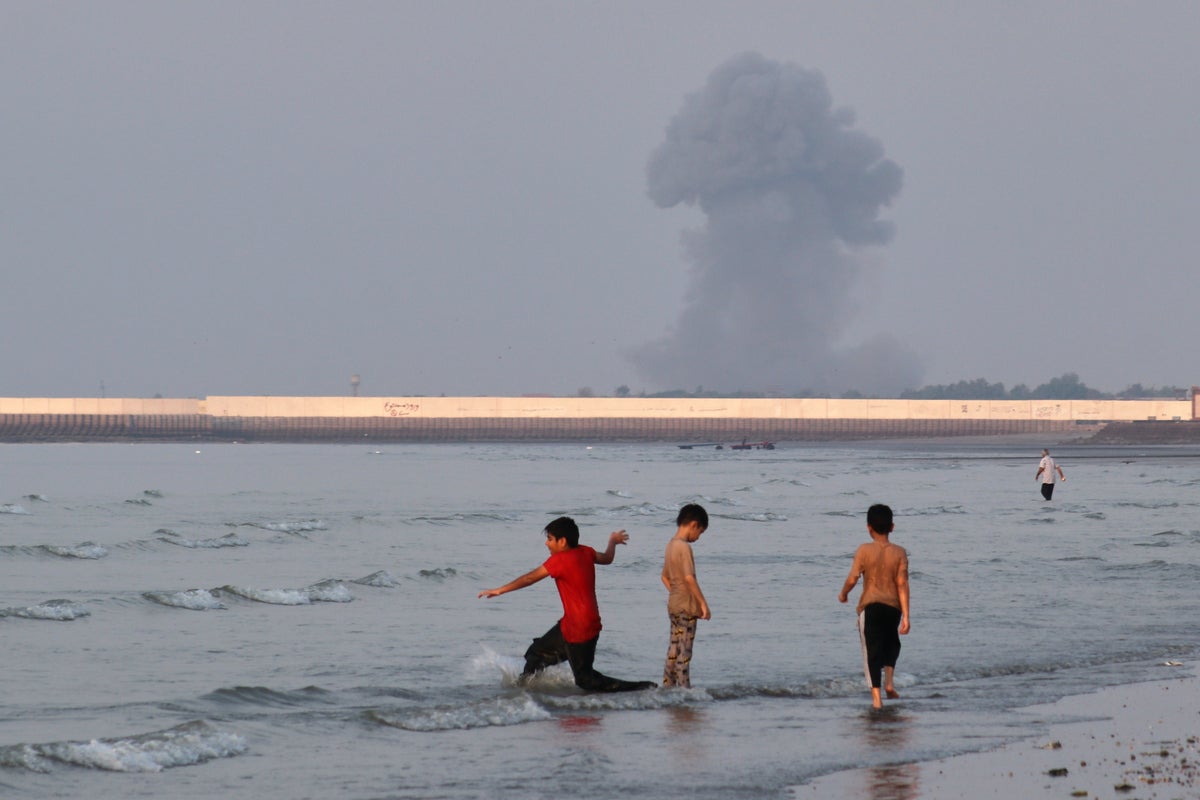
The military confrontation between Western coalition forces and regional actors has breached a geographical threshold that observers long assumed was off-limits. By targeting logistical hubs in northern Iran and disabling a commercial transport vessel attempting to bypass maritime restrictions, military planners have shifted their focus to the Caspian Sea basin. This is no longer a localized standoff in the Persian Gulf or the Red Sea. It is a fundamental expansion of the theater of operations. The strategic calculus of using precision strikes to enforce a blockade in landlocked northern waters introduces unprecedented risks for global energy corridors and regional stability.
To understand why this expansion occurred, one must look beyond the immediate headlines of intercepted ships and overnight missile strikes. The enforcement of a naval blockade relies on physical presence and the threat of overwhelming force. In the narrow straits of the south, this is standard doctrine. In the north, it requires a completely different operational playbook.
The Caspian Choke Point and the Northern Supply Route
For decades, northern Iran served as a secure rear area. It was protected by the natural barrier of the Alborz mountain range and the geopolitical buffer of the Caspian Sea. Cargo moved relatively unhindered between Iranian ports like Anzali or Amirabad and Russian ports like Astrakhan. This northern corridor bypassed Western-monitored maritime routes entirely. It allowed for the steady transfer of industrial components, machinery, and dual-use technologies away from the watchful eyes of international naval task forces.
That sanctuary has evaporated. The disabling of a cargo vessel in these waters demonstrates that surveillance and interdiction capabilities are no longer constrained by open-ocean geography.
National security analysts argue that the vessel was carrying sensitive guidance systems destined for regional proxy networks. The decision to disable the ship rather than sink it suggests a calculated escalation. It was a demonstration of capability designed to show that no body of water is sufficiently isolated to guarantee safe passage. The strike represents a direct challenge to the security architecture that has governed the Caspian basin since the fall of the Soviet Union.
The geography of the Caspian Sea complicates any traditional naval operation. It is an enclosed body of water. There are no international straits connecting it to the world's oceans, save for the Russian-controlled Volga-Don Canal. Consequently, traditional blue-water navies cannot sail destroyer groups into the area to enforce a blockade.
Instead, the interdiction was carried out through a combination of long-range aerial assets and localized intelligence networks. This approach relies heavily on precision-guided munitions and real-time satellite tracking. It is a high-stakes method that leaves very little room for error. A single miscalculation can drag neighboring states like Azerbaijan or Turkmenistan into a conflict they have desperately sought to avoid.
The Logistics of Targeting Northern Iranian Infrastructure
Expanding airstrikes to targets in northern Iran is a significant operational shift. Most historical military planning focused on the southern coast, where oil terminals, naval bases, and nuclear facilities are concentrated. The north is different. It is home to dense forests, rugged terrain, and major agricultural and urban centers.
Military planners targeting this region face distinct challenges.
- Terrain Hurdles: The Alborz mountains require strike assets to fly at specific trajectories, making them more vulnerable to localized air defense systems.
- Proximity to Neutral Borders: Northern Iranian facilities are often located just miles from neighboring countries, raising the risk of accidental border violations.
- Informed Defenses: Iranian forces have spent years hardening these northern logistics chains, believing they were safe from Western reach.
The facilities targeted in the recent wave of strikes were not large-scale military bases. They were civilian-style warehousing complexes and rail-to-sea transshipment points. This reflects a shift in modern warfare. The line between military logistics and commercial transport has become almost entirely blurred.
When a standard commercial warehouse is used to assemble or store drone components, it becomes a legitimate target under modern rules of engagement. However, attacking these dual-use sites carries immense political risk. It allows the targeted nation to claim that purely civilian infrastructure is being hit, rallying domestic support and complicating the diplomatic position of the attacking coalition.
International Law and the Legality of Landlocked Interdictions
The legal framework surrounding the disabling of a ship in the Caspian Sea is incredibly murky. Under the United Nations Convention on the Law of the Sea, the Caspian occupies a unique legal category. It is not classified as an international sea, nor is it simply a large lake. The five littoral states agreed to a special status in 2018, which explicitly barred any foreign military presence on the water.
By executing a strike within this zone, the conducting forces have bypassed a highly sensitive regional agreement.
The coalition justifies the action under the doctrine of collective self-defense. They argue that the cargo on board posed an imminent threat to international shipping lanes in other sectors. This argument stretches the traditional interpretation of self-defense to its absolute limit. It suggests that a threat does not need to be active or localized to warrant a preemptive strike.
Critics of this approach warn of a dangerous precedent. If a nation can legally disable a ship in an enclosed, neutral body of water based on intelligence regarding its future cargo destination, then no commercial shipping route is truly safe. It opens the door for other regional powers to declare their own preventive blockades in areas like the Black Sea or the South China Sea.
The economic fallout of this legal uncertainty is already visible. Insurance underwriters are rapidly re-evaluating the risk profiles for all shipping in the Caspian region. Freight rates have surged. Some shipping companies are refusing to charter vessels for northern routes, fearing that their assets could be caught in the crossfire of an undeclared blockade.
The Ripple Effects on Regional Energy Transit
The Caspian region is a critical artery for global energy. Pipeline networks cross the region, carrying oil and natural gas from Central Asia to European markets. Many of these pipelines run parallel to the transport corridors now targeted by military strikes.
[Caspian Sea Basin]
       |
       +--> Northern Route (Astrakhan to Anzali) <-- Target of Recent Interdiction
       |
       +--> Western Pipeline Corridor (Baku-Tbilisi-Ceyhan) <-- High Risk Zone
       |
       +--> Eastern Transit Line (Turkmenistan to Iran)
The physical destruction of a pipeline would trigger an immediate spike in global energy prices. Even without direct damage to the infrastructure, the psychological impact of military activity in northern Iran is destabilizing. Investors are hesitant to fund long-term infrastructure projects in a region that is now actively contested.
The Azerbaijan-Georgia-Turkey transit corridor is particularly vulnerable. It sits directly adjacent to the northern Iranian border. If the conflict escalates further, any spillover in the form of stray missiles or electronic warfare interference could temporarily shut down these vital pipelines. The global economy, already struggling with supply chain volatility, is poorly positioned to absorb another major energy shock.
Evaluating the Strategic Efficacy of the Blockade
Does disabling a single ship and hitting a handful of northern supply depots actually achieve the strategic objective? The historical record suggests that blockades are rarely 100% effective, especially when dealing with determined adversaries who have land-based alternatives.
While maritime transport is the most efficient way to move large volumes of cargo, it is not the only option. Iran and its partners have spent years developing overland rail networks through Central Asia. These rail lines are slower and more expensive to operate, but they are incredibly difficult to interdict using air power alone. Striking a railway line is a temporary fix; tracks can be repaired in a matter of hours.
The blockade, therefore, acts more as a tax on adversary operations than an absolute barrier. It forces them to use less efficient, more expensive transport methods. It slows down the tempo of their logistics, but it does not stop them entirely.
The real question is whether the marginal slowdown of these logistics chains is worth the immense risk of a wider regional war. By striking targets in the north, the coalition has signaled that it is willing to accept high levels of risk to achieve its containment objectives. It is a gamble that assumes the other side will back down rather than risk a full-scale confrontation that could destabilize the entire region.