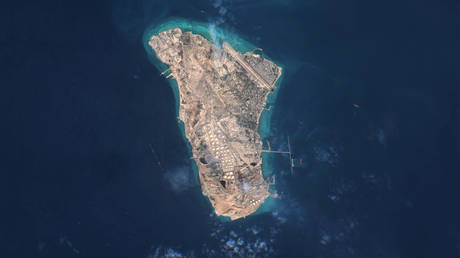
When President Donald Trump teased that "other people" would execute a ground campaign in Iran, he exposed the core contradiction of Washington's current military strategy. Speaking on Tuesday, Trump threatened to bomb Iranian power plants and bridges next week while refusing to rule out a ground campaign to seize Kharg Island. Yet his insistence that unnamed foreign actors or regional proxies will do the bloody work of invading a nation of 85 million people is a dangerous strategic illusion. It ignores the brutal realities of Middle Eastern geopolitics.
The conflict has escalated rapidly since the fragile interim ceasefire collapsed. With the U.S. Navy reinstating its blockade of the Strait of Hormuz and launching waves of strikes, the administration is attempting to force Tehran to the negotiating table through sheer economic and military pressure. But airpower alone cannot achieve the administration’s stated goals of stripping Iran of its enriched uranium and securing international shipping lanes.
A ground force is required. Yet the president’s assertion that the U.S. can avoid deploying its own troops by outsourcing the combat is a fiction that warrants close examination.
The Ghost Soldiers of the Iranian Opposition
The most convenient candidates for Trump’s proxy army are the various exiled opposition groups and ethnic insurgencies that have fought the regime in Tehran for decades. Chief among these is the Mujahedin-e Khalq, an exiled dissident group that has spent millions lobbying conservative politicians in Washington.
They are entirely incapable of executing a conventional ground campaign.
While these groups are adept at running information campaigns and occasionally sponsoring localized sabotage inside Iran, they possess no heavy armor, no air defense, and absolutely no domestic legitimacy. To the average Iranian, even those who despise the current government, these exiled groups are viewed as traitors who sided with Saddam Hussein during the devastating Iran-Iraq War. Any invasion force carrying their banner would instantly unite the Iranian public behind the very regime the U.S. is trying to topple.
Other localized insurgencies, such as Kurdish groups in the northwest or Balochi militants in the southeast, are too fragmented and poorly equipped to push beyond their immediate border regions. They are light infantry forces. They cannot march on Tehran or seize highly fortified coastal installations like Kharg Island.
The Gulf Allies Who Will Not Fight
If domestic dissidents cannot do the job, the administration’s gaze naturally turns to regional partners. Saudi Arabia, the United Arab Emirates, and Israel all view Tehran as an existential threat.
But they will not send their armies into the Iranian meat grinder.
The Gulf monarchies have spent the last decade building glitzy, high-tech cities on the western shore of the Persian Gulf. These glass-and-steel achievements are highly vulnerable. During previous flare-ups, a single coordinated strike on Saudi oil facilities or UAE ports sent shockwaves through their economies. The Gulf states have spent the last few years quietly pursuing diplomatic de-escalation with Tehran precisely because they know that a conventional war would destroy their economies. They are willing to bankroll American military actions, but they will not sacrifice their own soldiers to secure Kharg Island for Washington.
Israel possesses a highly sophisticated military, but its doctrine is built for rapid, high-intensity strikes, air superiority, and intelligence operations. It is not structured to launch a massive amphibious invasion across the Persian Gulf, thousands of miles from its borders.
The idea that a coalition of regional states will band together to launch a ground campaign on behalf of American strategic interests is a fantasy. It exists only in the PowerPoint presentations of Washington think tanks.
The Illusion of Privatized Warfare
There is a third, quieter possibility. The administration could be looking to private military corporations and mercenary forces to conduct specialized ground operations.
This approach is doomed to fail.
While private contractors can be useful for static defense, training, and logistical support, they cannot wage conventional, combined-arms warfare against a sovereign state. Seizing Kharg Island—the strategic heart of Iran’s oil export apparatus—would require an amphibious assault against deeply entrenched regular army and Revolutionary Guard forces. Such an operation requires naval gunfire support, close air support, and a level of logistical coordination that only a superpower military can provide.
A privatized invasion force would be annihilated before it even reached the beaches.
By pretending that "other people" can carry out these high-risk missions, the administration is trying to shield the American public from the true cost of the conflict. A real war with Iran cannot be fought on the cheap, and it cannot be won by proxy.
The Trap of the Anaconda Strategy
Supporters of the administration’s current policy argue that a full-scale ground invasion is not the goal. Former House Speaker Newt Gingrich recently compared the current approach to the Civil War-era Anaconda strategy, suggesting that a combination of naval blockades and targeted infrastructure strikes will gradually choke the regime into submission without requiring U.S. ground troops.
This is a fundamental misunderstanding of the target.
The Anaconda strategy worked against the American South because the Confederacy was a domestic rebellion with limited international leverage. Iran is a sovereign state with a sophisticated asymmetric arsenal, a network of regional allies, and a direct hand on the throat of the global economy through the Strait of Hormuz.
When you threaten to destroy a nation's power plants and bridges, you do not force them to the negotiating table; you force them to retaliate with everything they have left. Tehran's response to a total economic blockade will not be surrender. It will be the deployment of naval mines, anti-ship missiles, and drone swarms designed to shut down global energy shipping entirely.
If the administration proceeds with its plan to systematically dismantle Iran’s civilian infrastructure next week, the escalation will be immediate. The U.S. will find itself dragged into a massive, regional shooting war. When that happens, the illusion of "other people" fighting the ground campaign will evaporate, leaving Washington with a grim choice: accept a humiliating strategic defeat, or send American soldiers into the mountains of Iran.